|
GERMANY
|
|||||||||||||||||||||||||||||||||||||||||||||||||||||||||||||||||||||||||||||||||||||||||||||||||||||||||||||||||||||||||||||||||||||||||||||||||||||||||||||||
|
NEWS
Official rules and routes for the Cannonball world series starting in 2015, and the Blue Bird World Cup trophy, which will be awarded to the best ZEV team from 2015 (based on a points system) in the world, during an award ceremony in 2016, at a venue to be announced. Please note event shelved.
The first entrants to the 2015 world series is the Ecostar team from the United Kingdom - A road trip across the UK is planned (to equal the pace of IC vehicles) to demonstrate that electric eco cars can compete on range and performance. Starting from John O'Groats in the Scottish Highlands, driving (within legal speed limits) south to Lands End in Cornwall - a distance of 874 miles, stopping only for refreshments, to swap driver for co-driver and to recharge - it is hoped to complete this epic drive in under 16 hours in the Ecostar DC50 - requiring an average speed of 55 mph. A follow on event for 2016 sets the USA in the Ecostar team's sights. Another possible venue for 2017 is Australia. If you'd like to take part in any of this world series of events, you are advised to read the RULES to make the most of your attempt.
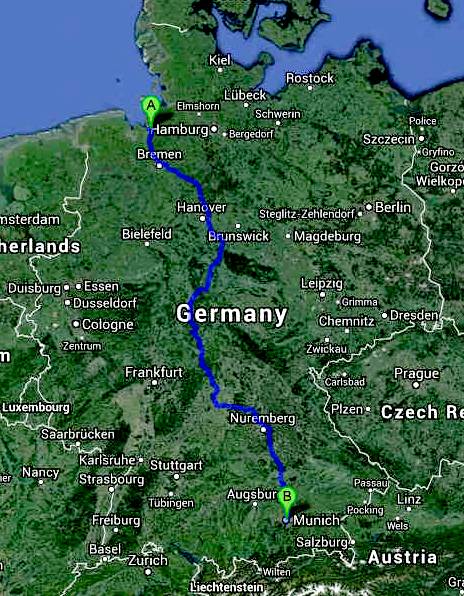
Route map of the Trans-Germany Cannonball ZEV Run, from Bremerhaven to Munich.
OVERVIEW
Germany (German: Deutschland), officially the Federal Republic of Germany (German: Bundesrepublik Deutschland), is a country located in Central Europe. It is bordered to the north by the North Sea, Denmark, and the Baltic Sea, to the east by Poland and the Czech Republic, to the south by Austria and Switzerland, and to the west by France, Luxembourg, Belgium and the Netherlands.
Germany is a democratic parliamentary federal republic, made up of 16 states (German: Bundesländer), which in certain spheres act independently of the federation. Historically consisting of several sovereign nations with their own history, culture and religion, Germany was unified as a nation state during the Franco-Prussian War in 1870/1871.
The Federal Republic of Germany is a member state of the United Nations, NATO, the G8 and the G4 nations, and is a founding member of the European Union. It is the European Union's most populous and most economically powerful member state. Germany also plays a role as one of the world's major powers.
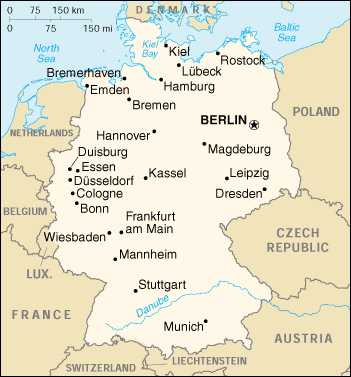
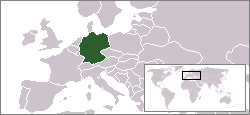
Map of Germany
History
The state now known as Germany was unified as a modern nation-state only in 1871, when the German Empire, dominated by the Kingdom of Prussia, was forged. This began the German Reich, usually translated as "empire", but also meaning "kingdom", "domain" or "realm."
Early history of the Germanic tribes (100 BC–AD 300)
The ethnogenesis of the Germanic tribes is assumed to have occurred during the Pre-Roman Iron Age in southern Scandinavia and northern Germany, from the first century BC expanding south, east and west, coming into contact with Celtic tribes of Gaul and Iranian, Baltic and Slavic tribes in Eastern Europe. Little is known about early Germanic history, except through their interactions with the Roman Empire and archaeological finds.
Under Augustus, the Roman General Drusus began to invade Germany, and it was from this period that the German tribes became familiar with Roman tactics of warfare whilst maintaining their national identity. In AD 9 a Roman army led by Publius Quinctilius Varus was defeated by the Cheruscan leader Arminius (Hermann) in the Battle of the Teutoburg Forest. Germany as far as the Rhine and the Danube therefore remained outside the Roman Empire. By AD 100, the time of Tacitus' Germania, Germanic tribes settled along the Rhine and the Danube (the Limes Germanicus), occupying most of the area of modern Germany. The 3rd century saw the emergence of a number of large West Germanic tribes — Alamanni, Franks, Chatti, Saxons, Frisians, Thuringians. Around 260, the Germanic peoples finally broke through the Limes and the Danube frontier.
Migration Period and Franks (300-843)
The migration included the Goths, Vandals, and Franks, among other Germanic and Slavic tribes. The migration may have been triggered by the incursions of the Huns, population pressures, or climate changes. Several Germanic peoples, such as the Franks and Burgundians invaded the Roman Empire and formed kingdoms.
The conversion to Roman Catholicism of the pagan Frankish king Clovis to better appeal to his conquered Roman subjects was a crucial event in the history of Europe. It resulted in more support from Rome, further solidification of power during the slow, often bloody conversion process, the eventual end to the ancient tribalism of Germany and secured domination over the rival Christian conversion attempts by Arianism. Under the Merovingian and Carolingian kings the Franks formed a new Germanic empire, which replaced the Roman Empire in Western Europe. The
Holy Roman Empire of German Nation (843–1806)
|
|||||||||||||||||||||||||||||||||||||||||||||||||||||||||||||||||||||||||||||||||||||||||||||||||||||||||||||||||||||||||||||||||||||||||||||||||||||||||||||||


|
|||||
|
Motto:
Einigkeit und Recht und Freiheit |
|||||
|
Anthem: The third stanza of Das Lied der Deutschen |
|||||
|
|
|||||
|
Capital |
Berlin |
||||
|
Largest city |
|||||
|
Official language(s) |
German 1 |
||||
|
Government |
Federal Republic |
||||
|
•
President |
Horst
Köhler |
||||
|
Formation |
|
||||
|
Accession to EU |
March
25, 1953 (West G.) |
||||
|
Area |
|
||||
|
- Total |
357,050 km² (63rd) |
||||
|
|
137,858 sq mi |
||||
|
- Water (%) |
2.416 |
||||
|
Population |
|
||||
|
- 2005 est. |
82,689,000 (14th) |
||||
|
- 2000 census |
N/A |
||||
|
- Density |
230.9/km² (34th) |
||||
|
GDP (PPP) |
2005 estimate |
||||
|
- Total |
$2,521,699 million (5th) |
||||
|
- Per capita |
$30,579 (17th) |
||||
|
HDI (2003) |
0.930 (20th) – high |
||||
|
Currency |
Euro
(€) 2 ( |
||||
|
Time zone |
CET (UTC+1) |
||||
|
- Summer (DST) |
CEST (UTC+2) |
||||
|
Internet TLD |
.de |
||||
|
Calling code |
|
||||
German Empire (1871–1918)
After the French defeat in the Franco-Prussian War, the German Empire (Deutsches Kaiserreich) was proclaimed in Versailles on January 18, 1871. As a result, the new empire was a unification of all the scattered parts of Germany but without Austria—Kleindeutschland. After 1888, the Year of Three Emperors, Bismarck was forced by the new emperor, young Wilhelm II, to quit in 1890 due to political and personal differences. Beginning in 1884 Germany established several colonies. The young emperor's foreign policy was opposed to that of Bismarck, who had established a system of alliances in the era called Gründerzeit, securing Germany's position as a great nation and avoiding war for decades. Under Wilhelm II, however, Germany took an imperialistic course, not unlike other powers, but it led to friction with neighbouring countries. Most alliances in which Germany had been previously involved were not renewed, and new alliances excluded the country. Austria and Germany became increasingly isolated.
Although not one of the main causes, the assassination of Austria's crown prince triggered World War I on July 28, 1914, which saw Germany as part of the unsuccessful Central Powers in the second-bloodiest conflict of all time against the Allied Powers. In November 1918, the second German Revolution broke out, and Emperor Wilhelm II and all German ruling princes abdicated. An armistice was signed on November 11, putting an end to the war. Germany was forced to sign the Treaty of Versailles in 1919, whose unexpectedly high demands were perceived as humiliating in Germany and as a continuation of the war by other means.
Weimar Republic (1919–1933)
After the German Revolution in November 1918, a Republic was proclaimed. That year, the German Communist Party was established by Rosa Luxemburg and Karl Liebknecht, and in January 1919 the German Workers Party, later known as the Nationalsozialistische Deutsche Arbeiterpartei (National Socialist German Workers Party, NSDAP, "Nazis"). On August 11, 1919, the Weimar Constitution came into effect. 1920s Berlin was a vibrant and exciting city that flourished with the activity of artists, intellectuals and scientists, during the Weimar Republic; many considered it to be the cultural capital of the world during this time.
In a climate of economic hardship due to both the world wide Great Depression and the harsh peace conditions dictated by the Treaty of Versailles, and growing tired with a long succession of more or less unstable governments and continuous coalition changes, the political masses in Germany increasingly lacked identification with their political system of parliamentary democracy. This was exacerbated by a wide-spread right-wing (monarchist, völkische, and Nazi) Dolchstoßlegende, a political myth which claimed the German Revolution was the main reason why Germany had lost the war, decried the Revolutionists as traitors (Novemberverbrecher = November criminals) and the political system born of the Revolution as illegitimate. On the other hand, radical left-wing communists such as the Spartacist League had wanted to abolish what they perceived as a "capitalist rule" in favour of a "Räterepublik" and were thus also in opposition to the existing form of government.
During the years following the Revolution, German voters increasingly supported anti-democratic parties, both right- (monarchists, Nazis) and left-wing (Communists). In the two extraordinary elections of 1932, the Nazis achieved 37.2% and 33.0%, while the Communists achieved 17% in the latter election - half of the parliament was actually anti-democratic, not including smaller parties with questionable credentials in this respect. As a result, democratic moderate parties like the Social Democratic Party of Germany (SPD) were left with a minority.
At the beginning of the 1930s, Germany was not far from a civil war. Paramilitary troops were set up by several parties. They intimidated voters and seeded violence and anger among the public, who suffered from high unemployment and poverty. Meanwhile, elitists in influential positions, alarmed by the rise of anti-governmental parties, fought amongst themselves and exploited the emergency authority provided in the Weimar Constitution to rule undemocratically by presidential decree.
After a succession of unsuccessful cabinets, on January 29, 1933, President von Hindenburg, seeing little alternative and pushed by advisors, appointed Adolf Hitler Chancellor of Germany.
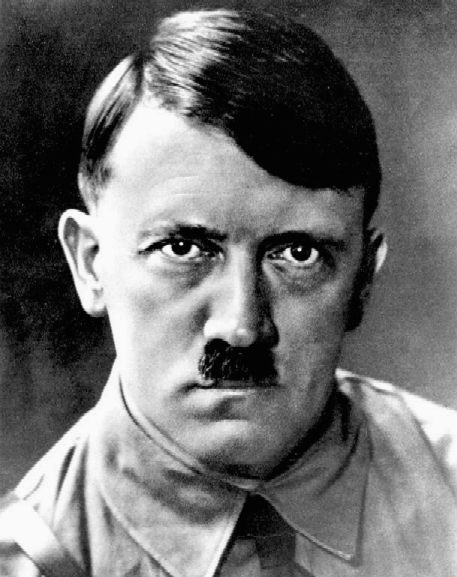
Adolf Hitler: Brilliant statesman, orator and artist, unfortunately with obsessive tendencies leading him to excesses that soon cast him in the role of evil dictator.
Geography
Germany is located in Central Europe and shares borders with Denmark in the North, Netherlands, Belgium, Luxembourg and France in the West, Austria and Swiss in the South and Poland and Czechia in the East. The North Sea and the Baltic Sea represent additional National Borders in the North.
-
Geographic coordinates:
Map references: Europe
Area
-
-
Total: 357,021 km² (137,850 mi²)
-
Land: 349,223 km² (134,835 mi²)
-
Water: 7,798 km² (3,010 mi²)
-
Classification
Germany's climate is temperate overall and marine in the northern reaches; characterised by cool, cloudy, wet winters and summers and occasional warm föhn winds. The greater part of Germany lies in the cool/temperate climatic zone in which humid westerly winds predominate.
In the northwest and the north the climate is extremely oceanic, subject to active Baltic Sea spawned fogs and-or low clouds and some significant rain falls nearly all the year round, so winters there are relatively mild and summers comparatively cool due to the influence of the Baltic.
In the east the climate shows clear continental features; winters can be very cold for long periods, and summers can become very warm, and long dry periods are often recorded.
In the centre and the south there is a transitional climate (i.e. a mix) which may be predominantly oceanic or continental, according to the general seasonal prevailing wind patterns influencing the local weather situation.
Federal States (Bundesländer)
Germany is divided into sixteen states (in German called Länder, singular Land; commonly Bundesländer, singular Bundesland). It is further subdivided into 439 districts (Kreise) and cities (kreisfreie Städte) (2004).
The five largest cities in Germany (population as of March 31, 2005):
-
Berlin (capital of Germany) with 3,391,407 inhabitants
-
Hamburg with 1,736,752 inhabitants
-
Munich with 1,397,537 inhabitants
-
Cologne with 975,907 inhabitants
-
Frankfurt am Main with 657,126 inhabitants
The five largest metropolitan areas in Germany (population as of January 1, 2005):
-
Rhein-Ruhr with 11,785,196 inhabitants
-
Frankfurt Rhein-Main Region with 5,822,383 inhabitants
-
Berlin with 4,262,480 inhabitants
-
Hamburg with 3,278,635 inhabitants
-
Stuttgart with 2,344,989 inhabitants
|
In English |
Auf Deutsch (In German) |
|||
|---|---|---|---|---|
|
Federal State |
Capital |
Bundesland |
Hauptstadt |
|
|
1 |
Baden-Württemberg |
Stuttgart |
Baden-Württemberg |
Stuttgart |
|
2 |
(Free State of) Bavaria |
Munich |
(Freistaat) Bayern |
München |
|
3 |
Berlin |
Berlin |
Berlin |
Berlin |
|
4 |
Brandenburg |
Potsdam |
Brandenburg |
Potsdam |
|
5 |
(Free Hanseatic City of) Bremen |
Bremen |
(Freie Hansestadt) Bremen |
Bremen |
|
6 |
(Free and Hanseatic City of) Hamburg |
Hamburg |
(Freie und Hansestadt) Hamburg |
Hamburg |
|
7 |
Hesse |
Wiesbaden |
Hessen |
Wiesbaden |
|
8 |
Mecklenburg-Western Pomerania |
Schwerin |
Mecklenburg-Vorpommern |
Schwerin |
|
9 |
Lower Saxony |
Hanover |
Niedersachsen |
Hannover |
|
10 |
North Rhine-Westphalia |
Düsseldorf |
Nordrhein-Westfalen |
Düsseldorf |
|
11 |
Rhineland-Palatinate |
Mainz |
Rheinland-Pfalz |
Mainz |
|
12 |
Saarland |
Saarbrücken |
Saarland |
Saarbrücken |
|
13 |
(Free State of) Saxony |
Dresden |
(Freistaat) Sachsen |
Dresden |
|
14 |
Saxony-Anhalt |
Magdeburg |
Sachsen-Anhalt |
Magdeburg |
|
15 |
Schleswig-Holstein |
Kiel |
Schleswig-Holstein |
Kiel |
|
16 |
(Free State of) Thuringia |
Erfurt |
(Freistaat) Thüringen |
Erfurt |
Territory
Since reunification Germany has resumed its role as a major centre between Scandinavia in the north and the Mediterranean region in the south, as well as between the Atlantic west and the countries of Central and Eastern Europe.
The territory of Germany stretches from the high mountains of the Alps (highest point: the Zugspitze at 2,962 m / 9,718 ft) in the south to the shores of the North Sea (Nordsee) in the north-west and the Baltic Sea (Ostsee) in the north-east. In between are the forested uplands of central Germany and the low-lying lands of northern Germany (lowest point: Neuendorfer/Wilstermarsch at 3.54 metres (11.6 ft) below sea level), traversed by some of Europe's major rivers such as the Rhine, Danube and Elbe.
Due to its central location, Germany shares borders with more European countries than any other country. Its neighbours are Denmark in the north, Poland and the Czech Republic in the east, Austria and Switzerland in the south, France and Luxembourg in the south-west and Belgium and the Netherlands in the north-west.
Climate
The greater part of Germany lies in the cool/temperate climatic zone in which humid westerly winds predominate.
The climate is affected among other things by the Gulf Stream, which promotes an unusually mild climate.
In the north-west and the north the climate is oceanic and rain falls all year round. Winters there are relatively mild and summers tend to be comparatively cool, even though temperatures can reach above 28 degrees Celsius (82 °F) for prolonged periods of time. Average temperatures: Hamburg: January 0.3 °C (33 °F) / July 17.1 °C (63°F); Essen: January 1.5 °C (35 °F) / July 17.5 °C (64 °F)
In the east the climate shows clear continental features; winters can be very cold for long periods, and summers can become very warm. Here, too, long dry periods are often recorded. Average temperatures: Berlin: January −0.9 °C (30 °F) / July 18.6 °C (65 °F)
In the central part and the south there is a transitional climate which varies from moderately oceanic to continental, depending on the location. Hot summers with temperatures about 30 degrees (86 °F) are possible. Average temperatures: Munich: January −2.2 °C (28 °F) / July 17.6 °C (64 °F); Freiburg: January 1.2 °C (34 °F) / July 19.4 °C (67 °F)
Demographics
Due to the country's federal and decentralised structure Germany has a number of larger cities. The most populous cities of Germany are Berlin, Hamburg, Munich, Cologne, Frankfurt and Dortmund. By far the largest conurbation is the Rhine-Ruhr region, including the Düsseldorf-Cologne district and the cities of Essen, Dortmund, Duisburg and Bochum. The federal structure has kept the population oriented towards a number of large cities, and has precluded the growth of any single city that would rival such European capitals as London, Paris or Moscow for size.
As of 2004, about 7.5 million foreign citizen residents were living in Germany. The majority came from Turkey, followed by Italy, Greece, Croatia, Bosnia and Herzegovina, the Netherlands, Albania, Serbia, Montenegro, Spain, Austria, Portugal, Vietnam, Morocco, Poland, Macedonia, Lebanon and France. [6] Thanks to reform of German nationality law, many of these immigrants are eligible for naturalisation ([7]).
Germany is still a primary destination for political and economic refugees from many less industrialised countries, especially Turkey and Southern/Southeastern Europe, but the number of annual asylum seekers has been declining in recent years, reaching about 50,000+ in 2003.
An ethnic Danish minority of about 50,000 people lives in Schleswig, most of them close to the Danish border, in the north; a small number of Slavic people known as the Sorbs lives in the states of Saxony (about 40,000) and Brandenburg (about 20,000). The Frisian language is mother tongue to about 12,000 speakers in Germany. In rural areas of Northern Germany, Low German is widely spoken.
There are also a large number of ethnic German immigrants from the former Soviet Union area (1.7 million), Poland (0.7 million) and Romania (0.3 million) (1980–1999 totals), who are automatically granted German citizenship, and thus do not show up in foreign resident statistics; unlike non-ethnic German immigrants, they have been settled by the government almost evenly spread throughout Germany.
Economy
Germany is the largest European economy and the third largest economy in the world in real terms, placed behind the United States, and Japan. According to the World Trade Organization, Germany is also the world's top exporter, ahead of the United States and China. Its major trading partners include France, the United States, the United Kingdom, Italy and the Netherlands. Germany is the largest trading partner of most European countries. A major issue of concern remains the persistently high unemployment rate and weak domestic demand which slows down economic growth.
However, according to Bert Rürup, head of Germany's Council of Economic Advisers, reunification is to blame for two-thirds of Germany's growth lag compared to its EU neighbours. In particular, eastern Germany lacks a solid base of small and medium-sized companies, which provided the foundation for West Germany's economic prosperity. Domestic demand has stagnated for many years due to wage stagnation and zealous cost-cutting by the federal state. The missing demand has caused many of the prevalent economic problems, such as rising unemployment, high social security costs, and, ironically, high state debt as tax revenues plummeted and social security cost rose. The missing demand is also due to a internationally high savings rate.
Science and technology
Germany is a leading nation in scientific research and the production of innovative technological products. Some of the most important industrial contributions include rocketry, material science, and chemical products.
As in physics and chemistry, Germans are a leading nation in the Nobel Prizes for physiology or medicine.
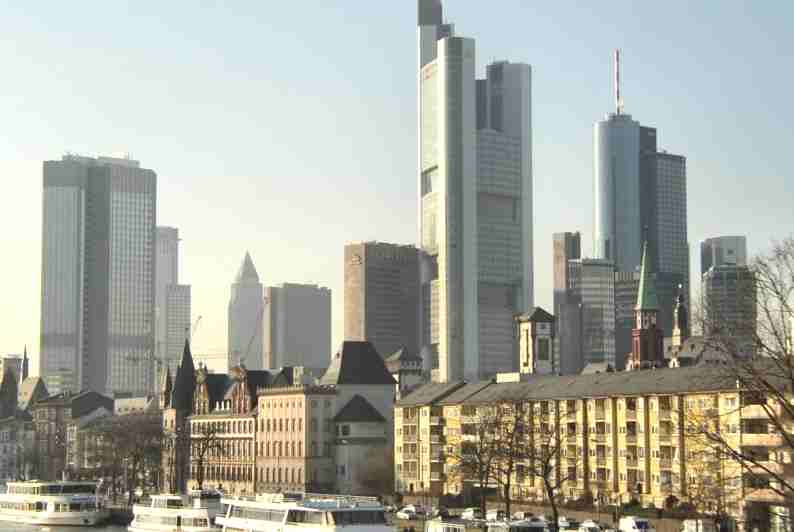
Frankfurt is Germany's financial centre
Exports
As mentioned above the exporting of goods is an essential part of the German economy and one of the most relevant reasons for Germany's wealth. Like many other export oriented countries, Germany itself does not have the climate or the natural resources necessary to support a high living standard.These shortages have long made international trade completely indispensable to the German economy. Overtaking the United States in 2003, Germany is now the world's largest exporter of goods with $1.016 trillion exported in 2005.
Germany's main exports:
-
Machinery
-
Vehicles
-
Chemicals
-
Metals and Manufactures
-
Foodstuffs
-
Consumer electronics
-
Textiles
-
Beer
Imports
As a nation that relies heavily on international trade, Germany also imports a wide variety of goods. Germany is the world's second largest importer of goods with a total of $801 billion in imports.
Germany's main imports are:
-
Machinery
-
Vehicles
-
Chemicals
-
Foodstuffs
-
Textiles
-
Metals
Agriculture
For many years now, agriculture in Germany has been in a state of decline. Poor earnings and lack of profitability are counted as the main reasons for the failure of many medium and small farms. The main crops grown are potatoes, wheat, barley, sugar beets and rapeseed. Germany ranks among the world's largest producers of milk, dairy products and meat. Agricultural support is managed under the EU Common Agricultural Policy.
Industrial sector
As in most other large economic nations, Germany's industrial sector has declined in favour of the service sector. Germany is among the world's largest and most technologically advanced producers of iron, steel, cement, chemicals, machinery, motor vehicles, machine tools and electronics, as well as a world leader in the shipping business. Major car manufacturers like BMW, DaimlerChrysler (Mercedes), Opel (owned by GM), Porsche and Volkswagen AG (including Audi, and more non-German brands) are German. Germany is also home to huge multinational corporations like BASF, Bosch, E.ON, Deutsche Telekom (with its subsidiary T-Mobile) and Siemens AG, which consistently rank among the world's largest firms.
Service sector
The service sector has grown steadily in recent years and now contributes the largest share of GDP. This sector includes tourism. As of 2004, the largest numbers of foreign visitors to Germany came from the Netherlands, followed by the United States and the United Kingdom ([8]). Germany also has a large (and possibly underrated) presence in the banking world, led by Deutsche Bank and Allianz.
Natural resources
Germany is lacking in natural raw materials, if one disregards the hard coal deposits in the Ruhr area, in the Aachen district and in the Saarland, where mining is profitable only thanks to state subsidies. Brown coal from mines in the Leipziger Bucht and the Niederlausitz is still the major energy source in the eastern states, while petroleum enjoys this position in the western "Länder". The previous red-green (1998-2005) coalition government was pursuing a long-term strategy of phasing out nuclear power by 2020 in favour of renewable sources of energy. The current coalition has not yet agreed on its nuclear policy.
Politics
Politics of Germany takes place in a framework of a federal parliamentary representative democratic republic, whereby the Federal Chancellor is the head of government, and of a pluriform multi-party system. Executive power is exercised by the government. Federal legislative power is vested in both the government and the two chambers of parliament, Bundestag and Bundesrat. Since 1949 the party system is dominated by the conservative Christian Democratic Union and the Social Democratic Party of Germany.
The Judiciary of Germany is independent of the executive and the legislature. The political system is laid out in the 1949 constitution, the Grundgesetz (Basic Law), which remained in effect with minor amendments after 1990's German Reunification.
Legal system
Germany has a civil or statute law system based ultimately on Roman law with some references to Germanic law. Legislative power is divided between the Federation and the individual federated states. While criminal law and private law have seen codifications on the national level (in the Strafgesetzbuch and the Bürgerliches Gesetzbuch respectively), no such unifying codification exists in administrative law where a lot of the fundamental matters remain in the jurisdiction of the individual federated states. In 1976, with the Verwaltungsverfahrensgesetz (VwVfG), the main form of actions of administration was codified. Most federated states have followed this codification. There are a series of specialist supreme courts; for civil and criminal cases the highest court of appeal is the Bundesgerichtshof (Federal Court of Justice), located in Karlsruhe. The courtroom style is inquisitorial.
The Federal Constitutional Court (Bundesverfassungsgericht), also located in Karlsruhe, is the German Supreme Court responsible for constitutional matters, with power of judicial review. It acts as the highest legal authority and ensures that legislative and judicial practice conforms to the Constitution. It acts independently of the other state bodies, but cannot act on its own behalf.
Foreign Relations
Germany plays a leading role in the European Union, having a strong alliance with France. Germany is at the forefront of European states seeking to advance the creation of a more unified and capable European political, defence and security apparatus.
Since its establishment on May 23, 1949, the Federal Republic of Germany kept a notably low profile in international relations, both because of its recent history as well as its occupied status. In 1999, however, on the occasion of the NATO war against Yugoslavia, Chancellor Gerhard Schröder's government broke convention by sending German troops into combat for the first time since World War II.
In 2003, France, Germany and Russia were leaders in the coalition of nations opposing the US-led war in Iraq. Nevertheless, the German government has offered help to the reconstruction efforts in Iraq, but only outside of the war-torn country, mainly by training Iraqi military and police personnel.
Germany and the United States have been close allies since the end of the Second World War. The Marshall Plan and continued US support during the rebuilding process after World War II, as well as the significant influence American culture has had on German culture, have crafted a strong bond between Germany and the US that lasts to this day. Not only do the United States and Germany share many cultural similarities but they are also deeply economically interdependent. 8.8% of all German exports are US bound, and US-German trade according to the US Census Bureau totalled $108.2 billion for 2004. An illustration of the strong economic relations between the US and Germany may be the fact that 18.3% of all cars sold in the US were manufactured by German car manufacturers. Other signs of the close ties between Germany and the US are the fact that German-Americans remain the largest ethnic group in the US and the largest US community outside the US is the Ramstein Air Base, close to the city of Kaiserslautern, Germany.
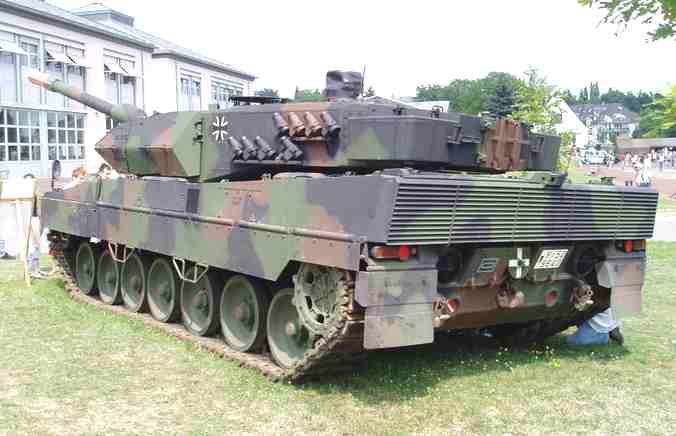
German Heer Leopard 2A6 tank
Armed Forces
Germany's military, the Bundeswehr, is a defence force with Heer (German Army), Marine (German Navy), Luftwaffe (German Air Force), Zentraler Sanitätsdienst (Central Medical Services) and Streitkräftebasis (Joint Service Support Command) branches. It employs some 257,000 soldiers (including women in active fighting branches since 2001) and 125,000 civilians. 50,000 of the soldiers are 18-23-year-old men on national duty, currently for at least 9 months. In peacetime, the Bundeswehr is commanded by the Minister of Defence, currently Franz Josef Jung. If Germany goes to war, the Chancellor becomes commander in chief of the German Bundeswehr.
The military budget has not kept up with the Bundeswehr's mission, which has changed dramatically from protecting Germany's borders against a Soviet invasion into a mobile unit deployed around the world. The funding levels for the Bundeswehr have actually been falling since 1990, when military spending amounted to about 3.5% of gross domestic product. Today, defence spending equals about 1.2% of German GDP, compared to the NATO average of 2.3% and the United States' more than 4%. Critics argue that the current budget of € 24.4 billion is too small to finance the necessary transformation of the Bundeswehr into a well-equipped force ready for NATO and UN led missions abroad. Opponents argue that the transformation from a manpower based army securing the Eastern border to a modernised force with fewer soldiers on the payroll is duly reflected in a lower budget.
Currently, the German military has about 1,180 troops stationed in Bosnia-Herzegovina; 2,650 Bundeswehr soldiers are serving in Kosovo; and 3,900 Bundeswehr troops are assisting the US anti-terrorism operation called Enduring Freedom off the Horn of Africa. In Afghanistan, 4,500 German troops currently make up the largest contingent of the NATO-led ISAF force.
Energy policy
In 2000, the German SPD-led government along with Bündnis 90/Die Grünen (Alliance '90/The Greens), officially announced its intention to phase out the use of nuclear energy. Jügen Trittin as the Minister of Environment, Nature Conservation and Nuclear Safety, reached an agreement with energy companies on the gradual shut down of the country's nineteen nuclear power plants and a cessation of civil usage of nuclear power by 2020.
In 1999, electricity production in Germany was powered by coal (47%), nuclear power (30%), natural gas (14%), renewable sources (including hydro, wind and solar power) (6%), and oil (2%) ([9]). As for energy consumption, oil accounted for 41% of the total. At the World climate conference, the German government announced a carbon dioxide reduction target of 25% by the year 2005 as compared to 1990, to protect global climate.
In 2005, the German government reached a controversial agreement with Russia in building a gas pipeline at the bottom of the Baltic Sea directly from Russia to Germany.
Germany leads Europe by having the greatest solar and wind electricity generating capacity on the continent.
Society
Religion
Germany is the home of the Reformation launched by Martin Luther in the early 16th century. Today, Protestants (particularly in the north and east) comprise about 33% of the population and Catholics (particularly in the south and west) also 33%. The current pontiff of the Roman Catholic Church, Pope Benedict XVI, is German. In total more than 55 million people officially belong to a Christian denomination. The third largest religious identity in Germany is that of non-religious people (including atheists and agnostics), who amount to a total of 28.5% of the population (23.5 million).
Most German Protestants are members of the Evangelical Church in Germany. Free churches (as Baptists, Methodists and other independent Protestants are usually called in Germany) exist in all larger towns and many smaller ones, but most such churches are small.
Besides this there are several hundred thousand Orthodox Christians (mostly Greeks and Serbs), 400,000 New Apostolic Christians, more than 150,000 Jehovah's Witnesses, and numerous other small groups. The largest such denomination in Germany is the Greek Orthodox Church, the Serb Orthodox Church coming fourth.
Approximately 3.2 million Muslims (predominantly from Turkey and the former Yugoslavia) live in Germany. Most are Sunnis, but there are a large number who adhere to Alevism and a variety of Sufi orders (Bektashism in particular).
Today's Germany has Western Europe's third-largest Jewish population. In 2004, twice as many Jews from former Soviet republics settled in Germany as in Israel, bringing the total influx to more than 200,000 since 1991. About half joined a settled Jewish community, of which there are now more than 100, with a total of 100,000 members—up from 30,000 before reunification. Some German cities have seen a revival of Jewish culture, particularly in Berlin, where there are also 3,000 Israelis. Jews have a voice in German public life through the Zentralrat der Juden in Deutschland (Central Council of Jews in Germany). Other cities with significant Jewish populations are Frankfurt and Munich.
In the territory of the former German Democratic Republic, there is much less religious feeling than in the West. Only 5% attend Mass at least once per week, compared with 14% in the West according to a recent study. About 30% of the total population is officially religiously unaffiliated. In the East this number is considerably higher. This stems from the fact that like all Leninist countries the former East German Government did not foster religious education at all (unlike West Germany, where religious education was common in school, but could be opted out by parents) and churches and church-goers were eyed suspiciously by the East German Government, although churches were still allowed to exist. As a secular alternative to any statements of faith (like Confirmation) the Jugendweihe (Youth consecration) was offered and officially promoted.
Church and state are separate, but there is cooperation in many fields, most importantly in the social sector. Churches and religious communities, if they are large, stable and loyal to the constitution, can get special status from the state as a corporate body under public law which allows the churches to levy taxes called Kirchensteuer (church tax) on their members on the basis of laws of the Länder, and to apply laws of public service to their ministers. In most cases, the revenue is collected by the state in return for a collection fee, while some smaller-sized religious bodies chose to administer the collection of the taxes themselves (such as the Jewish Community of Berlin).
Also of note is that Germany hosts one of only seven Bahá'í Houses of Worship in the world. Completed in 1964, it is located at the foot of the Taunus Mountains in the village of Langenhain, approximately 25 kilometres (15.5 mi) west of Frankfurt.
Social issues
The German social market economy (German: soziale Marktwirtschaft) helped bring about the "economic miracle" (the German "Wirtschaftswunder") that rebuilt Germany from ashes after World War II to one of the most impressive economies in Europe. Still today, Ludwig Erhard, minister of economics in the Adenauer administration (1949-1963) and later federal chancellor (1963-1966), is widely recognised as having been the "father" of this profound rise in the country's economic and social wealth.
Germany continues to struggle with a number of social issues although problems created by the German Reunification of 1990 have begun to diminish. The standard of living is higher in the western half of the country, but easterners now share a reasonably high standard of living. Germans continue to be concerned about a relatively high level of unemployment. Germany has passed several reforms to curb unemployment. Some of these reforms will require people in the labour force to work harder and more efficiently. This will enable employers to reduce the number of their employees further.
For centuries, a woman's role in German society was summed up by the three words: Kinder (children), Küche (kitchen), and Kirche (church) - Kinder, Küche, Kirche. Throughout the twentieth century, however, women have gradually won victories in their quest for equal rights. Despite significant gains, discrimination remains in united Germany. Women are noticeably absent in the top tiers of German business. They only hold 9.2% of jobs in Germany's upper and middle management positions. Until 2001 women were barred from serving in combat units in the Bundeswehr, being restricted to the medical service and the administration. The first woman to become chancellor is Angela Merkel, who was elected in 2005.
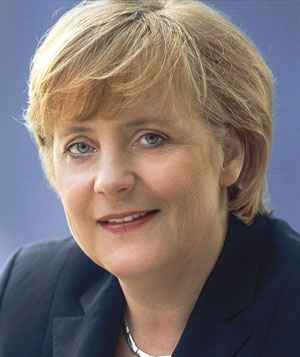
Angela Merkel
Since World War II, Germany has experienced intermittent turmoil from various extremist groups. In the 1970s leftist terrorist organisations like the Red Army Faction engaged in a string of assassinations and kidnappings against political and business figures and there has been a recent surge in right-wing extremist crimes. According to former Interior Minister Otto Schily, the number of these crimes rose 8.4% to 12,553 cases in 2004, which the minister attributed to such crimes as the display of illegal Nazi symbols being reported more frequently. The majority of these cases are not violent crimes, although these do exist as well.
Germany is also burdened with an extremely low fertility/birthrate. Obviously, this has and will continue to cause many economic and social problems. For instance, the low birthrate may cause a shortage of young workers to replace the ageing ones in the future. This is expected to cause trouble in Germany's generous social welfare system, due to fewer taxpayers and more elderly who will receive benefits. There is much debate as to what should be done to curb this trend. More daycare centres, the government paying cash to mothers for babies that are born, and incentives for men or women to stay home with the children have all been offered as solutions to this problem. So far none have been fully implemented.
Germany has failed to implement EU laws prohibiting racial discrimination. The European Court of Justice ruled on April 29, 2005, that Germany had breached EU law by failing to transpose fully the 'Racial Equality Directive' prohibiting discrimination on the grounds of race or ethnic origin (Directive 2000/43/EC). The deadline for EU Member States to transpose this Directive was July 19, 2003 – except for the 10 new Member States, who had to ensure that their legislation complied with the Directives by their accession to the EU on May 1, 2004. Immigrants to Germany may generally face integration issues and other difficulties. In addition to the challenges of adapting to a new language and culture, they may be subject to security-related police inquiries and violence from right-wing extremist groups. The government has attempted to improve immigrant integration by mandating courses on language, culture, politics, and society for some immigrants.
Some German states have banned Muslim teachers from wearing headscarves in class and all except Bavaria have banned crosses from the classroom as well, generally by prohibiting the use of all religious symbols by teachers. This is legitimate by combining the German states' privilege of educational laws with the principle of separation of church and state, both provided for in the German federal constitution: According to this legal view, teachers in their vocational function within a state administered educational system are obliged to maintain and publicly exhibit religious neutrality when on duty. As this status of employment does not hold for pupils, whose constitutional right to religious freedom thus remains unencumbered by these provisions, this ban cannot legally be extended to them as it is in France. Decisions by headmasters to ban Muslim girls wearing burkas or tchadors from schools have been very controversial. The question of headscarves and crosses in schools has been heavily discussed politically throughout Germany in recent years, but could only be solved by a decision of the Bundesverfassungsgericht (Federal Constitutional Court) in 2003.
Education
Germany has one of the world's highest levels of education and many famous universities. The most important foreign languages taught at school are English, French, Latin, Italian and Ancient Greek. Some languages, such as Russian, Turkish, Spanish, Chinese, Japanese and Arabic are taught less widely. Since the end of World War II, the number of youths entering universities has more than tripled, but university attendance still lags behind many other European nations. In the annual league of top-ranking universities compiled by Shanghai Jiaotong University in 2004, Germany came 4th overall, but with only 7 universities in the top 100 (to compare, the United States had 51). The highest ranking university, at #45, was the TU Munich. Most German universities are state-owned and free of charge. Additionally university students are often supported by the so called BAföG, a federal subsidy, running as high as €290 per month as interest free credit plus €290 as direct payment.
German educational ideals differ considerably from Anglo-Saxon educational ideals, emphasising socialisation, debate, vocal participation in class and critical faculties. Consequently the results of the PISA student assessments, that revealed comprehension of the respective subject matters only, were a shock to the German public but no surprise to many educational experts. The comparatively low scores brought on heated debate about how the school system should be changed. Furthermore it was revealed that more than in other countries students with higher-earning parents are better-educated and tend to achieve higher results. There is also some diversity between the schools of the various states that determine their respective school system independently. Failing integration of foreigners also proved to be a big educational obstacle, as in many urban schools teachers are more occupied teaching their numerous foreign students basic German instead of algebra or physics.
Germany prohibits home-schooling; however, this is still practised by a number of people. There has been some publicity to government prosecution of this practice.
The German school system consists of an elementary school (Grundschule) where pupils go for 4 years (1st-4th grade, in some German states to the 6th grade) after that, in some states, they go to a secondary school where they learn English, French or Latin as their first foreign language (erste Fremdsprache). In the 5th grade (the 7th in states with secondary schools) they have to decide whether they will go to a Hauptschule (5th or 7th-9th or 10th grade), where they only have English as a foreign language, or a Realschule (7th-10th grade), where they can learn both English and a third language (usually French), or a Gymnasium (5th or 7th-12th or 7th-13th grade), where numerous foreign languages are taught and often Latin is mandatory. In some schools (Humanistisches Gymnasium) they may learn Ancient Greek beginning in the 9th grade. In the 11th grade in a Gymnasium, they may learn Spanish, (Ancient) Greek or Russian (not available at every school). In some states one can learn Chinese, Arabic, Turkish and Japanese beginning from the 11th grade (e.g. Bremen). The Gymnasium's final degree, the Abitur, entitles you to attend university and has become a requirement for many jobs, leading to severe social problems among Hauptschule graduates. Most German states have the Gesamtschule (comprehensive school), too. It offers diplomas after the 10th grade (Realschulabschluss, Mittlere Reife) and after the 13th grade (Abitur). The school system depends on the state, as a result of German federalism there are huge differences between the states.
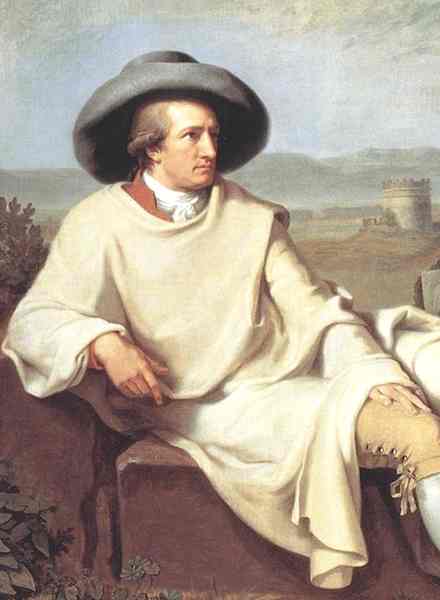
Johann Wolfgang von Goethe was a significant German poet
Contrary to the first impression, the Abitur does not correspond with the US high school diploma but with the Associate Degree in college. Germans finish their equivalent of the high school diploma in their 10th grade exams leading to the degree of Mittlere Reife. In the Oberstufe (literally upper level) of Gymnasium they achieve the Allgemeine Hochschulreife (the ability to directly jump into university courses - usually what is achieved in US colleges). This decision of the German states seriously impairs international comparisons of university attendance, as what is usually done in college elsewhere is done in German schools. Considering the high drop-out rates of pre-bachelor courses in the US, the low university attendance of Germans might be a statistical myth altogether.
With the Mittlere Reife after the 10th grade (usually at the age of 16), German pupils can also begin an industrial education instead of choosing to go on until the 12th or 13th grade. This vocational education in the so-called dual educational system (duales Ausbildungssystem) consists of education at a company as well as attending vocational school (Berufsschule). In three years you are in an apprentice state in the company. The practical parts of your job description are taught at the company, while the theoretical parts are mostly taught at the vocational school. After the three years there are exams held by the chamber of commerce and industry (Industrie- und Handelskammer). Lately there have been reports of apprentices stealing and/or buying exam questions in advance. After the exams companies are normally expected to employ their former apprentices or at least part of them because they cost money to train. Due to subsidies for companies taking part in the dual educational system some companies have, however, begun only to train the apprentices for three years and then ditch them for new apprentices and subsidies.
For higher qualified work German companies expect German universities to complete the education of the students. Training-on-the-job and the like are either uncommon or simply introductory for students, as companies demand ready-made employees from the educational system. Common job offers demand 2+ years of work experience, young age and better than average skills.
Besides the university there is also the Fachhochschule (FH), usually referred to in English as University of Applied Sciences. Courses taught at the Fachhochschule are more streamlined and practically oriented and are expected to result in faster training and better readiness for the job. As with the university you graduate from the Fachhochschule with a Diploma. The official titles are "Dipl. <branch of study>" for the university and "Dipl. <branch of study> (FH)" for the Fachhochschule. Bachelor and Master degrees have been slowly replacing the Diplom since 2003 and are equal between FH and University, enabling FH graduates to attend University Master courses and vice versa.
Again, the German Bachelor Degree differs from international standards as it is a rather hard degree trying to reconcile the economy's demand for ready-made employees with a short-time degree which tends to package the bulk of the original 4,5 year Magister (corresponding to Master of Arts) or Diplom (Master of Science) Degree's subject matter into a 3 year course.
Culture
Germany's contributions to the world's cultural heritage are numerous, and the country is often known as das Land der Dichter und Denker (the land of poets and thinkers). German literature can be traced back to the Middle Ages, in particular to such authors as Walther von der Vogelweide and Wolfram von Eschenbach, considered some of the most important poets of medieval Europe. The fairy tales by Jacob and Wilhelm Grimm are world famous and the Nibelungenlied, whose author is not known, is also a major contribution to German literature. Theologian Luther, who translated the Bible into German, is widely credited for having set the basis for modern "High German" language. The mostly admired German poets and authors are without doubt Lessing, Goethe, Schiller, Kleist and Hoffmann. Other poets include Friedrich Hölderlin, Heinrich Heine, Annette von Droste-Hülshoff, Theodor Fontane, Rainer Maria Rilke and authors of the 20th century include Nobel Prize winners Thomas Mann, Hermann Hesse, Heinrich Böll, and Günter Grass. Other famous authors are Brecht and Schmidt. Germany's influence on world philosophy was significant as well, as exemplified by Magnus, Leibniz, Kant, Herder, Mendelssohn, Novalis, Fichte, Hegel, Marx, Engels, Feuerbach, Schopenhauer, Schweitzer, Nietzsche, Husserl, Hartmann, Jaspers, Luxemburg, Heidegger, Arendt, Steiner, Gadamer, and Habermas. In the field of sociology influential German thinkers were Tönnies, Simmel, Weber, Horkheimer, Adorno, and Luhmann.
Many historical figures, though not citizens of Germany in the modern sense, were important and influential figures in German culture, such as Wolfgang Amadeus Mozart, Franz Kafka, Stefan Zweig, and Nicolaus Copernicus.
German language
The German language was once the lingua franca of central, eastern and northern Europe. Within the European Union, German is the language with the most native speakers, with more than English, French, Spanish and Italian. As a foreign language, German is the third most taught worldwide.[11] It is also the second most used language on the Internet. The language has its origin in Old High German. There are numerous dialects of German, many of which are not intelligible to speakers of standard German or a different dialect. Some consider Low German to be a different language from German; Low German has been given the status of a minority language by the European Union, although it is less used today in the traditionally Low German-speaking areas of northern Germany.
Music
In the field of music, Germany's influence is noted through the works of, among others, Bach, Mozart, Händel, Telemann, Schütz, Beethoven, Mendelssohn Bartholdy,Humperdinck, Nicolai, Lortzing, Brahms, Schumann, Wagner, Pachelbel, Offenbach, Furtwängler, Eisler, Reger, Strauss, Hindemith, Orff, Stockhausen, Henze and Lachenmann. Germany also has indulged in other types of music such as Hard Rock/Heavy Metal in which Rammstein is leading the way.
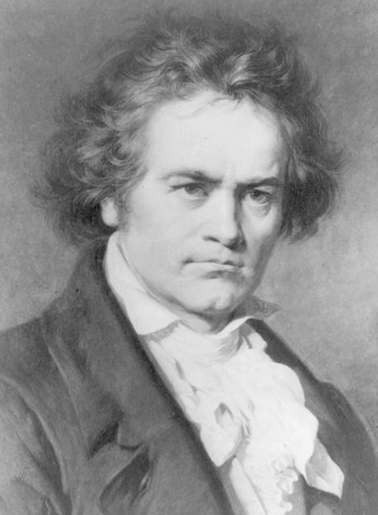
Ludwig van Beethoven was an influential German composer and pianist
Science and technology
Germany has been the homeland of many great scientists like Helmholtz, Fraunhofer, Fahrenheit, Kepler, Haeckel, Wundt, Virchow, Ehrlich, Humboldt, Röntgen, Braun, Einstein, Born, Planck, Heisenberg, Creuzfeldt, Hertz, Koch, Hahn, Leibniz, Liebig, Mayr and Bunsen; and inventors and engineers such as Gutenberg, Otto, Geiger, Fick, Lilienthal, Bosch, Siemens, von Braun, Porsche, Maybach, Daimler, Zuse, Benz and Diesel.
Important mathematicians were born in Germany such as Dedekind, Bessel, Gauß, Hilbert, Jacobi, Riemann, Riese, Klein, Einstein and Weierstraß.
Transportation
Due to its central situation in Europe, the volume of traffic, especially goods transit, in Germany is very high. In the past decades, much of the freight traffic shifted from rail to road transport, which led the Federal Government to introduce a motor toll for Lorries in 2005. In addition, individual traffic increased to an extent that on German roads, traffic densities are very high by international comparison. For the future, a further strong increase of traffic is expected. Thus, the 2003 federal transportation infrastructure plan scheduled an investment volume of approx. 150 billion euros for the 2001-2015 periods, in order to deal with the expected increase in motorised passenger traffic of around 20% (1997-2015) and freight traffic of around 64% (1997-2005).
High speed vehicular traffic has a long tradition in Germany, not only owing to the automobile industry, but also, because the first Autobahn in the world, the AVUS, and the world's first automobile were built in Germany. Germany possesses one of the densest road systems of the world. It covers 12,037 kilometres (7,479 mi) of federal "Autobahn" motorways and 41,386 kilometres (25,716 mi) of federal highways. In contrast to other European countries, German motorways have no blanket speed limit. However, signposted limits are in place on many dangerous or congested stretches, and where traffic noise or pollution poses a nuisance; some of these limits apply only at night or only in wet conditions. A vehicle is not permitted to use the Autobahn unless it can attain a speed of at least 60 km/h (37 mph). Recommended speed (Richtgeschwindigkeit) is 130km/h (80 mph).
Another way to travel is via rail. Deutsche Bahn (German Rail) is the major German railway infrastructure and service operator. For commuter and regional services, franchises of various sizes are granted by the individual states, though largely financed from the federal budget. Unsubsidised long-range service operators can compete freely all over the country, at least in theory. Actually, Deutsche Bahn holds a de facto monopoly on long-range services, while its market domination in the subsidised, franchise-based commuter train market and the freight market is being slowly eroded by several hundreds of comparatively small competing railways.
The InterCity Express or ICE is a type of high-speed train operated by Deutsche Bahn in Germany and neighbouring countries, for example to Zürich, Switzerland or Vienna, Austria. ICE trains also serve Amsterdam (The Netherlands) as well as Liège and Brussels (Belgium). In spite of branch lines progressively being closed for at least the last seven decades, the rail network throughout Germany is still very extensive and provides excellent services in most areas. On regular lines, at least one train every two hours will call even in the smallest of villages. The quality of rail service differs from state to state, generally being better in the South. Some states and regions have been pioneering the reopening of closed branch lines (notably Rhineland-Palatinate) or the interconnection of tramway and overland rail networks (e.g. around Karlsruhe). Nearly all larger metropolitan areas are being served by an S-Bahn heavy rail metro system. A large proportion of towns feature underground and/or tram systems. Good urban and overland bus services are ubiquitous.
Frankfurt International Airport is a major international airport and European transportation hub. Frankfurt Airport ranks among the world's top ten airports and serves 304 flight destinations in 110 countries. Depending whether total passengers, flights or cargo traffic are used to measure, it ranks as the busiest, second busiest and third busiest in Europe alongside London Heathrow Airport and Paris' Charles de Gaulle.
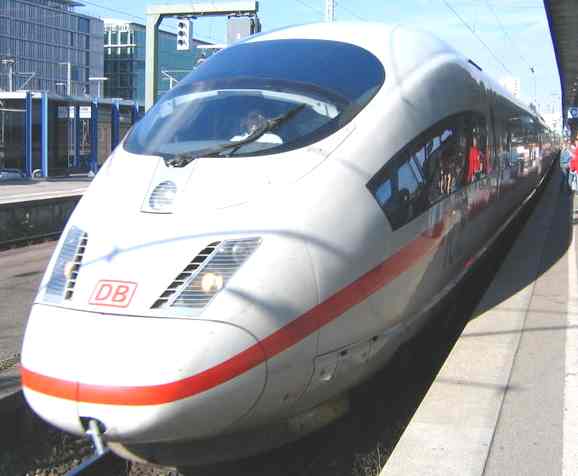
InterCity Express train (generation III), Stuttgart
NAVIGATION
MONA LISA 2
MonaLisa 2 is a Swedish led project concentrating on Sea Traffic Management with increased focus on the safe navigation of large passenger vessels, after the Costa Concordia and Baltic Ace accidents in January and December 2012. MonaLisa 2 is a continuation of the MonaLisa 1 project, the partners for which are as follows:-
The Danish Maritime Authority has responsibility for the construction, equipment and operation of Danish ships including safety, navigational regulations, ship registration, shipping policy, maritime law as well as industrial policy, both nationally and internationally. The DMA is a government agency part of the Ministry of Business.
The Finnish Transport Agency The Finnish Transport Agency is responsible for the traffic management on roads, waterways and railways. The Finnish Transport Agency’s Hydrographic Office publishes printed and electronic charts of Finland’s coastal and lake areas and manages the ongoing chart update service.
GateHouse is specialises in the development of technical software and system integration for advanced satellite communications and tracking systems. They are a leading independent provider of complete embedded software for Inmarsat BGAN terminals
SAAB serves the global market: governments (navy), coastguards and corporations with products, services and solutions from military defence to civil navigation via LPI pulsed radar, sonar and other transponders.
SSPA provide effective marine transport solutions for the maritime field – ship design, maritime operations, port development and coastal services. Seventy percent of the earth’s surface is water, with 90 percent of cargo transported by ships. SSPA is aware that the maritime industry has tremendous impact on our environment.
The Swedish
Maritime Administration (SMA)
offers modern and safe shipping routes with 24 hour service. SMA is a
governmental agency and enterprise within the transport sector and is
responsible for maritime safety and the future of shipping, primarily
merchant shipping, but also pleasure boating and fishing. Services include:
Port Pilots and Marine Traffic Information
The University
of Chalmers is a highly
progressive, situated in Gothenburg. They are known globally for education,
research and innovation.
EfficienSea is
concerned with the development of safe sustainable traffic at sea - in
particular the e-Navigation: "the harmonized creation, collection,
integration, exchange and presentation of maritime information on board and
ashore by electronic means to enhance berth-to-berth navigation and related
services, for safety and security at sea and protection of the marine
environment." Ref: Committee of the International Association of Marine
Aids to Navigation and Lighthouse Authorities, IALA.
MONA LISA CONTACTS
Magnus
Sundström
MONALISA Project Leader
Swedish
Maritime Administration
Market Department
Phone: +46 10 47 84 681
E-mail: magnus.sundstrom@sjofartsverket.se
http://www.sjofartsverket.se/en/MonaLisa/
MUNIN
The MUNIN project (Maritime Unmanned Navigation through Intelligence in Networks) is a collaborative research project, co-funded by the European Commission under its Seventh Framework Programme.
The MUNIN project is to develop and verify a concept for an autonomous ship, which they define as a vessel primarily guided by automated on-board decision system. The onboard system is finally controlled by a remote operator in a shore side control station. The concept therefore runs parallel to the thinking of the SolarNavigator team - provided only that the levels of autonomy may vary - clearly, a solar powered ship is that much more self reliant.
MUNIN PARTNERS
The Fraunhofer Center for Maritime Logistics and Services CML (Fraunhofer CML) is situated at the Hamburg University of Technology in Hamburg, Germany. Fraunhofer CML homepage Hans-Christoph Burmeister, is the project coordinator at Fraunhofer CML
The Norwegian Marine Technology Research Institute (MARINTEK), Trondheim, Norway. MARINTEK is a company in the SINTEF Group, one of Europe’s largest independent research institutions. MARINTEK homepage
Chalmers University of Technology is a Swedish university located in Gothenburg that focuses on research and education in technology, natural science, and architecture. Chalmers homepage
Hochschule Wismar – University of Applied Sciences Technology: Department of Maritime Studies is part of the faculty of Engineering at Hochschule Wismar, situated in Rostock-Warnemünde, Germany. They are exerts in simulator training as full mission ship handling carried out by Professors and lecturers with license management levels such as Master of a ship or Chief Engine Officer. Hochschule Wismar homepage
Aptomar AS is a Norwegian company located in Trondheim specialising in marine sensor systems such as the SECurus system that combines advanced stabilized long range IR and digital video cameras with an Electronic Chart System which overlays information of several sources for a speedy evaluation of real time situations for good response. Aptomar AS homepage
MarineSoft Entwicklungs- und Logistikgesellschaft mbH is an internationally operating provider for maritime software solutions, located in Rostock-Warnemünde, Germany. It offers state-of-the-art solutions in the field of maritime simulation of machinery plants, computer based training applications, information and operation systems, consultancy and courseware. MarineSoft homepage
Marorka ehf is a leading provider of energy management solutions for the international shipping industry with it’s headquarters in Reykjavik, Iceland. Marorka’s products and services enable vessel operators to optimize fuel consumption by maximizing the energy efficiency of their vessel or fleet. Marorka ehf homepage
University College Cork UCC is situated in south-west Ireland and was founded as a Queen’s College in 1845. The Law Department at UCC is at the forefront of legal research in Ireland, the EU and internationally in various areas, including environmental law, human rights, marine law, business law, comparative law, constitutional law and legal theory. UCC homepage
MUNIN CONTACTS
Project Manager - Hans-Christoph Burmeister
Fraunhofer
Center for Maritime Logistics and Services CML
Schwarzenbergstraße 95 D
21073 Hamburg, Germany
Phone: +49 (0)40 42878-6131
Fax: +49 (0)40 42878-4452
Ørnulf Jan Rødseth
MARINTEK
Dep. Maritime Transport Systems
Otto Nielsens veg 10
Trondheim, Norway
Phone: +47 7359 5257
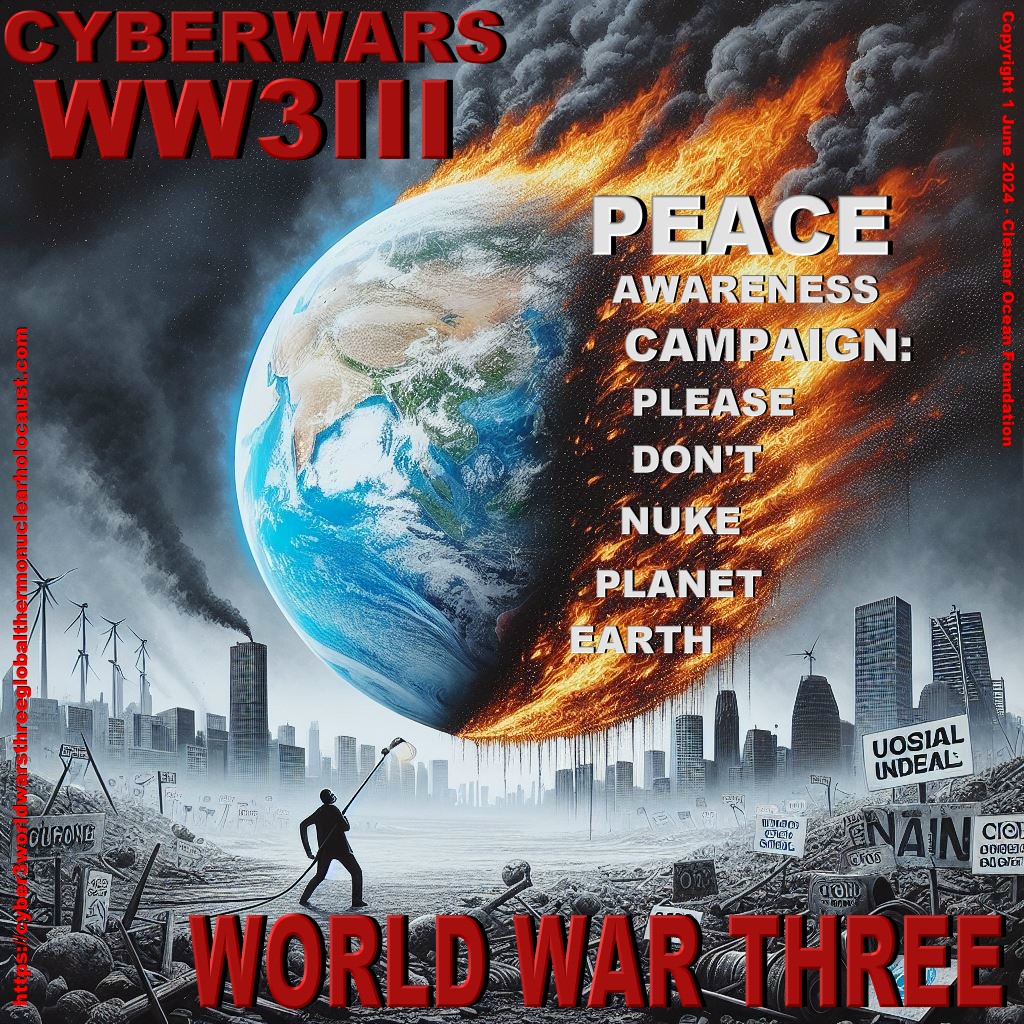
DOOMSDAY OPERATION GRAND SLAM - Disillusioned extremists in Iran, North Korea and Russia, have grown impatient waiting for their leaders to act decisively, having watched the Ukraine debacle of Vladimir Putin rebound to weaken their CRINK axis members. This despite Hamas launching against Israel and Houthi attacks on the Red Sea. All that had the effect of waking the sleeping giant: NATO.
They
hatch a plot to kidnap top politicians from the west to create confusion, as
a prelude to an all out cyber
nuclear first and second strike, having first stockpiled sufficient gold
and weapons reserves, and fallout bunkers for their cells, to be able to
stage a second wave of conventional attacks, to in effect, take over the
world after the nuclear holocaust they
have engineered. Including assassinating their jaded leaders: Xi
Jinping; Vladimir
Putin, Iranian Grand Ayatollah, Ali
Khamenei, and Kim
Jong Un, supreme leader of communist North
Korea.
WORLD CUP TEAMS 2006 - BERLIN
|
|
|
Solar Cola drinkers care about planet earth
.. Thirst for Life

(330ml Planet Earth can)
REFERENCES and LINKS
-
([1], pdf)
-
[2]. This achievement was boosted by the Renewable Energies Act (EEG), introduced on April 1, 2000, aimed at achieving a minimum 12% market share for renewable energy by 2010 (compared to 3.4 % in 1990). By 2005 German solar electricity capacity had reached 794,000 MWp (78.6% of total European capacity) [3], while wind generating capacity had reached 16,629 MWp (48.4% of European capacity) [4]. It is estimated that the renewable industries now employ, directly or indirectly, more than 120,000 people. Germany has committed to a 21% reduction in carbon dioxide emissions from 1990 levels by 2012.
-
Hoppenstedt business databank 2002
-
Deutschland.de — Official German portal
-
Travel to Germany - by Wikitravel.org
-
Facts about Germany — by the German Federal Foreign Office
-
A manual for Germany — by the German Government Representative for Migration, Refugees and Integration
-
Destatis.de — Federal Statistical Office Germany (in English)
-
The Germans explained and Take it from a German - Essays about German ideosyncrasies, from Der Spiegel.
Welcome - Youtube
|
Oktoberfest - Youtube
|
EDUCATIONAL LINKS:
|
Arctic - North Pole Atlantis - Plato's Lost City Black Rock Desert, Nevada Caribbean - Central America Columbia - S. America Daytona Beach - Florida USA East Africa
|
Kyoto - Japan London - Big Ben London Houses Parliament London - Buckingham Palace London - Old Bailey London - Trafalgar Square Maya Empire - Central America
|
Pendine Sands - Carmarthen Salt Lake City - Utah Senegal West Africa Sri Lanka - Links Surrey, England Index Sydney, Australia UAE - United Arab Emirates United Kingdom - Gov Wendover, Utah
|
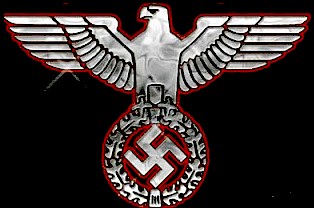
Adolf Hitler's dream of a master race did not die with him in 1945.
This website is Copyright © 1999 & 2024 MEL. The bird logos and name Solar Navigator are trademarks. All rights reserved. All other trademarks are hereby acknowledged. Max Energy Limited is an educational charity working hard for world peace.