|
We
are so busy dealing with our day to day lives, that most of us
don't have the time to look around us, at out place in the
Universe and realise just how wonderful the planet we live on
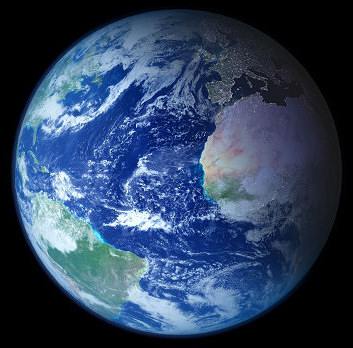
really is. The BBC commissioned a series to show us what we take
for granted. On the 6th of March 2006 'Planet Earth' BBC TV broadcast
proved a natural hit:
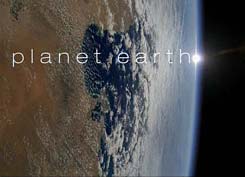
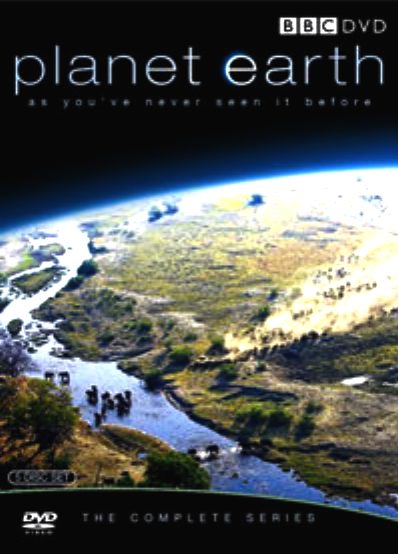
Planet
Earth Explorer: ake a spin around the world and dip
into a selection of stunning video clips
using our Flash interactive.
For UK users only.
Life
on Air:
Explore David Attenborough's
extraordinary career, from his passion
for fossils to his amazing contribution
to natural history film-making.
Sir David Attenborough's nature programme
Planet Earth
attracted nearly nine million viewers on the first Sunday
it was aired.
The first in the BBC One series, Pole to Pole, featured
footage of a great white shark attacking a
seal and the
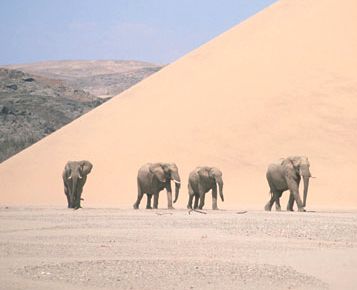
migration of elephants across Africa.
An average of 8.7 million viewers tuned in at 9pm but
ITV1's Midsomer Murders was not far behind, with 8.4
million.
ITV1 drama Wild at Heart had 9 million viewers at 8pm,
while BBC One's Just the Two of Us final got 6.1 million. Actress Sian Reeves and singer Russell Watson beat
rivals actor Mark Moraghan and pop star Natasha Hamilton.
The
BBC described Planet Earth as the most ambitious
factual series it has ever commissioned.
The series was made using high definition cameras and
took four years to make. Four programmes titled Mountains, Freshwater, Caves and
Deserts will follow over the coming weeks and the series
will continue in the autumn with another six habitats.
The autumn shows will be accompanied by three 50 minute
films called Saving Planet Earth which will look at what
needs to be done to preserve the animals that have been
brought to the small screen. Sir David told the BBC's Sunday AM show that the series
was the best he had worked on in more than 50 years of
natural history broadcasting. "Every series, I think, gets better, largely
because of the technology," he said.
"We can do more things better than we ever did
before. You get animals you never could film before,
closer, better sequences. "The aerial shots that you will see in Planet
Earth simply blow the mind - at least they blow my
mind."
BACKGROUND
In 2001 the BBC broadcast The Blue Planet, a landmark series on the natural history of the world's oceans. It received critical acclaim, high viewing figures and audience appreciation ratings and a string of awards. It also became a hugely profitable global brand, eventually being sold to 150 countries worldwide.
Feedback showed that audiences particularly liked the epic scale, the scenes of new and unusual species and the cinematic quality of the series. Programme commissioners were keen for a follow-up, so Alastair Fothergill decided that the Natural History Unit should repeat the formula with a series looking at the whole planet. The idea for Planet Earth was born, and the series was commissioned by Lorraine Heggessey, then Controller of BBC One, in January
2002.
A feature film version of Planet Earth was commissioned alongside the television series, repeating the successful model established with The Blue Planet and its companion film, Deep Blue. Earth was released around the world from 2007 to 2009. There was also another accompanying television series, Planet Earth: The Future, which looked at the environmental problems facing some of the species and habitats featured in the main series in more detail.
Production
Production team
With a budget of £16 million, Planet Earth is the most expensive documentary series the BBC has ever
made. The corporation signed a co-financing deal with the Discovery Channel and NHK (Japan’s state broadcaster), its production partners on The Blue Planet, to spread the cost of the ambitious project. Under the terms of the deal, Discovery retained the US rights and NHK the
Japanese rights, while BBC Worldwide retained the rights for the rest of the
world. Together, the Discovery and NHK financing amounted to 60–70% of the cost of the
series, which paid for the upgrade to the high-definition
format. BBC Worldwide also funded the additional £7.4 million budget of Earth, the feature
film.
The production duties were handled by the BBC Natural History Unit under the leadership of executive producer Alastair Fothergill. The individual episodes were overseen by six producers: Vanessa Berlowitz, Mark Brownlow, Andy Byatt, Huw Cordey, Jonny Keeling and Mark Linfield. They directed the film crews in the field, backed up by a team of production co-ordinators and researchers at the Natural History Unit's offices in Bristol,
England. In addition, the supporting team of scientists, guides, fixers,
pilots, drivers and field assistants numbered in the hundreds or even
thousands.
Post-production was carried out using BBC Resources' facilities in Bristol. Investment in new technology enabled the series to be edited and delivered without using
videotapes. Planet Earth's distinctive use of satellite imagery and time-lapse effects were provided by design company Burrell Durrant Hifle, using NASA
photography. The original score was composed and conducted by George Fenton, a veteran of previous BBC natural history documentaries, and performed by the BBC Concert Orchestra. The script was written by the producers with input from David
Attenborough, though the US episodes feature different narration and are slightly shorter in
length.

Filming
Production began in 2002 and was completed in autumn 2006, shortly before the final six episodes went to
air. The first year after commissioning was spent on researching and planning the shoots. To capture all the footage required by the producers, 71 camera operators filmed in 204 locations in 62 countries on all seven continents, spending more than 2000 days in the
field.
The decision to film Planet Earth in high definition (HD) was initially regarded by the BBC as a risk. In 2002, the technology was still largely untested in the field, and Fothergill was concerned about the difficulties of adapting to the new
cameras. Despite the reservations, the HD cameras proved to be reliable and even out-performed traditional film cameras in certain situations. Their high sensitivity allowed the team to film at lower light levels than film cameras, in dark rainforests for example. Because tape stock is smaller, lighter, and cheaper than film, the lengths of shoots were limited primarily by the capacity of
batteries. This improved the chances of capturing interesting behaviour, and enabled longer aerial shoots.
Panasonic VariCam HD cameras were used for land-based
footage and Sony HD cameras for aerial sequences. The latter, a distinctive feature of Planet Earth, were shot using a technique borrowed from Hollywood action films. Michael Kelem, the aerial cameraman, had previously worked on Mission: Impossible III and Black Hawk Down. The camera was mounted in a device called a Cineflex (Heligimbal), a gyroscopically-stabilised housing attached to the underside of a
helicopter and controlled by joystick from inside the cockpit. The unit was lightweight, enabling lenses with a longer reach to be attached (up to 40x magnification). This enabled him to capture steady images of individual creatures from a height which prevented the noise of the helicopter from disturbing them.
TV firsts
-
One of the producers' aims was to build as much unique footage into Planet Earth as possible, and
the crews succeeded in filming a number of species, locations and events from the natural world
which had never before been shown on
television, including:
-
Wild Bactrian
camels filmed eating snow in the Gobi desert
-
An Amur leopard mother and cub in the forests of eastern Russia
-
A sequence showing a snow
leopard attempting to hunt a markhor in north-west Pakistan
-
Arctic wolf and
African wild dog hunts filmed from the air
-
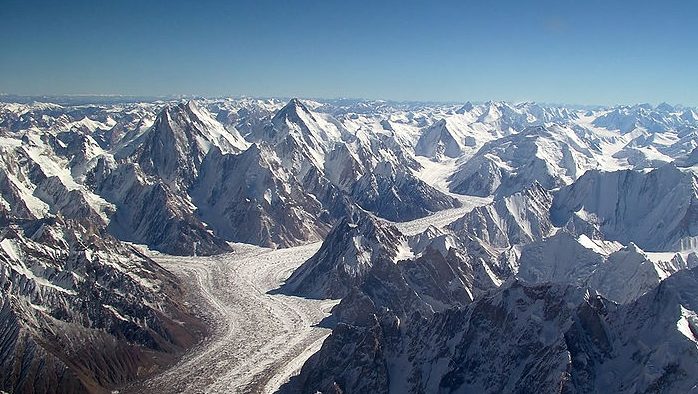
The highest-ever aerial footage of Mount Everest and the Karakoram
Desperate lions hunting and killing an elephant at night
-
A piranha feeding frenzy filmed in the water with the
fish
-
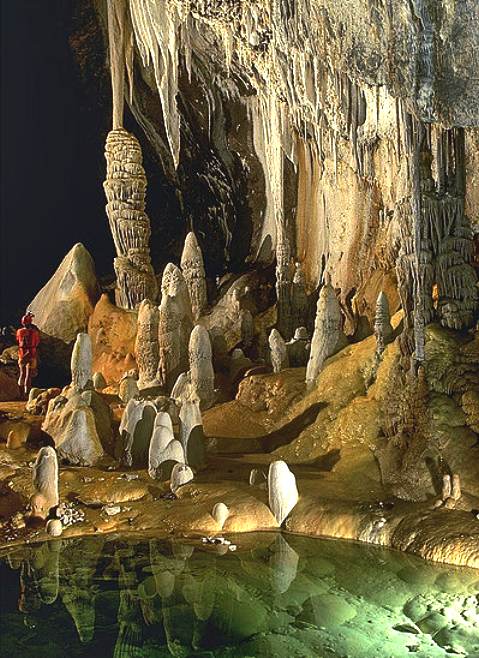
Unprecedented access to the dramatic Lechuguilla Cave in New
Mexico
-
The oceanic whitetip
shark, a rare ocean wanderer

Broadcast details
British television
The episodes are each an hour in length, comprising the main programme and a 10-minute featurette called Planet Earth Diaries which details the filming of a particular event. In the UK, Planet Earth was split into two parts, broadcast in spring and autumn 2006. The first five episodes premiered on BBC One at 9:00pm on Sundays, beginning on 5 March 2006. The programmes were repeated the following Saturday in an early evening slot on BBC Two. Along with its 2005 dramatisation of Bleak House, the BBC selected Planet Earth for its trial of high-definition
broadcasts. The opening episode was its first-ever scheduled programme in the format, shown 27 May 2006 on the BBC HD channel.
The first episode in the autumn series, "Great Plains", received its first public showing at the Edinburgh International Television Festival on 26 August 2006. It was shown on a giant screen in Conference
Square. The remaining episodes were broadcast from 5 November 2006 in the same primetime BBC One slot, following a further repeat run of the spring programmes on BBC Four. The autumn episodes were broadcast simultaneously on BBC HD and were repeated on BBC Four the following week.
Besides being BBC One's featured "One to Watch" programme of the day, Planet Earth was heavily trailed on the BBC's television and radio channels both before and during its run. The music that was featured in the BBC trailers for the series is the track "Hoppípolla" from the album Takk... by
Icelandic post-rock band Sigur Rós. Following the advertisements, interest was so widespread that the single was
re-released. In the USA, the series was promoted using "The Time Has Come" from Epic
Score, composed by Gabriel Shadid and Tobias Marberger. The
Australian trailers initially used "Jupiter: The Bringer of Jollity" from Gustav Holst's orchestral suite The Planets, but later reverted to "Hoppípolla".

US television
On 25 March 2007, the series began its run on American television on the Discovery network, premiering on the Discovery Channel and Discovery HD Theater. There were a number of revisions to the original British programmes. Actress and conservationist Sigourney Weaver was brought in to replace David Attenborough as narrator, as it was thought her familiarity to American audiences would attract more viewers. The Discovery programmes also used a different script to the British original. The series was broadcast on Sundays in one 3-hour block followed by four 2-hour blocks, with the episodes shown in a different running order to the UK broadcast. The Planet Earth Diaries segments were not shown immediately after each episode, but collectively in Planet Earth: The Filmmakers' Story, a two-hour special which was broadcast after the series had finished its initial network run. Edited versions were later broadcast on The Science Channel, Animal Planet, and Planet Green.
Other countries
The BBC pre-sold the series to several overseas
broadcasters, including the Australian Broadcasting Corporation, the Canadian Broadcasting Corporation, China Central Television, Germany's WDR, the Indian Discovery Channel,
New Zealand's Prime Television and C1R in
Russia. The series was eventually sold to 130
countries.
In Canada, the series did not air on the Canadian Discovery Channel, as it is owned by CTV and the
Canadian rights were exclusively sold to the CBC
EDUCATIONAL
LINKS http://www.testking.com/642-973.htm http://www.testking.com/techking/roundups/the-13-best-analytics-tools-to-keep-track-of-your-visitors/ http://www.certkiller.com/exam-640-802.htm http://www.examsheets.com/exam/70-413.htm http://www.testkingsite.com/microsoft/70-659.html
OTHER
ANIMALS:
A
taste for adventure

A
heartwarming adventure: Pirate
whalers V Conservationists,
with
an environmental
message.
For
release as an e-book when the time is right.
|