|
ARACHNIDS
|
||||||||||||||||||||||||||||||||||||||||||||||||
|
HOME | BIOLOGY | BOOKS | FILMS | GEOGRAPHY | HISTORY | INDEX | INVESTORS | MUSIC | NEWS | SOLAR BOATS | SPORT |
||||||||||||||||||||||||||||||||||||||||||||||||
It's sad to think that one day, the planet Earth may be gone. This is despite our best efforts to save her. The good news is that provided we all work together, we can preserve the status quo on our beautiful blue world, for centuries to come. Provided that is we heed the warnings nature is sending us, such as global warming and other pollutions.
Let the animals enjoy the Earth
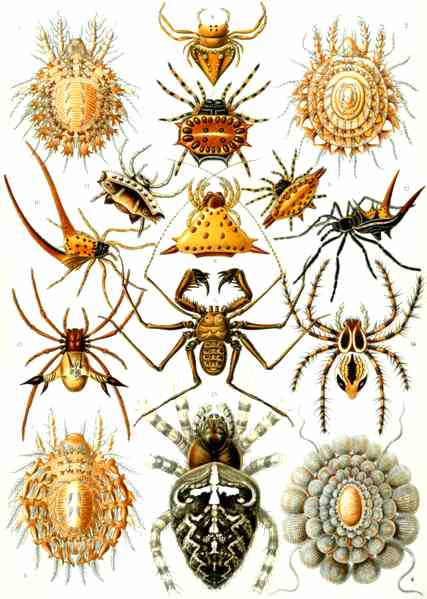
Arachnids are a class (Arachnida) of joint-legged invertebrate animals in the subphylum Chelicerata. Arachnids are named after the mythological figure Arachne. They are chiefly terrestrial arthropods, comprising some 65,000 to 73,000 named species including spiders, scorpions, harvestmen, ticks, and mites.
Arachnids may be easily distinguished from insects by the fact that arachnids have eight legs whereas insects have six. The chelicerae serve to macerate food particles. The first post-oral pair of appendages —pedipalps (leg-like mouthparts) — of some species have been adapted for sensory, prey capture or reproductive functions. In Solifugae, the palpi are quite leg-like and make Solifugae appear to have ten legs. The larvae of mites have only six legs; the fourth pair appears when they moult into nymphs. Arachnids are further distinguished by the fact they have no antennae and no wings. They have a two-segmented body, made up of a cephalothorax and an abdomen, the cephalothorax being derived from the fusion of the cephalon (head) and the thorax.
Tarantula on a human hand
Arachnids are mostly carnivorous, feeding on the pre-digested bodies of insects and other small animals. Many are venomous - they secrete poison from specialized glands to kill prey or enemies. Others are parasites, some of which are carriers of disease. Arachnids usually lay eggs, which hatch into immature adults.
Tarantula
Classification
Arachnida
Arachnida in human culture
Arachnids since ancient times have captured the human imagination, for example as objects of superstitious fear. They make their appearance in the Western zodiac, in the constellation of Scorpius. They are also present in the Egyptian hieroglyphs and diverse mythological characters such as the Greek Arachné and the west African Anansi. There are a number of gods based on arachnids, such as the Egyptian Serket. Images of scorpion-men are present in Assyrian reliefs.
Arachnophobia movie trailer
LINKS
Please use the Index below to navigate the Animal Kingdom:-
|
||||||||||||||||||||||||||||||||||||||||||||||||
|
This website is Copyright © 1999 & 2013 NJK. The bird logos and name Solar Navigator are trademarks. All rights reserved. All other trademarks are hereby acknowledged. Max Energy Limited is an educational charity working hard for world peace. |
||||||||||||||||||||||||||||||||||||||||||||||||
|
AUTOMOTIVE | BLUEPLANET BE3 | ELECTRIC CARS | ELECTRIC CYCLES | SOLAR CARS | SOLARNAVIGATOR | UTOPIA |