|
It's
sad to think that one day the planet
known as Earth may be gone.
This is despite our best efforts to save her. The good news is
that provided we all work together, we can preserve the status
quo on our beautiful blue world, for centuries to come.
Provided that is, we heed the warnings nature is sending us, such
as global warming and other
pollutions that is poison for blue
growth.
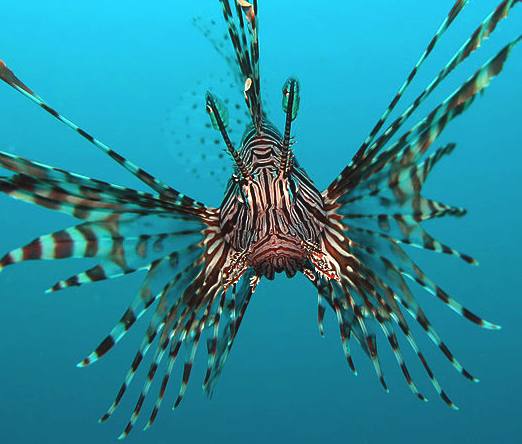
Stunning
Red Lion fish
A fish is any member of a paraphyletic group of organisms that consist of all gill-bearing aquatic craniate animals that lack limbs with digits. Included in this definition are the living hagfish, lampreys, and cartilaginous and bony fish, as well as various
extinct related groups. Most fish are ectothermic ("cold-blooded"), allowing their body temperatures to vary as ambient temperatures change, though some of the large active
swimmers like white
shark and tuna can hold a higher core
temperature. Fish are abundant in most bodies of water. They can be found in nearly all
aquatic environments, from high mountain streams (e.g., char and gudgeon) to the abyssal and even hadal depths of the
deepest
oceans (e.g., gulpers and anglerfish). At 32,000 species, fish exhibit greater species diversity than any other group of
vertebrates.
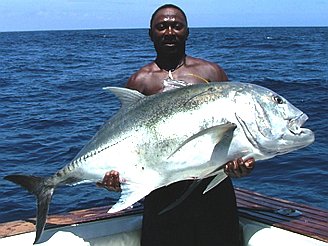
Kenya
is famous for big game fishing - a giant GT
Fish are an important resource worldwide, especially as
food if we are to sustain blue
growth in relation to population. Commercial and subsistence fishers hunt fish in wild fisheries (see
fishing) or farm them in ponds or in cages in the ocean (see
aquaculture). They are also caught by recreational fishers, kept as pets, raised by
fish-keepers, and exhibited in public aquaria. Fish have had a role in culture through the ages, serving as deities, religious symbols, and as the subjects of art, books and movies.
Fishing is part of the blue
growth agendas around the world to make better use of our
resources in a sustainable fashion, including the United
Nations 2030 Agenda and European
Commission.
Goliath
piranha, Africa
Because the term "fish" is defined negatively, and excludes the tetrapods (i.e., the amphibians, reptiles, birds and mammals) which descend from within the same ancestry, it is
paraphyletic, and is not considered a proper grouping in systematic biology. The traditional term pisces (also
ichthyes) is considered a typological, but not a phylogenetic classification.
The earliest organisms that can be classified as fish were soft-bodied chordates that first appeared during the Cambrian period. Although they lacked a true spine, they possessed notochords which allowed them to be more agile than their invertebrate counterparts. Fish would continue to evolve through the Paleozoic era, diversifying into a wide variety of forms. Many fish of the Paleozoic developed external armor that protected them from predators. The first fish with
jaws appeared in the Silurian period, after which many (such as
sharks) became formidable marine predators rather than just the prey of arthropods.
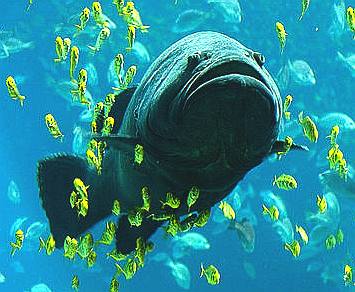
A
giant grouper in an aquarium
Evolution
Fish do not represent a monophyletic group, and therefore the "evolution of fish" is not studied as a single
event.
Proliferation of fish was apparently due to the hinged jaw, because jawless fish left very few
descendants. Lampreys may approximate pre-jawed fish. The first jaws are found in Placodermi
fossils. It is unclear if the advantage of a hinged jaw is greater biting force, improved respiration, or a combination of factors.
Fish may have evolved from a creature similar to a coral-like Sea squirt, whose larvae resemble primitive fish in important ways. The first ancestors of fish may have kept the larval form into adulthood (as some sea squirts do today), although perhaps the reverse is the case.
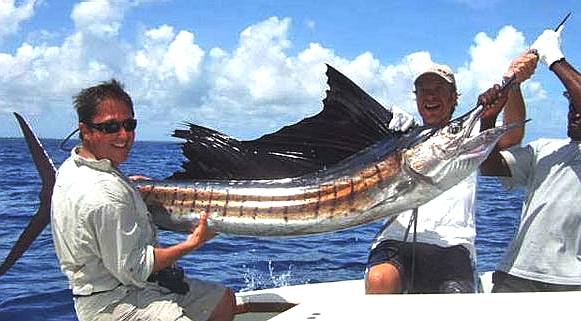
Sail
fish, big game fishing
Conservation
The 2006 IUCN Red List names 1,173 fish species that are threatened with
extinction. Included are species such as Atlantic cod, Devil's Hole
pupfish, coelacanths, and great white sharks. Because fish live underwater they are more difficult to study than terrestrial animals and plants, and information about fish populations is often lacking. However, freshwater fish seem particularly threatened because they often live in relatively small water bodies. For example, the Devil's Hole pupfish occupies only a single 3 by 6 metres (10 by 20 ft)
pool.
Overfishing
Overfishing is a major threat to edible fish such as cod and
tuna. Overfishing eventually causes population (known as stock) collapse because the survivors cannot produce enough young to replace those removed. Such commercial extinction does not mean that the species is extinct, merely that it can no longer sustain a fishery.
Bycatch,
where unselective fishing methods throw back dead fish into the
sea wastefully, is another major problem to be addressed.
One well-studied example of fishery collapse is the
Pacific sardine Sadinops sagax caerulues fishery off the
California coast. From a 1937 peak of 790,000 long tons (800,000 t) the catch steadily
declined to only 24,000 long tons (24,000 t) in 1968, after which the fishery was no longer
economically
viable.
The main tension between fisheries science and the fishing industry is that the two groups have different views on the resiliency of fisheries to intensive fishing. In places such as
Scotland, Newfoundland, and
Alaska the fishing industry is a major employer, so governments are predisposed to support
it. On the other hand, scientists and conservationists push for stringent protection, warning that many stocks could be wiped out within fifty
years.
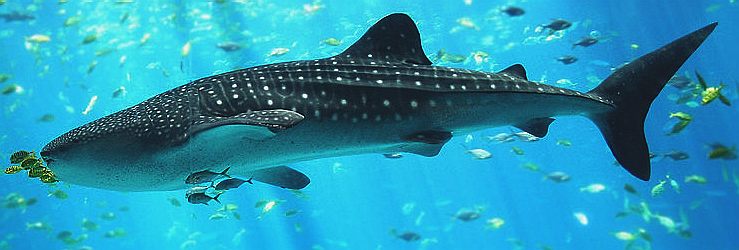
A
small whale shark in captivity
Habitat destruction
A key stress on both freshwater and marine ecosystems is habitat degradation including water pollution, the building of dams, removal of
water for use by
humans, and the introduction of exotic
species. An example of a fish that has become endangered because of habitat change is the pallid sturgeon, a North American freshwater fish that lives in rivers damaged by human
activity.
Bull
shark feeding - exciting genuine footage
Giant
prehistoric shark (stills with decent sounds)
LINKS:
ANGFA
– Database of freshwater fishes of Australia and New Guinea
Fischinfos.de
– Database of the freshwater fishes of Germany (German)
FishBase
online – Comprehensive database with information on over
29,000 fish species
Fisheries
and Illinois Aquaculture Center – Data for fisheries and
aquaculture research US
Philippines
Fishes – Database of Philippine Fishes photographed in
natural habitat
The
Native Fish Conservancy – Conservation and study of
North American freshwater fish
United
Nation – Fisheries and Aquaculture Department: Fish and
seafood utilization
University
of Washington Libraries Digital Collections – Freshwater
and marine fish images
Wikipedia
Piranha
Wikipedia
Flying_fish
Wikipedia
Barracuda
Wikipedia
Manta_ray
Wikipedia
Bluefish
Wikipedia
Tuna
http://en.wikipedia.org/wiki/Piranha
http://en.wikipedia.org/wiki/Flying_fish
http://en.wikipedia.org/wiki/Barracuda
https://en.wikipedia.org/wiki/Manta_ray
http://en.wikipedia.org/wiki/Bluefish
http://en.wikipedia.org/wiki/Tuna
Marlin
eaten by sharks, extreme fishing
Please
use the Index below to navigate the Animal Kingdom:-
|
AMPHIBIANS |
Such
as frogs (class: Amphibia) |
|
ANNELIDS |
As
in Earthworms (phyla: Annelida) |
|
ANTHROPOLOGY |
Neanderthals,
Homo Erectus (Extinct) |
|
ARACHNIDS |
Spiders
(class: Arachnida) |
|
BIRDS
|
Such
as Eagles, Albatross
(class: Aves) |
|
CETACEANS
|
such
as Whales
& Dolphins
( order:Cetacea) |
|
CRUSTACEANS |
such
as crabs (subphyla: Crustacea) |
|
DINOSAURS
|
Tyranosaurus
Rex,
Brontosaurus (Extinct) |
|
ECHINODERMS |
As
in Starfish (phyla: Echinodermata) |
|
FISH
|
Sharks,
Tuna (group: Pisces) |
|
HUMANS
-
MAN |
Homo
Sapiens THE
BRAIN |
|
INSECTS |
Ants,
(subphyla: Uniramia class:
Insecta) |
|
LIFE
ON EARTH
|
Which
includes PLANTS
non- animal life |
|
MAMMALS
|
Warm
blooded animals (class: Mammalia) |
|
MARSUPIALS |
Such
as Kangaroos
(order: Marsupialia) |
|
MOLLUSKS |
Such
as octopus (phyla: Mollusca) |
|
PLANTS |
Trees
- |
|
PRIMATES |
Gorillas,
Chimpanzees
(order: Primates) |
|
REPTILES |
As
in Crocodiles,
Snakes (class: Reptilia) |
|
RODENTS |
such
as Rats, Mice (order: Rodentia) |
|
SIMPLE
LIFE FORMS
|
As
in Amoeba, plankton (phyla: protozoa) |
|
|
|
John
Storm and Kulo Luna $billion dollar whale
When
a pirate whaler kills a small humpback whale, a larger
whale sinks the pirate ship to avenge the death, but is
itself wounded. The pirates put a price on the whale's
head, but an adventurer in an advanced solar powered
boat races to beat the pirates and save the wounded
animal.

|
ACIDIFICATION
- ADRIATIC
- ARCTIC
- ATLANTIC
- BALTIC
- BERING
- CARIBBEAN
- CORAL
- EAST
CHINA
ENGLISH
CH - GOC
- GULF
MEXICO - INDIAN
- IRC
- MEDITERRANEAN
- NORTH
SEA - PACIFIC
- PERSIAN
GULF - SEA
JAPAN
STH
CHINA - PLASTIC
- PLANKTON
- PLASTIC
OCEANS - SEA
LEVEL RISE - UNCLOS
- UNEP
- WOC
- WWF
|