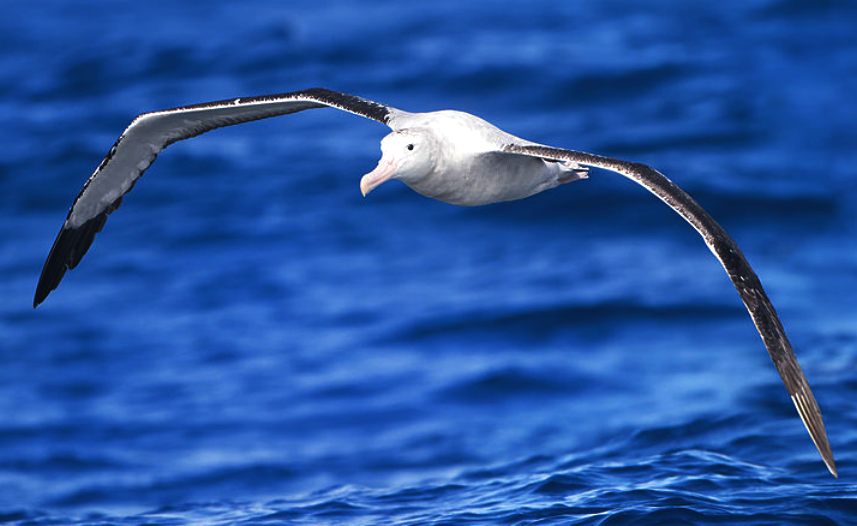
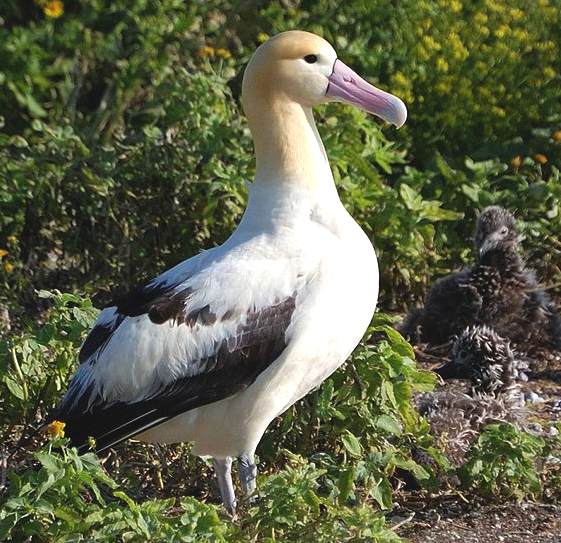
Albatrosses, of the biological family
Diomedeidae, are large seabirds allied to the procellariids, storm-petrels and diving-petrels in the order Procellariiformes (the tubenoses). They range widely in the
Southern Ocean and the North
Pacific. They are absent from the North
Atlantic, although fossil remains show they once occurred there too and occasional vagrants are found.
Albatrosses are among the largest of flying birds, and the great albatrosses (genus
Diomedea) have the largest wingspans of any extant birds, reaching up to 12 feet. The albatrosses are usually regarded as falling into four genera, but there is disagreement over the number of species.
Albatrosses are highly efficient in the air, using dynamic soaring and slope soaring to cover great distances with little exertion. They feed on squid, fish and krill by either scavenging, surface seizing or diving. Albatrosses are colonial, nesting for the most part on remote oceanic islands, often with several species nesting together. Pair bonds between males and females form over several years, with the use of 'ritualised dances', and will last for the life of the pair. A breeding season can take over a year from laying to fledging, with a single egg laid in each breeding attempt. A Laysan albatross, named "Wisdom" on Midway Island is recognized as the oldest wild bird in the world; she was first banded in 1956 by Chandler
Robbins.
Of the 21 species of albatrosses recognised by the IUCN, 19 are threatened with extinction. Numbers of albatrosses have declined in the past due to harvesting for feathers, but today the albatrosses are threatened by introduced species such as rats and feral cats that attack eggs, chicks and nesting adults; by pollution; by a serious decline in fish stocks in many regions largely due to overfishing; and by long-line fishing. Long-line fisheries pose the greatest threat, as feeding birds are attracted to the bait, become hooked on the lines, and drown. Identified stakeholders such as governments, conservation organisations and people in the fishing industry are all working toward reducing this bycatch.
TAXONOMY
& EVOLUTION
The albatrosses comprise between 13 and 24 species (the number of species is still a matter of some debate, 21 being the most commonly accepted number) in 4 genera. The four genera are the great albatrosses (Diomedea), the mollymawks (Thalassarche), the North Pacific albatrosses (Phoebastria), and the sooty albatrosses or sooties (Phoebetria). Of the four genera, the North Pacific albatrosses are considered to be a sister taxon to the great albatrosses, while the sooty albatrosses are considered closer to the
mollymawks.
The taxonomy of the albatross group has been a source of a great deal of debate. The Sibley-Ahlquist taxonomy places seabirds, birds of prey and many others in a greatly enlarged order Ciconiiformes, whereas the ornithological organisations in North America, Europe,
South Africa, Australia and New Zealand retain the more traditional order Procellariiformes. The albatrosses can be separated from the other Procellariiformes both genetically and through morphological characteristics, size, their legs and the arrangement of their nasal tubes (see Morphology and
flight).
Within the family the assignment of genera has been debated for over a hundred years. Originally placed into a single genus, Diomedea, they were rearranged by Reichenbach into four different genera in 1852, then lumped back together and split apart again several times, acquiring 12 different genus names in total (though never more than eight at one time) by 1965 (Diomedea, Phoebastria, Thalassarche, Phoebetria, Thalassageron, Diomedella, Nealbatrus, Rhothonia, Julietata, Galapagornis, Laysanornis, and
Penthirenia).
By 1965, in an attempt to bring some order back to the classification of albatrosses, they were lumped into two genera, Phoebetria (the sooty albatrosses which most closely seemed to resemble the procellarids and were at the time considered "primitive" ) and Diomedea (the
rest). Though there was a case for the simplification of the family (particularly the nomenclature), the classification was based on the morphological analysis of Elliott Coues in 1866, and paid little attention to more recent studies and even ignored some of Coues's
suggestions.
More recent research by Gary Nunn of the American Museum of Natural History (1996) and other researchers around the world studied the mitochondrial
DNA of all 14 accepted species, finding that there were four, not two, monophyletic groups within the
albatrosses. They proposed the resurrection of two of the old genus names, Phoebastria for the North Pacific albatrosses and Thalassarche for the mollymawks, with the great albatrosses retaining Diomedea and the sooty albatrosses staying in Phoebetria. Both the British Ornithologists' Union and the South African authorities split the albatrosses into four genera as Nunn suggested, and the change has been accepted by the majority of researchers.
While there is some agreement on the number of genera, there is less agreement on the number of species. Historically, up to 80 different taxa have been described by different researchers; most of these were incorrectly identified juvenile
birds.
Based on the work on albatross genera, Robertson and Nunn went on in 1998 to propose a revised taxonomy with 24 different
species, compared to the 14 then accepted. This interim taxonomy elevated many established subspecies to full species, but was criticised for not using, in every case, peer reviewed information to justify the splits. Since then further studies have in some instances supported or disproved the splits; a 2004 paper analysing the mitochondrial DNA and microsatellites agreed with the conclusion that the Antipodean Albatross and the Tristan Albatross were distinct from the Wandering Albatross, per Robertson and Nunn, but found that the suggested Gibson's Albatross, Diomedea gibsoni, was not distinct from the Antipodean
Albatross. For the most part, an interim taxonomy of 21 species is accepted by the IUCN and many other researchers, though by no means all—in 2004 Penhallurick and Wink called for the number of species to be reduced to 13 (including the lumping of the Amsterdam Albatross with the Wandering
Albatross), although this paper was itself controversial. On all sides, there is the widespread agreement on the need for further research to clarify the issue.
Sibley and Ahlquist's molecular study of the evolution of the bird families has put the radiation of the Procellariiformes in the Oligocene period (35–30 million years ago), though this group probably originated earlier, with a fossil sometimes attributed to the order, a seabird known as Tytthostonyx, being found in late Cretaceous rocks (70 mya). The molecular evidence suggests that the storm-petrels were the first to diverge from the ancestral stock, and the albatrosses next, with the procellarids and diving petrels separating later. The earliest fossil albatrosses were found in Eocene to Oligocene rocks, although some of these are only tentatively assigned to the family and none appear to be particularly close to the living forms. They are Murunkus (Middle Eocene of Uzbekistan), Manu (early Oligocene of
New Zealand), and an undescribed form from the Late Oligocene of South Carolina. Similar to the last was Plotornis, formerly often considered a petrel but now accepted as an albatross. It is from the Middle Miocene of France, a time when the split between the four modern genera was already underway as evidenced by Phoebastria californica and Diomedea milleri, both being mid-Miocene species from Sharktooth Hill, California. These show that the split between the great albatrosses and the North Pacific albatrosses occurred by 15 mya. Similar fossil finds in the southern hemisphere put the split between the sooties and mollymawks at 10
mya.
The fossil record of the albatrosses in the northern hemisphere is more complete than that of the southern, and many fossil forms of albatross have been found in the North Atlantic, which today has no albatrosses. The remains of a colony of Short-tailed Albatrosses have been uncovered on the island of
Bermuda, and the majority of fossil albatrosses from the North Atlantic have been of the genus Phoebastria (the North Pacific albatrosses); one, Phoebastria anglica, has been found in deposits in both North Carolina and England. Due to convergent evolution in particular of the leg and foot bones, remains of the prehistoric pseudotooth birds (Pelagornithidae) may be mistaken for those of extinct albatrosses; Manu may be such a case, and quite certainly the supposed giant albatross femur from the Early
Pleistocene Dainichi Formation at Kakegawa (Japan) actually is from one of the last pseudotooth birds. For more data on fossil species of the living albatross genera, see the genus articles.
It's
sad to think that one day, the planet Earth may be gone.
This is despite our best efforts to save her. The good news is
that provided we all work together, we can preserve the status
quo on our beautiful blue world, for centuries to come.
Provided that is we heed the warnings nature is sending us, such
as global warming and other pollutions.
Please
use the Index below to navigate the Animal Kingdom:-
A
heartwarming adventure: Pirate
whalers V Conservationists,