|
PETROAMAZONAS
In what looks to be one of the most one sided
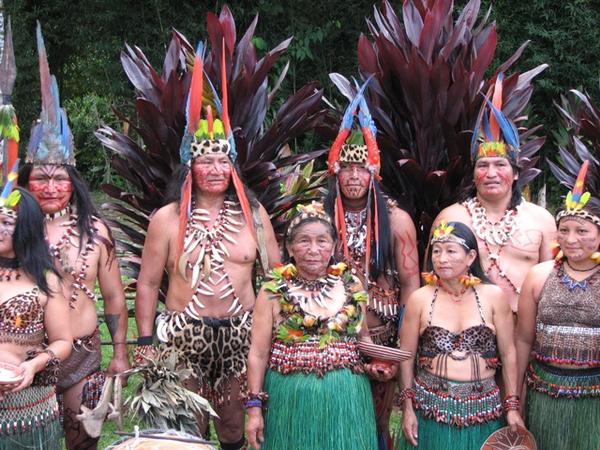
events in the history of the Amazon rainforest, an indigenous community of about 400 villagers is preparing to resist the Ecuadorean army and one of the biggest oil companies in South America – to protect their homes and the rainforest they live in.
The US did this with their native American Indians and the British did it
with the Aboriginal natives.
The Kichwa (also known as Quechua) tribe on Sani Isla were using blowpipes to hunt just two generations
ago. They live a simple life, in a territory covering 70,000 hectares of pristine rainforest.
They are not subject to financial slavery and do not want to join in the rat
race. They just want to live a natural life.
Petroamazonas –
have told them they will begin prospecting and will use military force if
they resist. So, it's David and Goliath. We wonder what little stone might
gain a reaction.
Much of the rainforest, which is extremely valuable in itself, even without people inhabiting it, covers a vast oil field. Desperate, with little options, the tribe have turned to the last resort, which can never end well: fighting. The Sani Islanders say they scared but determined.
Patricio Jipa says: “If there is a physical fight, it is certain to end
tragically.” Patricio is the local shaman and former community chief. “We may die fighting to defend the rainforest. We would prefer passive resistance, but this may not be possible. We will not start conflict, but we will try to block them and then what happens will happen.”
VICTORY IN 2012
The Kichwa people of Sarayaku, won two major victories in 2012: in April, for the first time in their history, the government of
Ecuador acknowledged responsibility for illegally licensing an oil company to do business on indigenous territory without the community’s consent; and in July the
Inter-American Court of Human Rights
(ICHR) ruled that the government must consult with indigenous communities prior to such enterprises and to pay for physical and ‘moral’ damages to the community.
Everything seemed to be going fine, and things seemed to finally step into a humane normality. But guess what? Even though about 90% of their
population is against oil exploitation, a self proclaimed leader of the tribe gave the company the go-ahead for the exploration – something which he can’t legally do without the consent of the population. This is what a British businesswoman, who is married to the village shaman is trying to prove.
Mari Muench, who is originally from London explained that the community repeteadly decided to reject the financial offer and oppose the oil exploitation; the financial offer included a new school, university places for village children and better healthcare, but here’s the kicker: in the new document signed by the “village leader”, all these are dropped, and the villagers are given just a meager compensation. The government is going ahead in this abusive, illegal manner, without even discussing any other options – they said that if any other opposition is posed, the military will kick in.
“It makes me feel sad and angry. Sad because we are indigenous people and not fully prepared to fight a government. And angry because we grew up to be warriors and have a spirit to defend ourselves. I wish we could use this force to fight in a new way, but our mental strength is not sufficient in this modern world. If the laws were respected we would win. But our lawyers have sent them letters and they won’t even talk to us in Quito.”
Aside from the community itself, the members of the Quechua indigenous group are custodians of swaths of the most biodiverse areas in the world. Their land is close to the Yasuni national park. A single hectare of their land contains a wider biodiversity than the entire North America!
REAL LIFE AVATAR (Medicine
Man)
This tribe and their supporters are the heroes that we idolize in
films - but as soon as real life kicks in the convenience of
cheap energy rolls down the shutters.
The Kichwa are appealing for outside assistance to aid them in this legal battle and/or offer alternatives – something which seems just as hopeless as an armed conflict with the Ecuadorian military.
http://ngm.nationalgeographic.com/2013/01/yasuni-national-park/wallace-text
NATIONAL
GEOGRAPHIC - THE BIRTH OF A SOCIETY
On the evening of January 13, 1888, thirty-three men traveled on
foot, horseback, and in horse drawn carriages through the streets
of Washington to the Cosmos Club, then on Lafayette Square
across from the White House. They convened around a large
mahogany table to discuss “the advisability of organizing a
society for the increase and diffusion of geographical
knowledge.” The entity they were about to create would become
the largest nonprofit scientific and educational institution in
the world. See the links below:
WOODS
HOLE OCEANOGRAPHIC INSTITUTION
Mission:
WHOI is dedicated to research and higher
education at the frontiers of ocean science. Its primary mission
is to develop and effectively communicate a fundamental
understanding of the processes and characteristics governing how
the oceans function and how they interact with Earth as a whole.
Read
WHOI’s Mission Statement
President &
Director: Robert B.
Gagosian, Ph.D. Go
to the President & Director’s Office Website
Location: Woods Hole, Massachusetts
USA (Cape Cod)
Staff and Students:
Scientists: 135
Technical staff: 155 Students: 130 Marine personnel: 60
Other support staff: 290
Funding
The Woods Hole Oceanographic Institution
is supported by a mix of grants from federal agencies including
the National Science Foundation and the Office of Naval
Research, private contributions, and endowment income.
Research Departments, Ocean Institutes,
and Centers
Applied
Ocean Physics & Engineering
Biology
Geology
& Geophysics
Marine
Chemistry & Geochemistry
Physical
Oceanography
Deep
Ocean Exploration Institute
Ocean
Life Institute
Coastal
Ocean Institute
Ocean
and Climate Change Institute
Marine Policy Center
Rinehart Coastal Research Center
Cooperative Institute for Climate & Ocean Research
Research Vessels and Instruments
Atlantis, Knorr, Oceanus and Asterias are the
Institution’s main research vessels. WHOI also operates a
group of vehicles designed for deep sea exploration. These
vehicles include Alvin, Jason, ABE, Argo II, and DSL-120.
Find
out more about WHOI’s operations at sea
Educational Degrees
Ph.D. and Master of Science.
In addition, WHOI offers postdoctoral and summer student
fellowships and other education programs.
Members
WHOI welcomes the financial support of the public through
donations, gifts, and Associate memberships. Associates receive
subscriptions to WHOI’s publications, the quarterly Woods Hole
Currents, and the semi-annual Oceanus. Memberships offer
additional benefits including participation in special on-site
scientific events, discounted merchandise from the gift shop,
and educational travel opportunities.
GENERAL
INFO
WHOI at a
Glance
 Mission
Statement Mission
Statement
WHOI
History
Oceanographic
Research
WHOI
Facilities
Publications
Oceanus
![]() Back
Issues Back
Issues
Woods
Hole Currents
![]() Back
Issues Back
Issues
Annual
Report
![]() Back
Issues Back
Issues
Visitor
Information
Directions
![]() Village
Facilities Village
Facilities
![]() Quissett
Campus Quissett
Campus
Tours
(Summer Only)
Exhibit
Center
Local
Information
Gift Shop
What's
New?
Weekly
Calendar
Archived
Front Page Stories
FAQs
Contact
WHOI
RESEARCH
Introduction
Applied
Ocean Physics & Engineering
Biology
Geology
and Geophysics
Marine
Chemistry and Geochemistry
Physical
Oceanography
Research
Groups
The
Ocean Institutes
Deep
Ocean Exploration Institute
Ocean
Life Institute
Coastal
Ocean Institute
Ocean
and Climate Change Institute
Multi-disciplinary
Projects
Joint
North Pacific Research Center (J-Pac)
Ridge
Inter Disciplinary Global Experiment (Ridge 2000)
U.S
GLOBEC Georges Bank Program
U.S
Joint Global Ocean Flux Program
WOCE
Subsurface Float Data Assembly Center
WHOI
Arctic Group
Centers
and Special Programs
Marine
Policy Center
WHOI
CICOR
Geophysical
Fluid Dynamics (GFD) Program
Rinehart
Coastal Research Center
WHOI
Sea Grant
EDUCATION
Overview
Education
Programs
MIT/WHOI
Joint Programs
![]() Go
to Joint Program Website Go
to Joint Program Website
Postdoctoral
Fellowships
Marine
Policy Fellowship Program
Summer
Student Fellowships
Geophysical
Fluid Dynamics Summer Study
![]() Go
to GFD Website Go
to GFD Website
Traineeships
in Oceanography for Minority Group Undergraduates
Guest
Students
K-12
Resources
Turnstone
Ocean Pilot & Ocean Explorer Science Kits
K-12
Related Resources
MBL/WHOI
Library
MIT/WHOI
Alumni/ae Association
MIT/WHOI
Alumni/ae Association
MIT/WHOI
Alumni/ae Committee
A
Message From The Alumni/ae President
Support
The Joint Program (PDF File)
WHOI
Education/Housing Office
WHOI Staff Training
and Development
WHOI
AT SEA
Overview
Research
Vessels
Atlantis
![]() Specifications Specifications
![]() Where
is Atlantis? Where
is Atlantis?
Knorr
![]() Specifications Specifications
![]() Where
is Knorr? Where
is Knorr?
Oceanus
![]() Specifications Specifications
![]() Where
is Oceanus? Where
is Oceanus?
Asterias
![]() Specifications Specifications
Vehicles
Deep
Submergence Vehicle Alvin
Remotely
Operated Vehicle Jason/Medea
ARGO
II
DSL-120A
Cruise
Planning
Support
Services
Port
Office
Online
Expeditions
MEDIA
Media
Realtions
Contact
Us
News
Releases
Hot Topics
Visual
Library
Staff
Honors and Awards
Obituary
Archives
Fellowships
Journalism
Award
WHOI
in the News
SUPPORT WHOI
Support
WHOI
Associates
Program & Annual Gifts
Levels
& Benefits of Membership
Lectures
& Special Events
![]() Annual
Giving-Travel Opportunities Annual
Giving-Travel Opportunities
Associates
Program & Annual Gifts-Enrollment
Leadership
Gifts
Planned
Giving & Bequests
Foundations
and Corporations
Ways
of Giving
Development
Office
ADMINISTRATION
& OPERATIONS
Computer &
Information Services (CIS)
Environmental
Health and Safety Office
Grant
& Contract Services
Graphic
Services
Human
Resources
Office
of Technology Transfer
President
and Director’s Office
Procurement
SCRIPPS
- OCEANOGRAPHIC INSTITUTION SCRIPPS
OVERVIEW RESEARCH
OVERVIEW NEWS
NEWS
ARCHIVES CONTACT
INFO
EXPLORATIONS
PHOTO GALLERY
RESEARCH
OVERVIEW RESEARCH
SCRIPPS
ARCHIVES
RESEARCH
AREAS RESEARCH
OVERVIEW SHIP
OPERATIONS RESEARCH
SUPPORT
EDUCATION
RESOURCES
SCRIPPS
LIBRARY OCEANOGRAPHIC
COLLECTIONS SHIP
OPERATIONS
RESOURCES:
Aluwihare Lab
Welcome to the Aluwihare CABOOM lab, with lots of soul and
flavor for your surfing pleasure.
Analytical Laboratory
Facility
Elemental (CHN) Analyzer, Environ. Scanning, Electron
Microscope, ICP - Mass Spectrometer, ICP - Optical Emission
Spectrometer, X-Ray Diffractometer
Atmospheric Aerosol
Group Home Page
The Atmospheric Aerosol Group investigates the behavior of
aerosol particles in the Earth's atmosphere under both pristine
marine and anthropogenically-influenced conditions.
Barbeau Lab website
Describes current research in the laboratory of Kathy Barbeau.
Birch Aquarium at
Scripps
The Birch Aquarium at Scripps is the interpretive center for
Scripps Institution of Oceanography in La Jolla, California.
Broadband Seismic Data
Collection Center
The Broadband Seismic Data Collection Center is responsible for
the collection and distribution of seismic data from several
regional networks, small aperture arrays, and portable
instrument deployments. We maintain local archives of all data
collected and distribute the data through the IRIS-DMC.
C4: The Center for
Clouds, Chemistry and Climate
We seek to integrate observations and field-tested hypotheses
with models used for climate predictions. We identify gaps in
current observing systems; fill these gaps with new data; and
integrate these into global observing systems and modeling
activities.
California Space
Institute
The California Space Institute (CalSpace) is a multi-campus
research unit (MRU) of the University of California. It strives
for excellence in research and education in aerospace-related
sciences, engineering and technology.
Cecil H. and Ida M.
Green Institute of Geophysics and Planetary Physics
The Cecil H. and Ida M. Green branch of the University of
California Systemwide Institute of Geophysics and Planetary
Physics (IGPP) is located in La Jolla, and is strongly linked to
Scripps Institution of Oceanography (SIO) through joint faculty
appointments, research interests, and shared facilities. IGPP
research in La Jolla covers many fields, including global
seismology, marine seismology and geodesy, geodynamics, high
frequency seismology and arrays, geomagnetism, nonlinear
dynamics, sea floor electromagnetic sounding, geodesy including
satellite geodesy, information technology, geophysical fluid
dynamics, seagoing experiments, geophysical inverse methods,
acoustical oceanography, marine acoustics, planetary physics,
and physical oceanography.
Centennial Site
A leader and innovator in oceanography and marine technology for
100 years, Scripps Institution of Oceanography is dedicating its
centennial celebration to communicating the importance of ocean
science to the global community and to reaching out to friends
and colleagues around the world.
Center for
Atmospheric Sciences
CAS conducts fundamental investigations of the atmosphere
related to climate and climate change.
Center for Marine
Biodiversity and Conservation
The center works to assess the state of marine ecosystems and
develop predictive models that help formulate appropriate
strategies to prevent and reverse loss of marine biodiversity.
CMBC trains new marine scientists capable of linking biological
physical, social and informatic sciences who can communicate
scientific issues in a manner that will increase public
understanding and sound policy decisions.
Center for Marine
Biotechnology and Biomedicine
Center for Marine Biotechnology and Biomedicine (CMBB) is a
campuswide UCSD research division dedicated to the exploration
of the novel and diverse resources of the ocean. Research
programs focus on marine biomedicine and marine drug discovery,
with an emphasis on cancer and both infectious and inflammatory
diseases. CMBB scientists investigate a wide range of
biotechnologies, from the special properties of deep-sea marine
microbes to the genetic engineering of commercially viable
marine animals.
Center for
Observations, Modeling and Prediction at Scripps
The Center for Observations, Modeling and Prediction at Scripps
(COMPAS), is intended to help lead the institution into the
future of ocean research. The initial effort is focussed upon
physical processes and phenomena in the ocean and the
atmosphere.
Climate Research
Division (CRD)
In the Climate Research Division (CRD), scientists study a broad
range of phenomena. Research themes include predicting the
natural variability of climate and understanding the
consequences of man made increases in the greenhouse effect.
Climate change caused by human actions is the paradigm that
illustrates why traditional disciplinary barriers in the earth
sciences are rapidly weakening. In the climate system, the
atmosphere, the seas, the land surface, and the world of living
things are tightly coupled. To understand these interactions, a
variety of expertise must be brought to bear through a team
approach to research.
Coastal Data Information
Program
CDIP measures, analyzes, archives and disseminates coastal
environment data for use by coastal engineers, planner and
managers as well as scientists and mariners.
Committee for Humanity
and Public Service (CHiPS)
Scripps CHiPS (Committee for Humanity and Public Service) is a
volunteer organization that facilitates community service by
UCSD graduate students, staff, faculty and friends. As of
January 2003, CHiPS volunteers have produced over 3000
person-hours of work in over 70 public service projects - join
us on our next outing!
Development
THE DEVELOPMENT OFFICE at Scripps Institution of Oceanography (SIO)
is responsible for developing private support from individuals,
corporations, and foundations for research and education
programs at SIO.
Earthguide
Earth, marine, and environmental science resources for teachers
and students featuring Scripps scientists.
Explorations
Magazine
Global Discoveries for Tomorrow's World Join adventures in
science with Explorations, a quarterly magazine and video series
featuring the educational and research programs at Scripps
Institution of Oceanography.
Geosciences Research
Division
The Geosciences Research Division at Scripps Institution of
Oceanography is a multi-disciplinary group specializing in many
aspects of geoscience research.
Geowall
Visualization System
The Geowall is a low-cost visualization system - essentially it
is just a desktop PC (running Mac, Linux, or Windows flavor
operating system) with a fast graphics card, two digital
projectors, and a projector screen. The dual projectors
superimpose an image on top of one another creating a passive
stereo (or 3D) image, which can be observed by wearing cheap 3D
stereo glasses. With the advent of newer, faster graphics cards,
it is now possible to view quad-buffered stereo images and
movies.
Graduate
Department
A graduate department of the University of California at San
Diego, Scripps is one of the oldest and largest centers for
global science research and graduate training in the world.
Hydrogeology and
Tectonics Studies Laboratory
The Hydrogeology and Tectonics Studies Laboratory, under the
direction of Dr. Kevin M. Brown, focuses on the role of fluids
in active tectonic systems, primarily at plate boundary zones.
Much of our work involves the development of novel experimental
systems and instrumentation.
Inframatics.org
The new inframatics organization provides information about the
use of sub audible sound waves in the atmosphere for studying
natural atmospheric phenomena and monitoring anthropogenic sound
sources including clandestine nuclear tests. The main product of
this organization's website is a quarterly newsletter that
includes articles summarizing ground breaking research in
low-frequency atmospheric acoustics.
Institute of
Geophysics & Planetary Physics
The Cecil H. and Ida M. Green branch of the University of
California Systemwide Institute of Geophysics and Planetary
Physics (IGPP) is located in La Jolla, and is strongly linked to
Scripps Institution of Oceanography (SIO) through joint faculty
appointments, research interests, and shared facilities. IGPP
research in La Jolla covers many fields, including global
seismology, marine seismology and geodesy, geodynamics, high
frequency seismology and arrays, geomagnetism, nonlinear
dynamics, sea floor electromagnetic sounding, geodesy including
satellite geodesy, information technology, geophysical fluid
dynamics, seagoing experiments, geophysical inverse methods,
acoustical oceanography, marine acoustics, planetary physics,
and physical oceanography.
Integrative Oceanography
Division (IOD)
The Integrative Oceanography Division (IOD) is the result of the
merger of the Center for Coastal Studies (CCS) and the Marine
Life Research Group (MLRG).
Jeff Severinghaus
web page
Web page describes research interests, publications, students
and postdocs, and current projects.
Joint
Center for Observational Systems Science
UCSD's Scripps Institution of Oceanography and Goddard Space
Flight Center at the National Aeronautics and Space
Administration (NASA) have formed a new collaborative center for
observing the earth, oceans and atmosphere. Called the Joint
Center for Observation System Science (JCOSS), the teaming
arrangement brings together complementary expertise of the two
resources in developing, deploying and analyzing sea, land and
air-based measurements, and remotely-sensed observations from
satellites to better understand the earth systems.
Laboratory for Atmospheric
Acoustics
The Laboratory for Atmospheric Acoustics (L2A) has been
established at the Scripps Institution of Oceanography (SIO) at
the University of California, San Diego. Researchers at the lab
are interested in acoustic source phenomenology, the propagation
of sound through our turbulent atmosphere and the clear
reception of sound waves despite variable, and often high levels
of atmospheric noise. Although research at the lab has focused
on the use of sub audible sound to monitor the atmosphere for
nuclear testing activity, researchers at L2A anticipate further
research involving man-made and natural phenomena at frequencies
spanning the full acoustic spectrum.
Marine Biology Research
Division MBRD
The Marine Biology Research Division at Scripps Institution of
Oceanography consists of specialist marine research laboratories
in the fields of cell and developmental biology, ecology and
evolutionary biology, microbiology and physiology.
Marine Mammal Acoustics
Marine mammal acoustic research activities including a library
of marine mammal sounds.
Marine Physical
Laboratory
The Marine Physical Laboratory consists of individual research
groups headed by Principal Investigators with a common interest
in Observational Ocean Science with emphasis on developing
state-of-the-art instrumentation for studying ocean acoustic and
seismic propagation, air-sea interaction, ocean volume dynamics
and ocean bottom geophysics.
Nierenberg Hall Business
Office
Our fund managers, pre-award coordinators, management and
student staff will be the support hub of the research efforts of
over 50 Principle Investigators and faculty in the following
four divisions of the Scripps Institution of Oceanography;
Physical Oceanography Research Division (PORD), Climate Research
Division (CRD), Center for Atmospheric Science (CAS), and the
California Space Institute (CSI).
Physical Oceanography
Research Division
Scientists in the Physical Oceanography Research Division (PORD)
investigate the physics of the ocean. Researchers study the
large-scale circulation of the world's oceans or the specifics
of smaller environments such as the continental shelf, marginal
seas, straits, estuaries, or the surf zone of open shorelines.
Others examine the interaction between the ocean and the
atmosphere and the role of the ocean in the global climate
system. Theoretical studies range from classical fluid dynamics
problems to models of large-scale ocean circulation or the
atmospheric marine boundary layer.
Research Activities
Database
This database contains an overview of current research at
Scripps Institution of Oceanography. Scripps researchers are
listed by title and department affiliation. E-mail and Web site
address are included, if available.
Satellite Geodesy
The Satellite Geodesy research group at Scripps Institution of
Oceanography, University of California San Diego studies data
collected by radar altimetry and synthetic aperture radar and
applies it to geophysical problems.
Scripps Community
Outreach Program for Education
SCOPE is an organization for Scripps graduate students and staff
interested in science education outreach. Activities include
informing science curricula and taking on roles as mentors,
special speakers, and partner teachers.
Scripps Home
Scripps Institution of Oceanography today is world renowned for
its preeminence in scientific disciplines relating to biology,
physics, chemistry, climatology, geosciences, and geophysics.
Scripps News
The latest news at Scripps.
Scripps Oceanographic
Society
The Scripps Oceanographic Society (SOS) offers an array of
benefits and activities to its members.
Sea Grant College
Program
California Sea Grant College Program is the largest of the 30
Sea Grant programs and draws on the talents of scientists and
engineers at public and private universities throughout the
state. Through the research it sponsors, the Program contributes
to the growing body of knowledge about coastal and marine
resources and helps solve contemporary marine-related problems.
Ship Operations &
Marine Technical Support
Ship schedules, ship descriptions, and support offered by SOMTS.
SIO Library
Scripps Institution of Oceanography Library
Smith Lab
The Smith Lab specializes in deep-sea and antarctic biology, as
well as oceanographic instrument development to address
important research questions in these regions. This web site is
designed to introduce you to the poeple and activities of the
lab.
Stramski
Laboratory for Ocean Optics Research
Ocean optics research at this laboratory is focused on the
development of an understanding of interactions of light with
sea water, variability in ocean optical properties, and
propagation of light within the ocean. This includes studies of
light absorption and scattering by marine particles, field
measurements of ocean optical properties and light field
characteristics, modeling efforts in the areas of particle
optics and radiative transfer in the ocean, as well as
applications of optics to satellite remote sensing of the world
oceans, dynamics of ocean carbon reservoirs, and monitoring of
coastal marine environments.
Unified Laboratory
Facility
Elemental (CHN) Analyzer, Environ. Scanning, Electron
Microscope, ICP - Mass Spectrometer, ICP - Optical Emission
Spectrometer, X-Ray Diffractometer
Vacquier Laboratory
The website of Victor Vacquier's research group. Our primary
interests are the biochemistry of sperm-egg interactions in sea
urchins and abalone, and the mechanism of invertebrate immune
defenses.
Visualization
Center
The Visualization Center at the Cecil and Ida Green Institute of
Geophysics and Planetary Physics, Scripps Institution of
Oceanography, University of California San Diego is a
state-of-the-art visualization tool for presenting, and
manipulating very large datasets. The center employs a wide
range of hardware and software to give the user a totally
immersive working environment in which to display, analyze, and
discuss large datasets.
http://ngm.nationalgeographic.com/2013/01/yasuni-national-park/wallace-text
CONSERVATION
LINKS
http://www.zmescience.com/ecology/environmental-issues/quechua-people-oil-exploitation-16012013/
MONEY
FINDER

They
never found Blackbeard's
hidden treasure,
but now they have a map and have hired John Storm's boat to get then to the
Island, through a raging war.
|


