|
OIL CONSUMPTION & RENEWABLES
|
|||
|
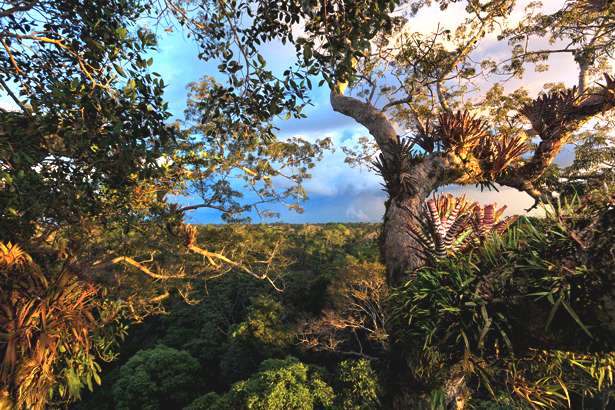
The quest to maintain cheap energy to sustain the unsustainable, has led to a fight between Petroamazonas and the Kichwa tribe in the Amazonian forests of Ecuador.
This superb Amazonian rainforest is under threat from greedy oil companies. Mari Muench and shaman Patricio Jipa
Gold and silver axe, 3rd-2nd millennium BC
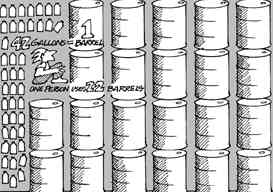
HOW MANY BARRELS OF OIL DOES YOUR FAMILY USE?
1. Display the graphic that one barrel = 42 gallons. Begin by explaining that all of the energy used by a person each year can be expressed in oil equivalents. Experts tell us that in the United States, on average, a person consumes twenty-two barrels each year. Write the formula on the board that each person uses twenty-two barrels of oil each year.
2. Have each student calculate how many barrels of oil his/her family consumes each year based on the number of people in the family.
3. How many barrels are used by the whole class together? The whole school? The whole town? The state? Have the students compare their family's, class', school's or town's energy consumption to the 11 million gallons spilled in Alaska. Use the formula of one barrel=forty-two gallons to figure how many barrels of oil were spilled in Alaska. (11,000,000 gallons by the Exxon Valdez.)
4. How many years would it take your family/class/school/town to use 11 million gallons of oil?
5. Discuss ways that students can reduce their oil consumption. (Turn down the heat, walk to school, improve housing insulation.)
Oil and Plastic
Generate a list with the class of all of the ways they use oil in their everyday life. Plastics and polyester-based fabrics (including the ever popular "fleece") are also oil-based products. Add to the list all of the ways students use plastic materials every day, and suddenly the list becomes quite long. Oil Embargo
What happens when there is no oil? Have students investigate the oil crisis of the 1970s. Have them look into the politics that caused the embargo. A number of environmental policies were implemented because of the necessity of limiting the amount of oil each consumer used. What were some of these policies and how do we see their lasting effects today, twenty years later?
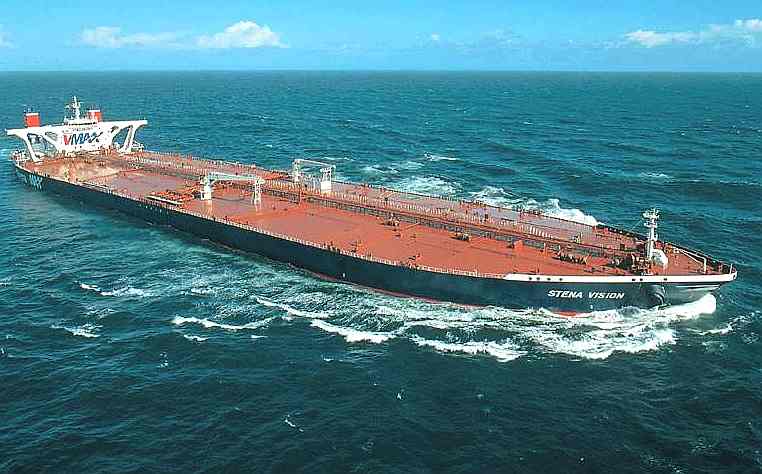
VLCC Stenna Vision
HOW BIG IS AN OIL TANKER?
To carry a large amount of oil, tankers are designed to be quite large. The Exxon Valdez was considered a midsized oil tanker measuring 967 feet long and 166 feet wide. In comparison, the largest tanker in the world, the Jahre Viking, formally known as the Seawise Giant, is 1504 feet long and 226 feet wide. These vessels are so large that crew members often use bicycles to travel from one point to another on the ship.
By measuring an average size oil tanker, such as the Exxon Valdez, students will have a much better understanding of how large a typical oil tanker is. In addition, the students will be asked to sketch a scale drawing of a typical oil tanker. Get a sense of the size of an oil tanker
1. Ask students to share any knowledge they have about oil spills in the news.
2. Discuss the length of a medium-sized tanker like the Exxon Valdez.
3. Measure the size of the Exxon Valdez outside your school and mark its size on the pavement to show to other students. Ask students to brainstorm various possible measuring strategies.
4. Using a tape measure, mark off a 50-foot or 100-foot piece of string or rope. Students simply lay the string down, making sure to accurately mark and record the number of times they step and repeat. As an example, using a 100-foot length, it would be necessary to step and repeat 10 times to lay out the distance of 1,000 feet.
5. Students can also measure the distance of their average stride. As an example, the stride of an adult is close to 3 feet. Knowing this, it is easy to estimate distances by counting the number of strides needed to cover a certain distance and multiply the number of strides by three (3 feet per stride). Allow students the opportunity to determine their stride and then check for accuracy with a predetermined distance.
6. With the outside work complete, distribute a piece of graph paper (8 1/2" x 11") to students and ask them to determine the scale which would allow for the Exxon Valdez to be sketched on the graph paper. An appropriate scale, assuming that you are using 1/4" grid paper, would be to have each square equal 25 feet. See if the students can determine the scale for themselves first. The Oil Tanker Run
The largest oil tanker in the world, the Jahre Viking, is 1504 feet long. Assuming you could run a mile in four minutes, how long would it take you to run from one end of the Jahre Viking to the other end? (5,280 feet/mile)
The 50-yard dash is a popular event in school track and field events. How many 50-yard dashes, placed end to end, would be needed to represent the entire length of the Jahre Viking?
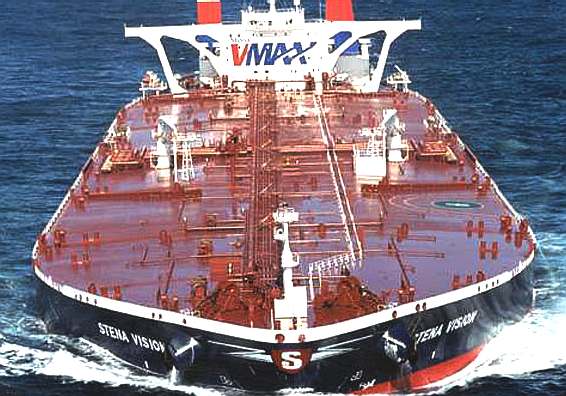
VLCC Stenna Vision's bows
SHIPPING RELATED LINKS
Baltic and International Maritime Council Australian Maritime Safety Authority Maritime and Coastguard Agency Maritime History and Naval Heritage Homepage Maritime Schools Pacific Maritime Group PORT - Maritime Information Gateway The International Maritime Organisation The Maritime History Virtual Archives The Maritime Museum of the Atlantic The Mother of All Maritime Links Welcome to Maritime Global Net
CONSERVATION LINKS
http://www.zmescience.com/ecology/environmental-issues/quechua-people-oil-exploitation-16012013/
MONEY FINDER
They never found Blackbeard's hidden treasure, but now they have a map and have hired John Storm's boat to get then to the Island, through a raging war.
|
|||
|
This website is copyright © 1991- 2013 Electrick Publications. All rights reserved. The bird logo and names Solar Navigator and Blueplanet Ecostar are trademarks ™. The Blueplanet vehicle configuration is registered ®. All other trademarks hereby acknowledged and please note that this project should not be confused with the Australian: 'World Solar Challenge'™which is a superb road vehicle endurance race from Darwin to Adelaide. Max Energy Limited is an educational charity working hard to promote world peace.
|
|||
|
AUTOMOTIVE | BLUEPLANET BE3 | ELECTRIC CARS | ELECTRIC CYCLES | SOLAR CARS | SOLARNAVIGATOR |