|
BROWN BEAR
|
||||||||||||||||||||||||||||||||||||||||||||||||
|
The Brown Bear (Ursus arctos) is a species of bear that can reach masses of 130–700 kg (290–1550 pounds). The Grizzly Bear (Ursus arctos horribilis), the Kodiak Bear and the Mexican Brown Bear are North American subspecies of the Brown Bear. It is sometimes referred to poetically as the bruin.
Brown Bear rearing
Appearance
Brown Bears have furry coats in shades of blonde, brown, black, or a combination of those colors; the long outer guard hairs are often tipped with white or silver, giving a "grizzled" appearance. Brown bears have a large hump of muscle over their shoulders which give strength to the forelimbs for digging. Their forearms end in massive paws tipped with extremely powerful claws that can be up to 15 cm (5.9 inches) in length. Unlike the claws of other large predatory animals, such as lions or tigers, the claws are not retractable. This gives the claws a dull edge when compared to other predators.
Despite the relatively dull edges to their claws, the sheer force of a blow from a large specimen is devastating. However, these claws are mainly used for digging, not for hunting. It uses its sharp canine teeth for neck-biting its prey when hunting. Bears use the same technique as tigers when hunting: they ambush their prey. Their heads are large and round with a concave facial profile. In spite of their size, some have been clocked at speeds in excess of 56 km/h (35 mph). Along with their strength and deceptive speed, Brown Bears are legendary for their physical stamina. They are capable of running at full speed for miles at a time without stopping. The largest subspecies of the Brown Bear are the Kodiak Bear and Alaskan Coastal Bear. Some exceptionally large male Kodiak stand over 3 m (10 feet) in height while on their hind legs, and weigh over 680 kg (1,500 lb).
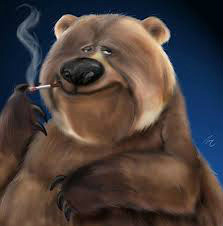
Smokey the bear says it’s time to take control of your life. As an ex-smoker he knows how hard it is to quit. Smoke-e can help you to quit and while doing so protect your health and your pocket.
LINKS and REFERENCE
Bear Facts. Polar Bears International. Brown Bear images from British Columbia, Alaska and Yellowstone. Endangered Species Act Listing Process for Polar Bears Underway. Center for Biological Diversity. Retrieved on 2006-07-28. T. Appenzeller nad D. R. Dimick, "The Heat is On," National Geographic 206 (2004): 2-75. cited in Flannery, Tim (2005). The Weather Makers. Toronto, Ontario: HarperCollins. ISBN 978000200751, 101-103. Guinness World Records, Guinness World Records 2006, Guinness (August 15, 2005), "Heaviest carnivores - world record holder", Guiness Book of World Records, p. 477. Wildfacts - Polar bear. BBC. Gunderson, A. 2002. "Ursus maritimus" (On-line), Animal Diversity Web. http://animaldiversity.html. Natural history. Center for Biological Diversity (2005-02-15). Polar Bear FAQ. Polar Bears International. http://www.itis.usda.gov/servlet/ http://www.itis.usda.gov/servlet/SingleRpt/ Iredale, Will, "Polar bears drown as ice shelf melts", The Sunday Times, 2005 Bear Specialist Group (1996). Ursus arctos. 2006 IUCN Red List of Threatened Species. IUCN 2006. Retrieved on 12 May 2006. Bear Attacks: Their Causes and Avoidance, Stephen Herrero, revised edition, 2002. Bears of the World, Terry Domico, Photographs by Terry Domico and Mark Newman, Facts on File, Inc, 1988, hardcover, ISBN 0816015368 Arctic Dreams, Barry Lopez, Macmillan 1986, hardcover, ISBN 0-333-42244-9 ARKive - images and movies of the polar bear (Ursus maritimus) Polar Bears turn green in Singapore, a BBC News report Polar Bears International, a Polar Bear conservation group The WWF Polar Bear Tracker, follow Polar Bears on Svalbard as they are tracked by satellite. Polar Cam, live video of the Polar Bear exhibit at the San Diego Zoo. Online daily between 09:00 – 16:00 UTC-8 (or UTC-7 during Daylight saving time) The Polar Bear Cam, live video and images from the Polar Bear migration near Churchill, Canada. Online during October and November only. Video of Polar Bears on YouTube Pictures of Polar Bears on the island of Spitsbergen CBC News article on possible "grolar bear" (Polar Bear/Grizzly Bear hybrid) Folly to predict polar bears' fate — Toronto Star, May 3, 2006 List the Polar Bear as a Threatened Species under the Endangered Species Act Starving polar bears shame Bush to act Global warming has U.S. rethinking polar bear status The Polar Bear and the Global Warming http://www.smoke-e-bear.co.uk/322980684
POPULAR MAMMALS:
John
Storm and Kulo Luna $billion dollar whale
When
a pirate whaler kills a small humpback whale, a larger whale sinks
the pirate ship to avenge the death, but is itself wounded.....
Please
use the Index below to navigate the Animal Kingdom:-
AMPHIBIANS Such
as frogs (class: Amphibia) ANNELIDS As
in Earthworms (phyla: Annelida) Neanderthals,
Homo Erectus (Extinct) Spiders
(class: Arachnida) BIRDS Such
as Eagles, Albatross
(class: Aves) CRUSTACEANS such
as crabs (subphyla: Crustacea) Tyranosaurus
Rex,
Brontosaurus (Extinct) ECHINODERMS As
in Starfish (phyla: Echinodermata) Sharks,
Tuna (group: Pisces) HUMANS
-
MAN Homo
Sapiens THE
BRAIN INSECTS Ants,
(subphyla: Uniramia class: Insecta) Which
includes PLANTS
non- animal life Warm
blooded animals (class: Mammalia) MARSUPIALS Such
as Kangaroos
(order: Marsupialia) MOLLUSKS Such
as octopus (phyla: Mollusca) Trees
- PRIMATES Gorillas,
Chimpanzees
(order: Primates) As
in Crocodiles,
Snakes (class: Reptilia) RODENTS such
as Rats, Mice (order: Rodentia) SIMPLE
LIFE FORMS As
in Amoeba, plankton (phyla: protozoa) LINKS http://www.imdb.com/title/tt1430132/ http://en.wikipedia.org/wiki/Wolverine http://en.wikipedia.org/wiki/Wolverine_%28comics%29 http://www.thewolverinemovie.com/ http://www.youtube.com/watch?v=g7kdUy5_WlI A
taste for adventure capitalists
Solar
Cola - a healthier alternative
|
||||||||||||||||||||||||||||||||||||||||||||||||
|
This website is Copyright © 1999 & 2014 Max Energy Limited an educational charity working hard for world peace. The bird logos and names Solar Navigator, Blueplanet Ecostar and Utopia Tristar are trademarks. All rights reserved. All other trademarks are hereby acknowledged.
|