|
HOMOSEXUALITY
|
||||||||||||||||||||||||||||||||||||||||||||||||||||||||||
|
HOME | BIOLOGY | FILMS | GEOGRAPHY | HISTORY | INDEX | INVESTORS | MUSIC | NEWS | SOLAR BOATS | SPORT |
||||||||||||||||||||||||||||||||||||||||||||||||||||||||||
Homosexuality is a sexual orientation and it is defined as sexual interaction and/or romantic attraction between individuals of the same sex. In modern use, the adjective homosexual is used for intimate relationships and/or sexual relations between people of the same sex, who may or may not identify themselves as gay or lesbian. Homosexuality, as an identifier, is usually contrasted with heterosexuality and bisexuality. The term gay is used predominantly to refer to self-identified homosexual people of either sex. Lesbian is a gender-specific term that is only used for self-identified homosexual females.
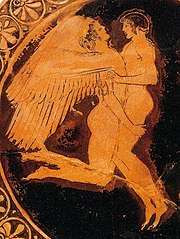
Zephyrus
and Hyacinthus 480 BC (Boston Museum of Fine Arts)
Erotic love and sexual expression between individuals of the same sex has been a feature of most known cultures since earliest history (see Homosexual relations through history below). However, it was not until the 19th century that such acts and relationships were seen as indicative of a type of person with a defined and relatively stable sexual orientation. The first recorded use of the word Homosexual was in 1869 by Karl-Maria Kertbeny, with Richard Freiherr von Krafft-Ebing's 1886 book Psychopathia Sexualis popularizing the concept.
In the years since Krafft-Ebing, homosexuality has become a subject of considerable study and debate. Originally viewed as a pathology to be cured, it is now more often investigated as part of a larger project to understand the biology, psychology, politics, genetics, history and cultural variations of sexual practice and identity. The legal and social status of people who perform homosexual acts or identify as gay or lesbian varies enormously across the world and remains hotly contested.
Etymology and usage
The word homosexual is predominantly used as an adjective, describing behavior, relationships, people, etc. Many object to its use as a noun. The adjectival form literally means “same sex”, being a hybrid formed from the Greek prefix homo – , which means “same”, and the Latin root sex – , which means “sex” or "gender". Its first known appearance in print is found in an 1869 German pamphlet by the Austrian-born novelist Karl-Maria Kertbeny, published anonymously. The prevalence of the concept owes much to the work of the German psychiatrist Richard Freiherr von Krafft-Ebing and his 1886 work Psychopathia Sexualis. As such, the current use of the term has its roots in the broader 19th century tradition of personality taxonomy. These continue to influence the development of the modern concept of sexual orientation, gaining associations with romantic love and identity in addition to its original, exclusively sexual meaning.
The adjective homosexual can be used to describe individuals' sexual orientation, sexual history, or self-identification. Many people reject all usage of "homosexual" as too clinical and dehumanizing, as the word only refers to one's sexual behavior, and does not refer to non-sexual romantic feelings. As a result, the terms gay and lesbian are usually preferred when discussing a person of this sexual orientation, whose sexual history is predominated by this behavior, or who identifies as such. The first letters are frequently combined to create the acronym LGBT (which is also written as GLBT), in which B and T refer to bisexuals and transgender individuals. A smaller number of same-sex oriented people personally prefer the adjective "homosexual" rather than "gay", as they may perceive the former as describing a sexual orientation and the latter as describing a cultural or socio-political group with which they do not identify.
Although early writers also used the adjective homosexual to refer to any single-gender context (such as an all-girls' school), today the term is used exclusively in reference to sexual attraction and activity. The term homosocial is now used to describe single-sex contexts that are not specifically sexual. There is also a word referring to same-sex love, homophilia.
New terms are arising for use in situations where specificity is important. For example, men who have sex with men, or MSM for short, is sometimes used in the medical community when specifically discussing sexual behavior (regardless of sexual orientation or self-identification). Same-sex attraction focuses on spontaneous feeling, but de-emphasizes identification with a demographic or cultural group, and also leaves open the possibility for co-existing opposite-sex attraction. Homoerotic is a synonym for same-sex attraction that is used to refer both to personal feelings and works of art. Non-straight is another attempt at neutrality that is gaining currency. Some other terms are now becoming more prevalent, including heteroflexible to refer to a person who identifies as heterosexual, but occasionally engages in same-sex sexual activities, or metrosexual to denote a straight man with stereotypically gay tastes in food, fashion and design.
A variety of negative terms also exist. Many of these, including words like queer and faggot, have been "reclaimed" as positive words by those against whom they were initially used.
Academic study
The manifestation of sexual orientation is subject to a considerable variability. Thus it is common for homosexual individuals in heteronormative societies to love, marry, and have children with individuals of the opposite sex, a practice that may be done primarily for social reasons in societies which reject same-sex relations, as a cover for one's orientation (such relationships are known as "beards"). These adaptations are forms of situational sexual behavior. Also some people of either sex want to pass their genes on and have children. Homosexual men or women may marry for that reason. Lesbian women may want a child through artificial insemination.
A further, and extremely common, manifestation of situational sexual behavior involving homosexual acts is seen in prisons where individuals can only meet members of their own sex for long periods of time.
Anthropology
Forms
Scholars who study the social construction of homosexuality, investigate the various forms that same-sex relationships have taken in different societies, and look for patterns as well as differences. Their work suggests that the concept of homosexuality would best be rendered as "homosexualities." Anthropologists group these socio-historical variations into three separate categories:
Gender-structured and age-structured homosexuality typically involve one partner adopting a "passive" and the other an "active" role to a much greater degree than in egalitarian relationships. Among men, being the passive partner often means receiving semen, i.e. performing fellatio or being the receptive partner during anal sex. This is sometimes interpreted as an emphasis on the sexual pleasure of the active partner, although this is disputed. For example, in gender-structured female homosexuality in Thailand, active partners (toms) emphasize the sexual pleasure of the passive partner (dee), and often refuse to allow their dee to pleasure them, while in ancient Greece the pederastic tradition was seen as engendering strong friendships between the partners, and was blamed for predisposing males to continue seeking the "passive" pleasures they experienced as adolescents even after they matured.
Some anthropologists have argued for the existence of a fourth type of homosexuality, class-structured homosexuality, but many scholars believe that this has no independent existence from the other three types.
Usually in any society one form of homosexuality predominates, though others are likely to co-exist. As historian Rictor Norton points out in his Intergenerational and Egalitarian Models, in Ancient Greece egalitarian relationships co-existed (albeit less privileged) with the institution of pederasty, and fascination with adolescents can also be found in modern sexuality, both heterosexual and homosexual. Egalitarian homosexuality is becoming the principal form practiced in the Western world, while age- and gender-structured homosexuality are becoming less common. As a byproduct of growing Western cultural dominance, this egalitarian homosexuality is spreading from western culture to non-Western societies, although there are still defined differences between the various cultures.
Incidence
Estimates of the modern prevalence of homosexuality vary considerably. They are complicated by differing or even ambiguous definitions of homosexuality, and by fluctuations over time and according to location.
It is important to note, however, that these numbers are subject to many of the pitfalls inherent in researching sensitive social issues. For example, because of the stigma associated with homosexuality, survey results will be biased downward by under-reporting. The frequent use of non-random samples in many studies could also serve to skew the data.
In general, most research agrees that the number of people who have had multiple same-gender sexual experiences is fewer than the number of people who have had a single such experience, and that the number of people who identify themselves as exclusively homosexual is fewer than the number of people who have had multiple homosexual experiences.
The then controversial Kinsey Reports of 1948 found that 37% of males had had some sexual experience with other men, and that 4% had always been exclusively homosexual. Among women, Kinsey found between 2% and 6% had "more or less exclusively" homosexual experience.
In the United States during the 2004 elections, exit polls indicated 4% of all voters self-identified as gay or lesbian. However, due to societal pressures, many who are homosexual may not be willing to identify as such.
In Canada, a 2003 report by Statistics Canada indicated that among Canadians aged 18 to 59, 1% reported that they are homosexual, and 0.7% reported to be bisexual. At the same time, a Global Sex Survey by Durex for 2005 reports that 19% of Canadians claim to have had a homosexual experience, along with 20% of Americans.
In North Africa, the Middle East and Central Asia, where gender- or age-structured relationships are the rule, homosexual practices among men are reported to be widespread, engaged in by many individuals who do not regard themselves as homosexual.
Biology
Prenatal hormonal theory
The neurobiology of the masculinization of the brain is fairly well understood. Estradiol, and testosterone, which is catalyzed by the enzyme 5α-reductase into dihydrotestosterone, act upon androgen receptors in the brain to masculinize it. If there are few androgen receptors (people with Androgen insensitivity syndrome) or too much androgen (females with Congenital adrenal hyperplasia) there can be physical and psychological effects. It has been suggested that both male and female homosexuality are results of variation in this process. In these studies lesbianism is typically linked with a higher amount of masculinization than is found in heterosexual females, though when dealing with male homosexuality there are results supporting both higher and lower degrees of masculinization than heterosexual males.
Physiological differences in homosexual people
Simon LeVay
Several recent studies, including pioneering work by neuroscientist Simon LeVay, demonstrate that there are notable differences between the physiology of a heterosexual male and a homosexual male. These differences are primarily noted in the brain, inner ear and olfactory sense. LeVay discovered in his double-blind experiment that the average size of the INAH-3 in the brains of homosexual men was significantly smaller than the average size in heterosexual male brains. Some people have interpreted this as showing that some people are born homosexual; however, in LeVay's own words:
LeVay's work has come under criticism for not taking into account the fact that all of the brains of homosexual men he studied were from homosexual men who had died of AIDS, which was not equally true of the heterosexuals whose brains he studied. However, when comparisons were made of the INAH-3 measurements in only the brains of those in each group who died from complications due to AIDS (albeit a small sample), similar size differences were found. It should also be noted that, currently, no evidence has been found to suggest that HIV or the effects of AIDS would result in changes in INAH-3 size.
To date, no analogous result has been found in women's brains.
Other studies
Some recent studies have tied a correlation between the number of older brothers a man has and his likelihood of being homosexual reported that each older brother increases the odds of being gay by 33%. This is now "one of the most reliable epidemiological variables ever identified in the study of sexual orientation." To explain this finding, it has been proposed that male fetuses provoke a maternal immune reaction that becomes stronger with each successive male fetus. Male fetuses produce H-Y antigens which are "almost certainly" involved in the sexual differentiation of vertebrates. It is this antigen which maternal H-Y antibodies are proposed to both react to and 'remember.' Successive male fetuses are then attacked by H-Y antibodies which somehow decrease the ability of H-Y antigens to perform their usual function in brain masculinization. This is now known as the fraternal birth order effect. In a study comparing the effects of being raised with older "brothers" and having biological older brothers, published July 26, 2006 in PNAS, Bogaert found that there was a link to homosexuality only if the older brothers were biologically related and even when they were not raised together. Interestingly, this relation seems to hold only for right-handed males. There has been no observable equivalent for women.
Squawk
and Milou
Homosexual behavior in animals
Homosexual behavior does occur in the animal kingdom, especially in social species, particularly in marine birds and mammals, monkeys and the great apes. Homosexual behavior has been observed among 1,500 species, and in 500 of those it is well documented. Georgetown University professor Janet Mann has specifically theorized that homosexual behavior, at least in dolphins, is an evolutionary advantage that minimizes intraspecies aggression, especially among males.
Psychology
Behavioral Studies
At the beginning of the 20th century, early theoretical discussions in the field of psychoanalysis posited original bisexuality in human psychological development. Quantitative studies by Alfred Kinsey in the 1940s and Dr. Fritz Klein's sexual orientation grid in the 1980s find distributions similar to those postulated by their predecessors.
Many modern studies, most notably Sexual Behavior in the Human Male and Sexual Behavior in the Human Female by Alfred Kinsey, have found that the majority of humans have had homosexual experiences or sensations and are bisexual. Contemporary scientific research suggests that the majority of the human population is bisexual, adhering to a fluid sexual scale rather than a category, as Western society typically views sexual nature. The Kinsey Reports found that approximately four percent of adult Americans were exclusively homosexual for their entire lives, and approximately 10 percent were homosexual in their behavior for some portion of their lives. Conversely, an even smaller minority of people appear to have had equal sexual experiences with both genders indicating an attraction scale or continuum. However, social pressures influence people to adhere to categories or labels rather than behave in a manner that more closely resembles their nature as suggested by this research.
Kinsey himself, along with current LGBT activist groups, focus on the historicity and fluidity of sexual orientation. Kinsey's studies consistently found sexual orientation to be something that evolves in many directions over a person's lifetime, not necessarily including forming attractions to a new gender. Rarely do individuals radically reorient their sexualities rapidly — and still less do they do so volitionally — but often sexualities expand, shift, and absorb new elements over decades. For example, socially normative "age-appropriate" sexuality requires a shifting object of attraction (especially in the passage through adolescence). Contemporary queer theory, incorporating many ideas from social constructionism, tends to look at sexuality as something that has meaning only within a given historical framework. Sexuality, then, is seen as a participation in a larger social discourse, and, though in some sense fluid, not as something strictly determinable by the individual.
Most sexual orientation specialists follow the general conclusion of Alfred Kinsey regarding the sexual continuum, according to which a minority of humans are exclusively homosexual or heterosexual, and that the majority are bisexual. The consensus of psychologists is that sexual orientation, in most individuals, is shaped at an early age; and is not voluntarily changeable.
Other studies have disputed Kinsey's methodology and have suggested that these reports overstated the occurrence of bisexuality and homosexuality in human populations. "His figures were undermined when it was revealed that he had disproportionately interviewed homosexuals and prisoners (many sex offenders)."
However, Kinsey's idea of a sexuality continuum still enjoys acceptance today and is supported by findings in the human and animal kingdoms including biological studies of structural brain differences between those belonging to different sexual orientations.
More modern and precise research Sex in America: A definitive survey (1995) is now available from NORC and the University of Chicago by Edward O. Laumann, University of Chicago. "Results reported from the study, and included in The Social Organization of Sexuality, include those related to sexual practices and sexual relationships, number of partners, the rate of homosexuality in the population (which the study reported to be 1.3% for women within the past year, and 4.1% since 18 years; for men, 2.7% within the past year, and 4.9% since 18 years).
Sexologists have attributed discrepancies in some findings to negative societal attitudes towards a particular sexual orientation. For example, people may state different sexual orientations depending on whether their immediate social environment is public or private. Reluctance to disclose one's actual sexual orientation is often referred to as "being in the closet". Individuals capable of enjoyable sexual relations with both sexes may feel inclined to restrict themselves to heterosexual or homosexual relations in societies that stigmatize same-sex or opposite-sex relations.
Although the concept of three basic sexual orientations is widely recognized, a small minority maintain that there are other legitimate sexual orientations besides homosexuality, bisexuality and heterosexuality. These may include significant or exclusive orientation towards a particular type of transsexual or transgender individual (e.g. female-to-male transsexual men), intersexed individuals, or those who identify as non-gendered or other-gendered.
Father-son Relationships and Male Sexual Development
Investigation into parent-child relations of homosexual and heterosexual men is heavily documented in research literature, and a link between the absence of sufficient bonding with same-sex parent or role models and the development of adult male homosexuality has been proposed. Numerous studies have found that adult homosexual males tend to report having had less loving and more rejecting fathers than their heterosexual peers (Bell, Weinberg, & Parks, 1981; Bieber et al., 1962; Braatan & Darling, 1965; Brown, 1963; Evans, 1969; Jonas, 1944; Millic & Crowne, 1986; Nicolosi, 1991; Phelan, 1993; Biggio, 1973; Siegelman, 1974; Snortum, 1969; Socarides, 1978; West, 1959).
Bieber (1976) stated:
Bieber (1976) later expanded and clarified his earlier findings by saying:
These reports have been criticized, particularly for confusing cause and effect. In other words, a tendency for gay males to bond more with their mothers than their fathers may be the result of homosexuality rather than the cause. The American Psychological Association has also criticized such reports, noting that the percentage of homosexual people is relatively constant across cultures, which is not what one would expect if parental influence were significant. The theory also fails to explain why homosexual acts were accepted among males in ancient Greece, pre-modern Japan, and other cultures, or why animals exhibit homosexuality.
Nature versus nurture
Considerable debate exists over whether predominantly biological or psychological factors produce sexual orientation in humans. Candidate factors include genes and the exposure of fetuses to certain hormones (or lack thereof). Historically, Freud and many other psychologists, particularly in the psychoanalytic or developmental traditions, speculated that formative childhood experiences helped produce sexual orientation; as an example Freud believed that all human teenagers are predominantly homosexual and transition to heterosexuality in adulthood; those who remain homosexual as adults he believed had experienced some traumatic event that arrested their sexual development; however, he did believe all adults, even those who had healthy sexual development still retained latent homosexuality to varying degrees. Although there is currently no general medical consensus, one theory is that biological factors — whether genetic or acquired in utero — produce characteristically homosexual childhood experiences (such as atypical gender behavior experiences), or at the least significantly contribute to them.
Critique of studies
The studies performed in order to find the origin of sexual orientation have been criticized for being too limited in scope, mostly for focusing only on heterosexuality and homosexuality as two diametrically opposite poles with no orientation in between.
It is also asserted that scientific studies focus too much on the search for a biological explanation for sexual orientation, and not enough on the combined effects of both biology and psychology.
In a brief put forth by the Council for Responsible Genetics, they review studies done so far and conclude that the evidence that sexual orientation is fixed at birth, is inconclusive. On the discourse over sexual orientation: "Noticeably missing from this debate is the notion, championed by Kinsey, that human sexual expression is as variable among people as many other complex traits. Yet just like intelligence, sexuality is a complex human feature that modern science is attempting to explain with genetics... Rather than determining that this results from purely biological processes, a trait evolves from developmental processes that include both biological and social elements. In addition, scientists rarely take into consideration sexual preferences that are not described by the two poles heterosexual and homosexual, 'in hopes of maximizing the chance that they will find something of interest.'"
Behavior modification
Homosexuality was officially removed as a disorder from the DSM in 1974 (although a category of "sexual orientation disturbance" and then "ego-dystonic homosexuality" remained for another 14 years). Homosexuality is no longer generally regarded as a mental illness or as needing "treatment", and there are also moves to delete "Gender Identity Disorder" from the DSM-IV Most mainstream medical and psychological organizations will not perform psychotherapy to change sexual orientation as they consider it ineffective and potentially harmful.
Nevertheless, a number of groups, particularly religious ones, continue to promulgate the view that homosexuality is a defective behavioral condition which can be corrected with behavioral conditioning. Reparative therapy is a form of aversion therapy aimed at the elimination of homosexual attractions and is employed by people who claim that homosexuality is a disorder or a sin; this has in the past involved such methods as shock treatment with the electrodes hooked up to a man's testicles, drugs used to induce physical illness while the subject is being shown pictures of naked men, and the administration of Metrazol to induce convulsions. It should be noted that no such "treatments" will be performed by credible psychotherapists that practice in the United States, as this would be a breach of the APA's code of conduct and ethics.. More modern reparative therapy organizations such as NARTH neither practice nor condone such techniques. A "transformational ministry" claims that homosexual behavior is essentially a sin that can be overcome through a religious approach employing repentance and faith.
According to the group Ontario Consultants on Religious Tolerance, many groups that practice "conversion therapies" claim high success rates, in some cases as high as 70%. These studies are not presented to peer groups for evaluation and often lack much data when published. When these claims are investigated by means of scientific studies based on available data, they actually have a success rate of only 0.4 to 0.6% (statistically zero).
Supporters of behavior modification point to people who claim to have experienced success.Conservative groups point to critique papers such as the one written by the Council for Responsible Genetics that sexuality may not be predetermined either way. However, most of this evidence is anecdotal, being based on testimonies by ministry participants, and to the neglect of the scientific method.
Today, the belief that homosexuality can be altered is most strongly promoted by the so-called ex-gay movement among American Evangelical Christians.
mural of a female couple kissing on the CCSF student union in San Francisco
Homosexuality and society
Societal attitudes towards same-sex relationships, reflected in the attitude of the general population, the state and the church, have varied over the centuries, and from place to place, from expecting and requiring all males to engage in relationships, to casual integration, through acceptance, to seeing the practice as a minor sin, repressing it through law enforcement and judicial mechanisms, to proscribing it under penalty of death.
Most nations do not impede consensual sex between unrelated individuals above the local age of consent. Some jurisdictions further recognize identical rights, protections, and privileges for the family structures of same-sex couples, including marriage. Some nations mandate that all individuals restrict themselves to heterosexual relationships — that is, in some jurisdictions homosexuality is illegal. Offenders face up to the death penalty in some fundamentalist Muslim areas such as Iran and parts of Nigeria. There are, however, often significant differences between official policy and real-world enforcement. See Violence against gays, lesbians, bisexuals, and the transgendered.
Coming out
Many people who feel attracted to members of their own sex have a so-called coming out at some point in their lives. Generally, coming out is described in two phases. The first phase is the phase of "knowing oneself," and the realization or decision emerges that one is open to same-sex relations. This is often described as an internal coming out. The second phase involves one's decision to come out to others, e.g. family, friends, and/or colleagues. This occurs with many people as early as age 11, but others do not clarify their sexual orientation until age 40 or older. Most have their coming out during school age, so sometime during the time of puberty. At this age, they may not trust or ask for help from others, especially when their orientation is not accepted in society. Sometimes their own parents are not even informed.
Suicide rates
Coming out can sometimes lead to a life crisis, which can elevate to suicidal thoughts or even committing suicide. Crisis centers in larger cities and information sites on the Internet can help these people to accept their homosexuality. In the United States, the attempted suicide rate is sixteen times higher among male gay youth (aged seventeen) who display homosexual tendencies than their heterosexual peers. Among twenty-year-old men, the attempted suicide rate is thirteen times higher; among 25-year-old men, it is six times higher. Attempted suicide among lesbians is also elevated compared to heterosexual women, about two times higher. Many resource groups offer suicide counseling, hotlines and other ways to help.
Sexual practices
Homosexual men obtain physical pleasure in a number of different ways. One scheme breaks these down into four categories: mutual masturbation, full body (including intercrural sex), oral genital and anal. Physical relationships begin with various forms of foreplay such as fondling, caressing, and kissing, and eventually can progress to one of the four forms of fulfillment mentioned above.
Mutual masturbation, intercrural sex and fellatio are the most popular sexual practices, in that order. In the United Kingdom in the late nineteen sixties it was assumed that no more than about 15% of practicing homosexual men took part in anal sex, a figure thought to be equal to or lower than that of heterosexual couples practicing the same technique, often for purposes of birth control.
The range of homosexual female practices can include tribadism, mutual masturbation, oral genital, annilingus, fisting and the use of sex toys for vaginal or oral penetration or clitoral stimulation.
Modern law
In most developed countries, same-sex relationships are accepted, and are accorded legal protection. Many governments have established formal structures for confirming legal relationships (either as marriage or partnership) between people of the same sex. For example, the Supreme Court of Canada, citing the Charter of Rights and Freedoms, established that the Government could allow same-sex marriage on the basis of human rights, which it then did when Bill C-38 received Royal Assent on July 20, 2005.
Some people argue for legal recognition and social acceptance of same-sex relationships, believing that homosexuality is an inborn trait; yet it is difficult for others who believe that homosexuality is a choice to change their moral stance on homosexuality. Some religious groups fear the slippery slope effect, arguing that same-sex tolerance is a step toward tolerance of other currently unaccepted practices such as polygamy and incest. Other religious-minded people believe that same-sex relationships are incompatible with their religious beliefs and world view. Some attempt to use state-sanctioned punitive measures to discourage homosexuality, short of death or imprisonment. This includes attempts to rescind domestic partnership benefits through anti-gay-marriage initiatives with broad language.
In some cultures homosexuality is still considered "unnatural" and is outlawed. In some Muslim nations (such as Iran) it remains a capital crime, as well as in some African countries. For example, two teenagers, Mahmoud Asgari and Ayaz Marhoni, were executed in Iran in 2005 reportedly because they had been caught having sex with each other, although the Iranian government maintains the conduct involved rape; the details of the event, including the allegations of the government, remain under dispute, particularly in the West.
Understudied phenomenon
Despite the emollience of attitudes towards, and general acceptance of homosexuality in some societies, in psychology it is considered an 'understudied relationship'. In his book Understudied Relationships, social psychologist S.W. Duck found that most mainstream research is predisposed towards studying only heterosexuality, in terms of relationships in contemporary Western cultures, implying that same-sex relationships are neglected and ignored by the majority of psychologists. More research since the 1990s has focused on homosexual relationships.
Political aspects
Scapegoating
Homosexuality has at times been used as a scapegoat by governments facing problems. For example, during the early 14th century, accusations of homosexual behavior were instrumental in disbanding the Knights Templar under Philip IV of France, who profited greatly from confiscating the Templars' wealth. In the 20th century, Nazi Germany's persecution of homosexual people was based on the proposition that they posed a threat to "normal" masculinity as well as a risk of contamination to the "Aryan race".
In the 1950s, at the height of the red scare in the United States, hundreds of federal and state employees were fired because of their homosexuality in the so-called lavender scare. (Ironically, politicians opposed to the scare tactics of McCarthyism tried to discredit Senator Joseph McCarthy by hinting during a televised Congressional committee meeting that McCarthy's top aide, Roy Cohn, was homosexual, as he in fact was.)
A recent instance of scapegoating is the burning of 6,000 books of homoerotic poetry of 8th c. Persian-Arab poet Abu Nuwas by the Egyptian Ministry of Culture in January 2001, to placate Islamic fundamentalists.
Business and attitudes towards homosexuality
In some capitalist countries, large private sector firms often lead the way in the equal treatment of gay men and lesbians. For instance, as of June 2006, more than half of companies listed in the Fortune 500 offer domestic partner benefits and nine of the top ten companies include sexual orientation in their non-discrimination policies.
Military
In the ancient world
Some ancient societies, such as Greece and Japan, fostered erotic love bonds between experienced warriors and their apprentices. It was believed that a man and youth who were in love with each other would fight harder and with greater morale. A classic example of a military force built upon this belief is the Sacred Band of Thebes.
During the Middle Ages
The adoption of Christianity by the Roman Emperor Constantine in the fourth century and subsequent predominance of Christianity led to a diminished emphasis on erotic love among military forces. By the time of the Crusades, the military of Europe had largely switched gears, asserting that carnal relations between males were sinful and therefore had no place in an army that served their perception of God's will. The Knights Templar, a prominent military order, was destroyed by accusations (probably fabricated) of sodomy.
The Arab world and Asia, by contrast, did not adopt such strict views. A classic work of Middle Eastern literature known as The Book of One Thousand and One Nights (or Arabian Nights) documents several accounts of intimate relationships between men and boys. Artwork that has survived from this period documents such relationships in both cultures.
In modern times
The modern world has brought about a fundamental shift in the acceptance of homosexual behavior. Europe and North America have seen growing acceptance of homosexuality as a result of modern liberalism and the Gay Liberation movement. By contrast, many Middle Eastern and Central Asian countries have gone from tolerance to outright hostility. The only nation in the region with significantly different policies is Israel.
Attitudes world wide vary, from country to country and over time, with some countries — like the United Kingdom and the Netherlands — accepting openly homosexual individuals into the armed forces, and others — like the United States, and many nations in South America and the Caribbean — either quieting or discharging homosexual people. The United States is known for its “don't ask, don't tell” policy, which was seen as a compromise between acceptance and the tactics of marginalization and humiliation that had been used before. Most nations that adhere to the strict interpretation of Sharia (Islamic law) remove individuals from their armed forces who are believed to be homosexual, and may have them punished, tortured, or executed.
Religious views
The relationship between religion and homosexuality varies greatly across time and place, within and between different religions and sects, and regarding different forms of homosexuality and bisexuality. Groups not influenced by the Abrahamic religions have sometimes regarded homosexuality as sacred, while a negative view of homosexuality has been common in the Abrahamic religions. In the wake of colonialism and imperialism undertaken by countries of the Abrahamic faiths some cultures have adopted new attitudes antagonistic towards homosexuality. Currently, bodies and doctrines of the Abrahamic religions generally view homosexuality negatively, from quietly discouraging homosexual activity, to explicitly forbidding same-sex sexual practices among adherents and actively opposing social acceptance of homosexuality. Some teach that homosexual orientation itself is sinful, while others assert that only sodomy is a sin. Some have claimed that homosexuality can be overcome through religious faith and practice. No scientific studies have been undertaken on this matter.
Polemic
Same-sex love practices have been the subject of a continuing debate dating back at least to Classical Greece. In antiquity, and in countries not under the sway of Abrahamic beliefs, the debates usually took the form of debating which love is best, the love of women or the love of boys, unlike more recent discussions which frame the question in terms of "right" and "wrong."
Each camp has made use of a relatively circumscribed arsenal of arguments, some of which have not changed greatly over the past two and a half thousand years. Recent advances in sociological studies and other discourse such as queer theory have brought a measure of rigor to the debate.
For
Against
Same-sex love in pre-modern times
Sexual customs have varied greatly over time and from one region to another. These, as well as the orientation of particular pre-contemporary figures continue to be studied. Modern Western gay culture, largely a product of 19th century psychology as well as the years of post-Stonewall Gay Liberation, is a relatively recent manifestation of same-sex desire. It is generally not applicable as a standard when investigating same-gender sex and historical opinions and beliefs held by other people.
It is generally accepted that the lives of historical figures such as Socrates, Lord Byron, Edward II, Hadrian, Julius Caesar, Michelangelo, Donatello and Christopher Marlowe included or were centered upon love and sexual relationships with people of their own gender. Terms such as gay or bisexual have been applied to them, but many regard this as risking the anachronistic introduction of a contemporary construction of sexuality foreign to their times. Variations from modern standards of beauty, social roles, sexual positions, and age disparities are of such magnitude so as to render meaningless any projection of modern roles onto historical personages. This does not mean, however, that people in the past experienced the physical phenomenon of homosexual attraction any differently than people experience it today.
While some pre-modern societies did not employ categories fully comparable to the modern homosexual or heterosexual dichotomy, this does not demonstrate that the polarity is not applicable to those societies. A common thread of constructionist argument is that no one in antiquity or the Middle Ages experienced homosexuality as an exclusive, permanent, or defining mode of sexuality. John Boswell has criticized this argument by citing ancient Greek writings by Plato, which he says indicate knowledge of exclusive homosexuality.
Michel Foucault and historians following his line of thought have argued that the homosexual person is a modern invention, a social construct of the last 100 years. While true of homosexuality as a scientific or psychological category, there are examples from earlier ages of those viewing their sexuality as a part of a human identity and not merely a sexual act. One cited example is the 16th century Italian artist Giovanni Antonio Bazzi who adopted the nickname "Sodoma", which is viewed by Louis Crompton as something analogous to the modern gay identity.
Africa
Though often denied or ignored by European explorers, homosexual expression in native Africa was also present and took a variety of forms.
Americas
In North American Native society, the most common form of same-sex sexuality seems to centre around the figure of the Two-Spirit individual. Such people seem to have been recognized by the majority of tribes, each of which had its particular term for the role. Typically the two-spirit individual was recognized early in life, was given a choice by the parents to follow the path, and if the child accepted the role then the child was raised in the appropriate manner, learning the customs of the gender it had chosen. Two-spirit individuals were commonly shamans and were revered as having powers beyond those of ordinary shamans. Their sexual life would be with the ordinary tribe members of the opposite gender. Male two-spirit people were prized as wives because of their greater strength and ability to work.
East Asia
In Asia same-sex love has been known since the dawn of history. Early Western travelers were taken aback by its widespread acceptance and open display.
Homosexuality in China, known as the pleasures of the bitten peach, the cut sleeve, or the southern custom, has been recorded since approximately 600 BCE. These euphemistic terms were used to describe behaviors, but not identities (recently the Chinese society adapted the term "brokeback", 斷背 duanbei, due to the success of Chinese director Ang Lee's film Brokeback Mountain.). The relationships were marked by differences in age and social position. However, the instances of same-sex affection and sexual interactions described in the Hong Lou Meng (Dream of the Red Chamber, or Story of the Stone) seem as familiar to observers in the present as do equivalent stories of romances between heterosexuals during the same period.
Homosexuality in Japan, variously known as shudo or nanshoku, terms influenced by Chinese literature, has been documented for over one thousand years and was an integral part of Buddhist monastic life and the samurai tradition. This same-sex love culture gave rise to strong traditions of painting and literature documenting and celebrating such relationships.
Similarly, in Thailand, Kathoey, or "ladyboys," have been a feature of Thai society for many centuries, and Thai kings had male as well as female lovers. Kathoey are men who dress as women. They are generally accepted by society, and Thailand has never had legal prohibitions against homosexuality or homosexual behavior. The teachings of Buddhism, dominant in Thai society, were accepting of a third gender designation.
Roman man and youth in bed Dated ca. 30 AD (1st century), found in Estepa, Spain
Europe
The earliest western documents (in the form of literary works, art objects, as well as mythographic materials) concerning same-sex relationships are derived from ancient Greece. They depict a world in which relationships with women and relationships with youths were the essential foundation of a normal man's love life. Same-sex relationships were a social institution variously constructed over time and from one city to another. The practice, a system of relationships between an adult male and an adolescent coming of age, was often valued for its pedagogic benefits and as a means of population control, and occasionally blamed for causing disorder. Plato praised its benefits in his early writings, but in his late works proposed its prohibition.
In Rome, the pagan emperor Hadrian allegedly practiced homosexuality himself, but the Christian emperor Theodosius I decreed a law, on August 6th, 390, condemning passive homosexual people to be burned at the stake. Justinian, towards the end of his reign, expanded the proscription to the active partner as well (in 558) warning that such conduct can lead to the destruction of cities through the "wrath of God." Notwithstanding these regulations, taxes on brothels of boys available for homosexual sex continued to be collected until the end of the reign of Anastasius I in 518.
During the Renaissance, rich cities in northern Italy, Florence and Venice in particular, were renowned for their widespread practice of same-sex love, engaged in by a considerable part of the male population and constructed along the classical pattern of Greece and Rome. But even as the majority of the male population was engaging in same-sex relationships, the authorities, under the aegis of the Officers of the Night court, were prosecuting, fining, and imprisoning a good portion of that population. The eclipse of this period of relative artistic and erotic freedom was precipitated by the rise to power of the moralizing monk Girolamo Savonarola. In northern Europe the artistic discourse on sodomy was turned against its proponents by artists such as Rembrandt, who in his "Rape of Ganymede" no longer depicted Ganymede as a willing youth, but as a squalling baby attacked by a rapacious bird of prey.
The relationships of socially prominent figures, such as King James I and the Duke of Buckingham, served to highlight the issue, including in anonymously authored street pamphlets: "The world is chang'd I know not how, For men Kiss Men, not Women now;...Of J. the First and Buckingham: He, true it is, his Wives Embraces fled, To slabber his lov'd Ganimede;" (Mundus Foppensis, or The Fop Display'd, 1691.)
1723 in England saw publication of Love Letters Between a Certain Late Nobleman and the famous Mr Wilson., which some modern scholars presume to be a novel. The 1749 edition of John Cleland's popular novel Fanny Hill includes a homosexual scene, but this was removed in its 1750 edition. Also in 1749 the earliest extended and serious defense of homosexuality in English Ancient and Modern Pederasty Investigated and Exemplified, written by Thomas Cannon, was published, but was suppressed almost immediately. It includes the passage: ""Unnatural Desire is a Contradiction in Terms; downright Nonsense. Desire is an amatory Impulse of the inmost human Parts." Around 1785 Jeremy Bentham wrote another defense, but this was not published until 1978. Executions for sodomy continued in the Netherlands until 1803, and in England until 1835.
Between 1864 and 1880 Karl Heinrich Ulrichs published a series of twelve tracts, which he collectively titled Research on the Riddle of Man-Manly Love. In 1867 he became the first self-proclaimed homosexual person to speak out publicly in defense of homosexuality when he pleaded at the Congress of German Jurists in Munich for a resolution urging the repeal of anti-homosexual laws.
Sir Richard Francis Burton's Terminal Essay, Part IV/D appendix in his translation of The Book of the Thousand Nights and a Night (1885-6) provided an effusive overview of homosexuality in the middle east and tropics. Sexual Inversion by Havelock Ellis, published in 1896 challenged theories that homosexuality was abnormal, as well as stereotypes, and insisted on the ubiquity of homosexuality and its association with intellectual and artistic achievement. Appendix A included A Problem in Greek Ethics by John Addington Symonds, which had been privately distributed in 1883. Beginning in 1894 with Homogenic Love, Socialist activist and poet Edward Carpenter wrote a string of pro-homosexual articles and pamphlets, and 'came out' in 1916 in his book My Days and Dreams.
In 1900, Elisar von Kupffer published an anthology of homosexual literature from antiquity to his own time, Lieblingminne und Freundesliebe in der Weltliteratur. His aim was to broaden the public perspective of homosexuality beyond it being viewed simply as a medical or biological issue, but also as an ethical and cultural one.
Middle East, South and Central Asia
Among many Middle-Eastern Muslim cultures, homosexual practices were widespread and public. Persian poets, such as Attar (d. 1220), Rumi (d. 1273), Sa’di (d. 1291), Hafez (d. 1389), and Jami (d. 1492), wrote poems replete with homoerotic allusions. Recent work in queer studies suggests that while the visibility of such relationships has been much reduced, their frequency has not. The two most commonly documented forms were commercial sex with transgender males or males enacting transgender roles exemplified by the köçeks and the bacchás, and Sufi spiritual practices in which the practitioner crossed over from the idealized chaste form of the practice to one in which the desire is consummated.
In Persia homosexuality and homoerotic expressions were tolerated in numerous public places, from monasteries and seminaries to taverns, military camps, bathhouses, and coffee houses. In the early Safavid era (1501-1723), male houses of prostitution (amrad khane) were legally recognized and paid taxes.
A tradition of art and literature sprang up constructing Middle Eastern homosexuality. Muslim — often Sufi — poets in medieval Arab lands and in Persia wrote odes to the beautiful Christian wine boys who, they wrote, served them in the taverns and shared their beds at night. In many areas the practice survived into modern times, as documented by Richard Francis Burton, André Gide, and others.
In the Turkic-speaking areas, one manifestation of this same-sex love was the bacchá, adolescent or adolescent-seeming male entertainers and sex workers.
In other areas male love continues to surface despite efforts to keep it quiet. After the American invasion of Afghanistan, Central Asian same-sex love customs in which adult men take on adolescent lovers were widely reported.
Sexual relations between older and younger boys are said to be frequent in the Middle East as well as in the Maghreb.
The prevailing pattern of same-sex relationships in the temperate and sub-tropical zone stretching from Northern India to the Western Sahara is one in which the relationships were — and are — either gender-structured or age-structured or both. In recent years, egalitarian relationships modeled on the western pattern have become more frequent, though they remain rare.
South Pacific
In many societies of Melanesia same-sex relationships are an integral part of the culture. Traditional Melanesian insemination rituals also existed where a boy, upon reaching a certain age would be paired with an older adolescent who would become his mentor and whom he would ritually fellate over a number of years in order to develop his own masculinity. In certain tribes of Papua New Guinea, for example, it is considered a normal ritual responsibility for a boy to have a relationship in order to accomplish his ascent into manhood. Many Melanesian societies, however, have become hostile towards same-sex relationships since the introduction of Christianity by European missionaries.
Modern Developments
Although homosexual acts were decriminalized in some parts of the Western world, such as in Denmark in 1933, in Sweden in 1944, in the United Kingdom in 1967, and in Canada in 1969, it was not until the mid-1970s that the gay community first began to achieve actual, though limited, civil rights in some developed countries. A turning point was reached in 1973 when, in a vote decided by a plurality of the membership, the American Psychiatric Association removed homosexuality from the Diagnostic and Statistical Manual of Mental Disorders, thus negating its previous definition of homosexuality as a clinical mental disorder. In 1977, Quebec became the first state-level jurisdiction in the world to prohibit discrimination on the grounds of sexual orientation.
Since the 1960s, in part due to their history of shared oppression, many LGBT people in the West, particularly those in major metropolitan areas, have developed a so-called gay culture. To many, gay culture is exemplified by the gay pride movement, with annual parades and displays of rainbow flags. Yet not all LGBT people choose to participate in "queer culture," and many gay men and women specifically decline to do so. To some it seems to be a frivolous display, perpetuating gay stereotypes. To some others, the gay culture represents heterophobia and is scorned as widening the gulf between gay and straight people.
With the outbreak of AIDS in the early 1980s, many LGBT groups and individuals organized campaigns to promote efforts in AIDS education, prevention, research, and patient support, and community outreach, as well as to demand government support for these programs. Gay Men's Health Crisis, Project Inform, and ACT UP are some notable American examples of the LGBT community's response to the AIDS crisis.
The bewildering death toll wrought by AIDS epidemic at first seemed to slow the progress of the gay rights movement, but in time it galvanized some parts of the LGBT community into community service and political action, and challenged the heterosexual community to respond compassionately. Major American motion pictures from this period that dramatized the response of individuals and communities to the AIDS crisis include An Early Frost (1985), Longtime Companion (1990), And the Band Played On (1993), Philadelphia (1993), and Common Threads: Stories from the Quilt (1989), the last referring to the NAMES Project AIDS Memorial Quilt, last displayed in its entirety on the Mall in Washington, D.C., in 1996.
During the 1980s and 1990s, most developed countries, with the notable exception of the United States of America, enacted laws decriminalizing homosexual behavior and prohibiting discrimination against lesbians and gays in employment, housing, and services. Yet as LGBT people slowly gained legal protection and social acceptance, gay bashing and hate crimes also increased due to homophobia. For some notable incidents of this phenomenon, see Violence against gays, lesbians, bisexuals, and the transgendered.
Marriage and Civil Unions
Legislation designed to create provisions for gay marriage in a number of countries has polarized international opinion and led to many well-publicized political debates and court battles in a number of countries. By 2006 the Netherlands, Belgium, Spain, Canada and South Africa had legalized same-sex marriage; in the United States, only Massachusetts had legalized gay marriage while the states of Vermont, Connecticut, and New Jersey allowed civil unions. Maine, California, and Hawaii, as well as the District of Columbia, offer domestic partnerships.
Other countries, including the majority of European nations, have enacted laws allowing civil unions, designed to give gay couples similar rights as married couples concerning legal issues such as inheritance and immigration. Numerous Scandinavian countries have had domestic partnership laws on the books since the late 1980s. In the United States, the framing of the debate around marriage rather than civil unions may have been partly responsible for the defeat of a number of measures by sparking opposition from many conservative and religious groups. For example, in California, Governor Arnold Schwarzenegger has stated that he supports full legal protection for gay couples - but that the issue of gay marriage is best decided by the people or in the courts.
In Asia, the conflict between homoerotic tradition and a resurgent Islamic fundamentalism continues. Liaquat Ali, a 42 year old Afghan refugee, and Markeen Afridi a 16 year old Pakistani boy, reportedly fell in love and got married in a very public ceremony in October of 2005. There are efforts to refute the original reports which were authored by a reporter from the tribe where the wedding occurred.
For many traditionalists, and in the light of unfavorable views by certain religions, objections have been raised, e.g. arguing that marriage is a specific institution designed as a foundation for parenthood, which an infertile union cannot qualify for. The American Psychological Association has largely discredited such arguments (C. Patterson, 1995) and found that the majority of unbiased academic studies of gay and lesbian parents contradict these beliefs.
Parenthood
Adoption by same-sex couples remains a contentious issue in many countries, and part of the platform of many gay rights organizations.
Political developments
Publicly gay politicians have attained numerous government posts, even in countries that had sodomy laws or outright mass murder of gays in their recent past.
Gay British politicians include former UK Cabinet ministers Chris Smith (now Lord Smith of Finsbury who is also a rare example of an openly HIV positive statesman) and Nick Brown, and, most famously, Peter Mandelson, a European Commissioner and close friend of Tony Blair. Openly gay Per-Kristian Foss was the Norwegian minister of finance until September of 2005.
Religious developments
The overall trend of greater acceptance of gay men and women in the latter part of the 20th century was not limited to secular institutions; it was also seen in some religious institutions. Reform Judaism, the largest branch of Judaism outside Israel has begun to facilitate religious weddings for gay adherents in their synagogues. Jewish Theological Seminary, considered to be the flagship institution of Conservative Judaism, decided in March 2007 to begin accepting gay and lesbian applicants, after scholars who guide the movement lifted the ban on gay ordination.
In 2005, the United Church of Christ became the largest Christian denomination in the United States to formally endorse same-sex marriage.
On the other hand, the Anglican Communion encountered discord that caused a rift between the African (except Southern Africa) and Asian Anglican churches on the one hand and North American churches on the other when American and Canadian churches openly ordained gay clergy and began blessing same-sex unions. Other Churches such as the Methodist Church had experienced trials of gay clergy who some claimed were a violation of religious principles resulting in mixed verdicts dependent on geography.
These developments have been accompanied by a response from certain conservative religious organizations, especially in the United States. In various instances, this movement has succeeded in overturning some of the aforementioned legislation and has had an influence on academia. In late 2005, Haworth Press withdrew from publication a volume on homosexuality in classical antiquity titled Same-Sex Desire and Love in Greco-Roman Antiquity and in the Classical Tradition of the West. This was in response to criticism from American conservative groups which objected to the discussion of positive aspects of classical pederasty, as well as to a chapter by the American academic Bruce Rind which was branded by the critics as advocating pedophilia. The publisher, in a letter to the editors, exonerated Rind from the accusation and conceded that his article was sound, but stood by its decision to withdraw it "to avoid negative press" and "economic repercussions." Article in the Halifax The Chronicle Herald
Fundamentalist religious organizations are also attempting to block the progress of equal rights through corporate boycotts. In spring of 2005, the "American Family Association" threatened a boycott of Ford products to protest Ford's perceived support of "the homosexual agenda and homosexual marriage." After meeting with representatives of the group, Ford announced it was curtailing ads in a number of major gay publications (thus depriving them of a major source of income), an action it claimed to be determined not by cultural but by "cost-cutting" factors. That statement was contradicted by the AFA, which claimed it had a "good faith agreement" that Ford would cease such ads. Soon afterwards, as a result of a strong outcry from the gay community, Ford backtracked and announced it would continue ads in gay publications, in response to which the AFA denounced Ford for "violating" the agreement, and renewed threats of a boycott. Anti-Gay Group Renews Ford Boycott Threat
The existence of sexual orientation (in the sense of an underlying same-sex, opposite-sex, dual-sex, or other spontaneous attraction) and its immutability has been contested by some religiously inspired organizations. Several religious groups have organized ex-gay groups to help individuals who are unhappy being gay (ego-dystonic homosexuality).
Young
men sipping tea, reading poetry, and making love
Art and literature
One of the main ways in which the record of same-sex love has been preserved is through literature and art. Typically through history, male homoeroticism has been the work of gay male artists, while lesbian eroticism has more often been the work of heterosexual men, although exceptions exist, especially in poetry and fiction.
Male homoerotic sensibilities are visible in the foundations of art in the west, to the extent that those roots can be traced back to the ancient Greeks. Homer's Iliad is considered to have the love between two men as its central feature, a view held since antiquity. Plato's Symposium also gives readers commentary on the subject, at one point putting forth the claim that male homosexual love is superior to heterosexual love.
The European tradition of homoeroticism was continued throughout the ages in the works of Leonardo da Vinci and Michelangelo. Since the Renaissance, both male and female homoeroticism has remained a common theme in the visual arts of the west.
In Islamic societies homoeroticism was present in the work of such writers as Abu Nuwas and Omar Khayyam. The Tale of Genji, called the "world's first real novel", fostered this tradition in Japan, as did the Chinese literary tradition in works such as Bian er Zhai and Jin Ping Mei. Today, the Japanese anime subgenre yaoi centers on male homosexuality. Japan is unusual in that the culture's male homoerotic art has typically been the work of female artists, mirroring the case of lesbian eroticism in western art.
In the twentieth century, entertainers such as Noel Coward, Madonna, kd lang, and David Bowie have brought homoeroticism into the field of western popular music. It is through these and other modern songwriters and poets that art by lesbians, rather than erotic art by men with lesbian themes, has had its greatest cultural impact in the West since the ancient Greek poet Sappho.
In the 1990s, a number of American television comedies began to feature gay and lesbian characters. The 1997 coming-out of comedian Ellen DeGeneres on her show Ellen was front-page news in America and brought the show its highest ratings. However, public interest in the show swiftly declined after this, and the show was cancelled after one more season. Immediately afterward Will & Grace, which ran from 1998 to 2005 on NBC, became the most successful series to focus on homosexuality.
Playwrights have penned such popular homoerotic works as Tennessee Williams's Cat on a Hot Tin Roof and Tony Kushner's Angels In America. Homosexuality has also been a frequent theme in Broadway musicals, such as A Chorus Line and Rent. In 2005, the gay romantic film Brokeback Mountain was a financial and critical success internationally. Unlike most gay film characters, both the film's lovers were "butch." The movie's success was considered a milestone in the public acceptance of the American gay rights movement.
LINKS and REFERENCE
SOME PROMINENT MISCARRIAGES OF JUSTICE:
HUMANS:
A taste for adventure capitalists
Solar Cola - the healthier cola alternative
|
||||||||||||||||||||||||||||||||||||||||||||||||||||||||||
|
This
website
is Copyright © 1999 & 2012 NJK.
The bird |
||||||||||||||||||||||||||||||||||||||||||||||||||||||||||
|
AUTOMOTIVE | BLUEPLANET | ELECTRIC CARS | ELECTRIC CYCLES | SOLAR CARS |