|
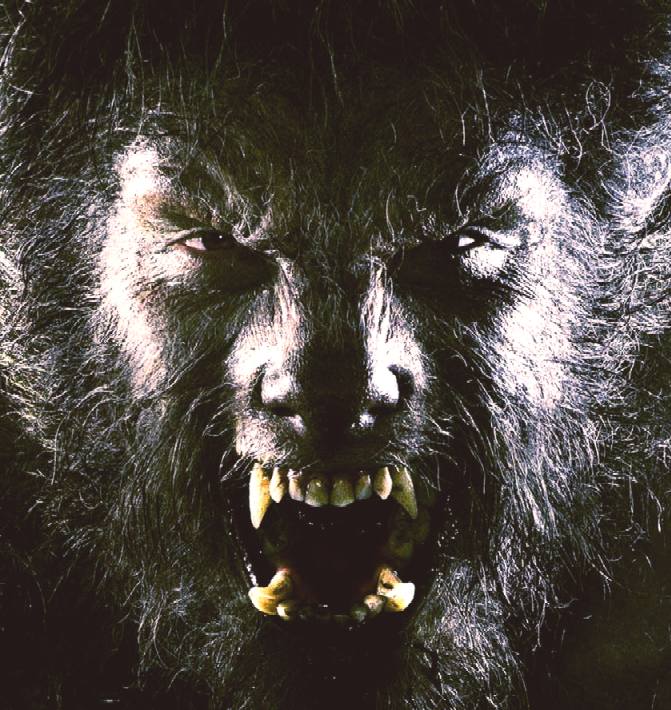
A werewolf (also
lycanthrope
or wolfman) in folklore
and mythology
is a person who shapeshifts
into a wolf
or wolflike creature, either purposely, by using magic,
or after being placed under a curse.
The medieval chronicler Gervase
of Tilbury associated the transformation with the appearance of the full
moon, but this concept was rarely associated with the werewolf until
the idea was picked up by modern fiction writers. Most modern fiction
agrees that a werewolf can be killed if shot by a silver
bullet, although this was not a feature of folk legends.
Werewolves are sometimes held to become vampires
after death.
ORIGINS
and VARIATION OF THE NAME
The name most likely derives from
Old
English wer (or were)
and wulf. The first part, wer, translates as
"man" (in the sense of male human, not the race of humanity).
It has cognates
in several Germanic languages
including Gothic
wair, Old
High German wer and Old
Norse var, as well as in other Indo-European
languages, such as Latin
vir, Irish
fear, Lithuanian
vyras and Welsh
gŵr, which have the same meaning. The second half, wulf,
is the ancestor of modern
English "wolf"; in some cases it also had the general
meaning "beast". An alternative etymology derives the first
part from Old
English weri (to wear); the full form in this case would be glossed
as wearer of wolf skin. Related to this interpretation is Old
Norse ulfhednar,
which denoted lupine equivalents of the bearlike berserkr
who were said to wear a bear skin into battle. They are also very common
in Omeath and Sligo.
Yet other sources derive the word from warg-wolf
, where warg (or later werg
and wero) is cognate with Old Norse vargr, meaning
"rogue," "outlaw" or, euphemistically,
"wolf". A Vargulf was the kind of wolf that slaughtered
many members of a flock or herd, but ate only a little of the kill. This
was a serious problem for herders, who had to somehow destroy the
individual wolf that had run mad before it destroyed their entire flock
or herd. They would then often hang the wolf's hide in the bedroom of a
young infant, believing it to give the baby supernatural
powers. Warg
by itself was used in Old English for this specific kind of wolf (see J.
R. R. Tolkien's book The
Hobbit) and for what would now be called a serial killer.
Possibly related is the fact that, in Norse society, outlaws (who could
be killed at will with no legal repercussions and were forbidden to
receive aid) were often referred to as vargr; that is, wolf.
The Greek term Lycanthropy
(a compound of which the first part derives from the same
Proto-Indo-European root for "wolf", *wlkwo-, as the
English word) is also commonly used for the "wolf - man"
transformation. The term for the metamorphosis
of people into animals
in general, rather than wolves specifically, is therianthropy
(therianthrope means beast-man). The term turnskin
or turncoat (Latin: versipellis,
Russian : oboroten, O. Norse: hamrammr) is sometimes
also used. The French name for a werewolf, sometimes used in English, is
loup-garou, from the Latin
noun lupus
meaning wolf.
The second element is thought to be from Old
French garoul meaning 'werewolf.' This in turn is most likely
from Frankish
*wer-wulf meaning man-wolf.
THE
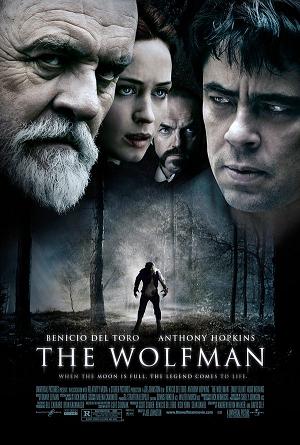
WOLFMAN - MOVIE 2010
The Wolfman is a 2010 American horror film directed by Joe Johnston. It is a remake of the 1941 film of the same name, and tells the story of Lawrence Talbot who returns to his eerie English hometown of Blackmoor following the death of his brother by a werewolf which later attacks him. The film includes an ensemble cast featuring Benicio del Toro,
Anthony Hopkins, Emily Blunt, Hugo Weaving, and Geraldine Chaplin. The screenplay was written by Andrew Kevin Walker and David Self with creature make-up effects by Rick Baker.
Acclaimed director Mark Romanek was originally attached to direct the film with the idea to "...infuse a balance of cinema in a popcorn movie scenario." However, creative disagreements between the studio forced him to depart from the project. Despite the project being left with no director, the planned filming schedule did not halt. Four weeks prior to filming,
Universal hired Joe Johnston to direct the film. Although Johnston convinced the studio he could shoot the film in under 80 days, the film suffered a troubled production with
re-writes, re-shoots, re-edits, the switch of music composers, all factors that forced the studio to push back the film's release date multiple times from its original November 2008.
The film was released in the United States on February 12, 2010. The film was met with a mixed to negative reception from critics and failed to make back its budget from the box office. Amongst the criticism pointed out by critics was the film's obvious troubled production reflected within the film's editing, directing, acting, and screenplay while some praised the film's dark melodic tone and atmosphere, its
Victorian era set pieces, Danny Elfman's moody/eerie Eastern
European-esque score and Baker's werewolf make-up effects which earned him an Academy Award for Best Makeup, along with make-up effects supervisor Dave Elsey.
RECEPTION
The Wolfman has received a mixed critical reception. Review aggregate Rotten Tomatoes reports that 34% of critics have given the film a positive review based on 210 reviews, with an average score of 4.8/10. The critical consensus is: "Suitably grand and special effects-laden, The Wolfman suffers from a suspense-deficient script and a surprising lack of genuine chills." It received a weighted average score of 43% on Metacritic based on 36 reviews, indicating mixed or average reviews.
Film critic Roger Ebert gave the film two and a half stars out of four, praising the atmospheric locations and melodramatic scope but lamenting CGI effects that he regarded as detrimental. Peter Travers of Rolling Stone assigned the film one and a half stars out of four, concluding that "The Wolfman bites, but not
- I think - in the way the filmmakers intended." Owen Glieberman of Entertainment Weekly praised Del Toro's performance as Lawrence Talbot, comparing it favourably to Lon Chaney, Jr.'s, in the 1941 film.
Ronald Meyer, president of Universal Studios, regarded the film as "crappy" and considered it to be "One of the worst movies we ever made."
AWARDS
In 2010, The Wolfman won at the 37th Saturn Awards for best make-up. In 2011, the film and makeup artists, Rick Baker and Dave Elsey, received an
Academy Award for Best Makeup for the 83rd Academy Awards.
BOX
OFFICE
The film grossed $19,850,000 on its opening day, and $31,479,235 in its opening weekend, coming in second at the box office after the film Valentine's Day. The Wolfman eventually grossed $61,979,680 in North America, and a total of $139,789,765 worldwide, failing to recoup its $150 million
budget. In 2014, the LA Times listed the film as one of the most expensive box office flops of all time.
MERCHANDISING
Several companies were involved in the merchandising of the film. Rubies Costumes is making both child and adult costumes. Because costumes are sold to retailers months in advance, the Halloween costumes came out in 2009 since the film being pushed back to 2010 happened after the costumes had been shipped to retailers.
Mezco Toyz produced 7 inch and 12 inch tall Wolfman action figures. They also produced replicas of the medallion from the film. In early January 2010, Mezco Toyz donated the prototypes of the toys to the Museum of the Moving Image in New York.
Jonathan Maberry wrote a novelization to the film, of which the paperback was released on 2 February 2010, the same day the original The
Wolf Man film was re-released on DVD with Universal's Legacy Series. It includes a scene early in the story which explains how Lawrence obtained the cane with a silver wolf's head (which features prominently in the original film but only sparingly in the remake), with Lawrence exchanging his ordinary wooden cane with an elderly Frenchman for the silver wolf's head cane on his initial trip to Blackmoor. It also has Gwen and her father owning an apothecary rather than an antiques shop, suggesting this was changed during the remake's development to be closer to the original film.
THE
WOLFMAN 1941 MOVIE
....The Wolf Man is a 1941 American drama horror film written by Curt Siodmak and produced and directed by George Waggner. The film stars Lon Chaney, Jr. as a werewolf named "The Wolf Man" and features Claude Rains, Evelyn Ankers, Ralph Bellamy, Patric Knowles, Béla Lugosi, and Maria Ouspenskaya in supporting roles. The title character has had a great deal of influence on Hollywood's depictions of the legend of the werewolf. The film is the second Universal Pictures werewolf movie, preceded six years earlier by the less commercially successful Werewolf of London (1935).
Lon Chaney, Jr. would reprise his classic role as "The Wolf Man" in four sequels, beginning with Frankenstein Meets the Wolf Man in 1943.
LEGACY
The Wolf Man is the only Universal monster to be played by the same actor in all his 1940s film appearances. Lon Chaney, Jr. was very proud of this, frequently stating in interviews: "He was my baby". Chaney would go on to play a wolf man (if not the Wolf Man) in very similar makeup in the 1959 Mexican film La Casa del Terror and a famous 1962 episode of TV's Route 66 titled Lizard's Leg and Owlet's Wing, which also starred Boris Karloff as the Frankenstein Monster. Nearly a decade later, even though he was seriously ill at the time, Chaney managed to conjure up his original energetic gestures while masked in a quasi-wolfish
rubber mask for one scene in his last film, 1971's Dracula vs. Frankenstein.
The Wolf Man was not Universal's first werewolf film. It was preceded by Werewolf of London from 1935, starring noted character actor Henry Hull in a quite different and more subtle werewolf makeup. As noted previously, Hull objected to having his face entirely covered in latex and hair, and a less-hirsute, more devilish version was used in the film. The film was not a huge box office success, probably because audiences of the day thought it too similar in many ways to Dr. Jekyll and Mr. Hyde, for which Fredric March had won an Oscar three years before. Some latter-day critics prefer Henry Hull's earlier werewolf to Chaney's, which was described in Carlos Clarens's book An Illustrated History of the Horror FIlm as "... looking like a hirsute Cossack."
The Wolf Man is one of three top-tier Universal Studios monsters without a direct literary source. The others are
The Mummy and the Creature from the Black Lagoon. In the 1970s, novelizations of the original films were issued as paperback originals as part of a series written by "Carl Dreadstone," a house name pseudonym for a several writers, including British horror writer Ramsey Campbell.
Fantasy/horror author Neil Gaiman uses the "Larry Talbot" character in two selections from his short story collection Smoke and Mirrors.
Harlan Ellison's Hugo Award-winning story "Adrift just off the Islets of Langerhans, latitude 38 degrees, 54' N., longitude 77 degrees, 00' 13' W" uses "Laurence Talbot" as the main character.
Heavy metal band Iced Earth's track "Wolf" from the album Horror Show, has the wolfsbane poem recited in its main chorus with some added words in between. Similarly, the track "Howl" by Florence + The Machine (from the album Lungs) features a slightly edited version of the poem in the closing verse. Cradle of Filth used the poem as the intro to their track entitled "Queen of Winter, Throned" on the album V Empire. The character of Jon Talbain, a werewolf attempting to overcome his curse in the Darkstalkers game series, bears a resemblance to the character of Larry Talbot in name and in characterization, made doubly so by the fact that the series primary characters are all homages to horror movie archetypes. Note also the name's similarity to Sir Jon Talbot; Talbain is English by heritage.
The Wolf Man also had an impact on future filmmakers as well. Cult films such as An American Werewolf in London and The Howling drew inspiration from The Wolf Man and made references to the film as well.
In the 1975 Spanish horror film, La maldición de la bestia, written by and starring Paul Naschy, one of the characters is called Larry Talbot.
The film is referenced in the comic book Screamland, where these films are pseudo-fictional in that the Wolf Man is a real person acting in a film of a similar name.
LINKS
and REFERENCE
Wikipedia
The_Wolfman_2010_film Wikipedia
The_Wolf_Man_1941 film http://en.wikipedia.org/wiki/The_Wolf_Man_%281941_film%29 http://en.wikipedia.org/wiki/The_Wolfman_%282010_film%29
Versipellis.
Perseus Digital Library.
(2000)
“loup-garou”, The
American Heritage® Dictionary of the English Language, 4.
(2000)
“Appendix I: Indo-European Roots: w-ro-”, The
American Heritage® Dictionary of the English Language, 4.
Pliny
the Elder. “viii”, Historia
Naturalis, 81.
22/34
Baring-Gould, Sabine. The Book of Were-Wolves: Being an Account
of a Terrible Superstition. London: Smith, Elder, 1865. ISBN
0-7661-8307-6
Douglas, Adam. The Beast Within: A History of the Werewolf.
London: Chapmans, 1992. ISBN 0-380-72264-X
Prieur, Claude. Dialogue de la Lycanthropie: Ou transformation
d'hommes en loups, vulgairement dits loups-garous, et si telle se
peut faire. Louvain: J. Maes & P. Zangre, 1596. (By a
Franciscan monk, in French)
Rev. Montague Summers, The Werewolf London: K. Paul,
Trench, Trubner, 1933. (1st edition, reissued 1934 New York: E.P.
Dutton, 1966 New Hyde Park, N.Y: University Books, 1973 Secaucus,
N.J.: Citadel Press, 2003 Mineola, N.Y.: Dover, with new title The
Werewolf in Lore and Legend). Written by an individual claiming
that werewolves are real, it is understandably filled with a number
of bizarre conclusions but has an impressive bibliography. ISBN
0-7661-3210-2
Wolfeshusius, Johannes Fridericus. De Lycanthropia: An vere
illi, ut fama est, luporum & aliarum bestiarum formis induantur.
Problema philosophicum pro sententia Joan. Bodini ... adversus
dissentaneas aliquorum opiniones noviter assertum... Leipzig:
Typis Abrahami Lambergi, 1591. (In Latin; microfilm held by the
United States National Library of Medicine)
The
French website of the werewolf: www.loups-garou.fr
Arby
Stones, "Hellhounds, Werewolves and the Germanic
Underworld"
The
Book of Were-Wolves, by Sabine
Baring-Gould, 1865
Therianthropy
History Timeline
Allen
Varney, "The New Improved Beast" (Originally InQuest,
Wizard Press, 1995).
GNU
free documentation license

SECTASAUR
- From within a block of ice, the prehistoric past comes back to
life and
threatens modern civilization. John
Storm and Charley
Temple battle fortune hunters to prevent mass extermination.
Jameson
Hunter
|