|
Isambard Kingdom Brunel's Great Eastern was the
superlative ship of the nineteenth century. She was a ship of
biblical proportions. Contemporary observers pointed out that
only Noah's 300-cubit Ark
was bigger. It was not until the Olympic
of 1899 that a longer ship was built. A ship of greater gross
tonnage did not appear until the Kaiser Wilhelm II of
1903. The idea behind Great Eastern was a ship that
could make the voyage out to Australia without having to stop
for coal (the Suez Canal would not open until 1869), a concept
that appealed especially to the newly formed Eastern Steam
Navigation Company (later the Great Ship Company).
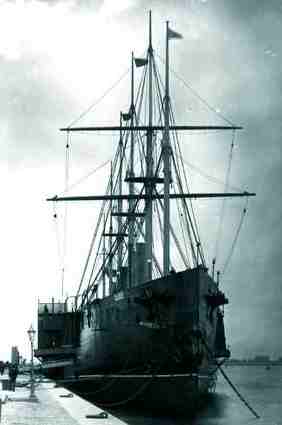
The
Great Eastern
From the first, Brunel worked on the project with the gifted
but less scrupulous marine engineer and shipbuilder John Scott
Russell, who described the ship as "a museum of
inventions" and who was awarded the contract to build the
vessel on the Isle of Dogs in the Thames. As in his earlier
ships, Brunel made sure that the ship had great longitudinal
strength and the hull was double-hulled throughout, a fact that
saved the ship in 1862 when an unmarked reef off Montauk, New
York, tore an 85-by-5-foot gash in the outer hull. (It is not
true that a riveter was accidentally shut into the ship's double
bottom.) In addition, the ship was designed with bulkheads that
divided her into ten watertight compartments. Great Eastern's
propulsion machinery included both side paddles and a single screw; with diameters of 56 feet and 24 feet, respectively,
these were the largest marine paddles and screw ever built.
While this combination was dictated by the limits of engine
efficiency of the time, the paddles and screw gave the ship a
maneuverability that was invaluable in her eventual career as a
cable layer. The sidewheels and propeller were driven by
separate engines, too, the sidewheels by a four-cylinder
oscillating steam engine built by Russell, and the screw by a
four-cylinder horizontal direct-acting engine built by James
Watt & Company.
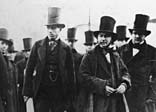
Isambard
Kingdom Brunel (center right)
The extraordinary dimensions of the ship dictated that she be
built on an inclined way parallel to the river so that she could
be launched sideways. Russell's financial incompetence nearly
destroyed the project, and only through direct supervision did
Brunel bring it to completion, though the effort is said to have
killed him. Despite Brunel's reluctance, circumstances dictated
that the ship be launched on November 3, 1857, and though it was
first attempted on that date, she did not take the water until
January 31, 1858. Fitting out lasted until September 1859. In
failing health, Brunel was again forced to oversee Russell's
work. During trials on September 5 - four days before Brunel's
death - there was a disastrous explosion, and repairs forced the
postponement of Great Eastern's maiden transatlantic
voyage until June 1860.
In 1857, during the planning of the Suez Canal, it was thought that Great Eastern would not be able to traverse it, since she had a draft of 28 ft (8.5 m) and it was expected that the canal would be excavated to a depth of 26 ft (7.9 m).[9] In any event, when the canal was opened to shipping in 1869, Great Eastern was no longer in passenger service.
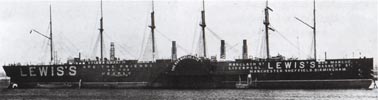
The
Great Eastern side on
Great Eastern made ten voyages in the North Atlantic
passenger trade, but two accidents (neither of them fatal) that
cost the company £130,000 forced her out of that trade, and in
1864 she was sold to the newly formed Great Eastern Steamship
Company. After alterations, including the removal of one set of
boilers and one funnel, Great Eastern embarked on a
career as a cable-laying ship. The first transatlantic cable had
failed shortly after it had been laid down by HMS
Agamemnon and USS
Niagara in 1858, and when American inventor Cyrus Field
visited England in connection with his plan, Brunel reportedly
pointed to Great Eastern's unfinished bulk and said,
"There is your ship."
Under charter to the Telegraph Construction Company, on June
24, 1865, Great Eastern lay off southern Ireland with
7,000 tons of cable and 500 crew, including Field. After the
European end of the cable was laid near Valentia, Ireland, by
the smaller HMS Caroline, Great Eastern sailed in
company with HMS Terrible and Sphinx. On
August 2, three-quarters of the way to Newfoundland, the cable
broke and after several failed attempts to recover it, Great
Eastern returned to Ireland. Undaunted, the Atlantic
Telegraph Company had already ordered 1,990 miles of new cable,
and after some alterations to her gear, Great Eastern
sailed again from Valentia on Friday, July 13, 1866. Twelve days
later, in Heart's Content, Newfoundland, communications between
Europe and North America had dropped from one month to a few
minutes. By the end of August, Great Eastern's crew had
recovered the submerged cable from the 1865 expedition, and
spliced it to a cable running from Newfoundland. By the end of
her career, Great Eastern had laid a total of five
transatlantic cables, and one between Bombay, Aden, and Suez.
In 1874, she was sold to a French company that sought to use Great
Eastern for first-class passenger service between New York
and France, but the project was abandoned after one voyage. Laid
up in Milford Haven from 1875 to 1886, she was sold for use as
an exhibition ship in Liverpool. She was broken up at Henry Bath
& Sons two years later.
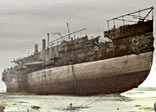
The
Great Eastern shipwrecked
THE
CONCEPT
After his success in pioneering steam travel to North America with Great Western and Great Britain, Brunel turned his attention to longer voyages as far as Australia and realised the potential of a ship that could travel round the world without the need of refuelling.
On 25 March 1852, Brunel had made a sketch of a steamship in his diary and wrote beneath it: "Say 600 ft x 65 ft x 30 ft" (180 m x 20 m x 9.1 m). These measurements were six times larger by volume than any ship afloat; such a large vessel would benefit from economies of scale and would be both fast and economical, requiring fewer crew than the equivalent tonnage made up of smaller ships. Brunel realised that the ship would need more than one propulsion system; since twin screws were still very much experimental, he settled on a combination of a single screw and paddle wheels, with auxiliary sail power. Using paddle wheels meant that the ship would be able to reach Calcutta, where the Hooghly River was too shallow for screws.
Brunel showed his idea to John Scott Russell, an experienced naval architect and ship builder whom he had first met at the Great Exhibition. Scott Russell examined Brunel's plan and made his own calculations as to the ship's feasibility. He calculated that it would have a displacement of 20,000 tons and would require 8,500 horsepower (6,300 kW) to achieve 14 knots (26 km/h), but believed it was possible. At Scott Russell's suggestion, they approached the directors of the Eastern Steam Navigation Company.
THE
EASTERN STEAM NAVIGATION COMPANY
The Eastern Company was formed in January 1851 with the plan of exploiting the increase in trade and emigration to India, China and Australia. To make this plan viable they needed a subsidy in the form of a mail contract from the British General Post Office, which they tendered for and Brunel started the construction of two vessels, Victoria and Adelaide. However, in March 1852 the Government awarded the contracts to the Peninsular and Oriental Steam Navigation Company, even though the Eastern Company's tender was lower. This left them in the position of having a company without a purpose.
Brunel's large ship promised to be able to compete with the fast clippers that currently dominated the route, as she would be able to carry sufficient coal for a non-stop passage and the company invited him to present his ideas to the board. He was unable to attend due to illness and Scott Russell took his place.
The Company then set up a committee to investigate the proposal, and they reported in favour and the scheme was adopted at a board meeting held in July 1852. Brunel was appointed Engineer to the project and he began to gather tenders to build the hull, paddle engines and screw engines. Brunel had a considerable stake in the company and when requested to appoint a resident engineer refused in no uncertain terms:
"I cannot act under any supervision, or form part of any system which recognises any other advisor than myself ... if any doubt ever arises on these points I must cease to be responsible and cease to act."
He was just as firm in the terms for the final contract where he insisted that nothing was to be undertaken without his express consent, and that procedures and requirements for the construction were specifically laid down.
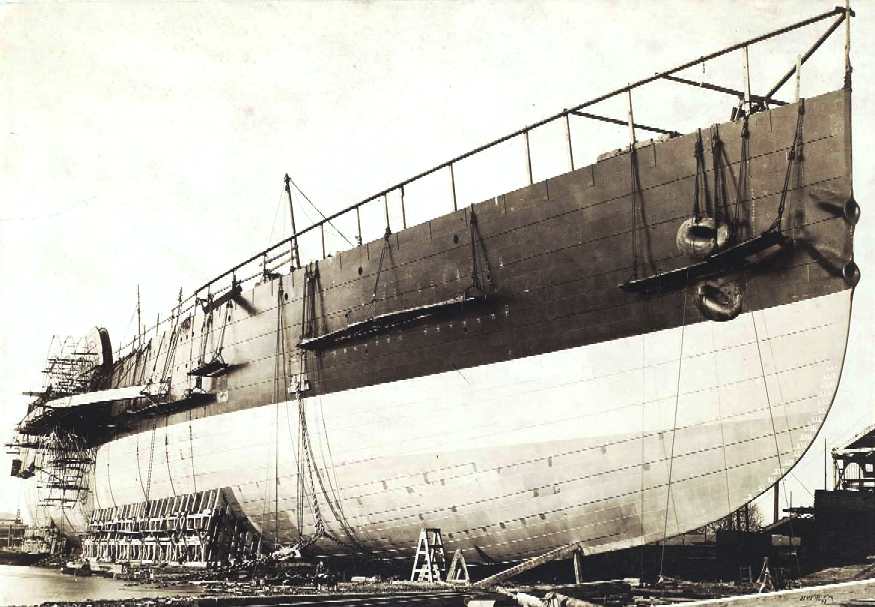
The
Great Eastern under construction
CONSTRUCTION
1854 - 1859
Although Brunel had estimated the cost of building the ship at £500,000, Scott Russell offered a very low tender of £377,200: £275,200 for the hull, £60,000 for the screw engines and boilers, and £42,000 for the paddle engines and boilers. Scott Russell even offered to reduce the tender to £258,000 if an order for a sister ship was placed at the same time. Brunel accepted Scott Russell's tender in May 1853, without questioning it; Scott Russell was a highly skilled shipbuilder and Brunel would accept an estimate from such an esteemed colleague without question.
In the spring of 1854 work could at last begin. The first problem to arise was where the ship was to be built. Scott Russell's contract stipulated that it was to be built in a dock, but Russell quoted a price of £8–10,000 to build the necessary dock and so this part of the scheme was abandoned, partly due to the cost and also to the difficulty of finding a suitable site for the dock. The idea of a normal stern first launch was also rejected because of the great length of the vessel, also because to provide the right launch angle the bow of the ship would have to be raised 40 feet (12 m) in the air. Eventually it was decided to build the ship sideways to the river and use a mechanical slip designed by Brunel for the launch. Later the mechanical design was dropped on the grounds of cost, although the sideways plan remained.
Having decided on a sideways launch, a suitable site had to be found, as Scott Russell's Millwall, London, yard was too small. The adjacent yard belonging to David Napier was empty, available and suitable, so it was leased and a railway line constructed between the two yards for moving materials. The site of the launch is still visible on the Isle of Dogs. Part of the slipway has been preserved on the waterfront, while at low tide, more of the slipway can be seen on the Thames foreshore. The remains of the slipways, and other structures associated with the launch of the SS Great Eastern, have recently been surveyed by the Thames Discovery Programme, a community project recording the archaeology of the Thames intertidal zone in London. Brunel's achievements in London are also commemorated in Rotherhithe, at the Brunel Museum.
Great Eastern's keel was laid down on 1 May 1854. The hull was an all-iron construction, a double hull of 19 mm (0.75 inch) wrought iron in 0.86 m (2 ft 10 in) plates with ribs every 1.8 m (6 ft). Internally, the hull was divided by two 107 m (350 ft) long, 18 m (60 ft) high, longitudinal bulkheads and further transverse bulkheads dividing the ship into nineteen compartments. Great Eastern was the first ship to incorporate the double-skinned hull, a feature which would not be seen again in a ship for several decades, but which is now compulsory for reasons of safety.
She had sail, paddle and screw propulsion. The paddle-wheels were 17 m (56 ft) in diameter and the four-bladed screw-propeller was 7.3 m (24 ft) across. The power came from four steam engines for the paddles and an additional engine for the propeller. Total power was estimated at 6 MW (8,000 hp).
She also had six masts (said to be named after the days of a week – Monday being the fore mast and Saturday the spanker mast), providing space for 1,686 square metres (18,150 sq ft) of sails (7 gaff and max. 9 (usually 4) square sails), rigged similar to a topsail schooner with a main gaff sail (fore-and-aft sail) on each mast, one "jib" on the fore mast and three square sails on masts no. 2 and no. 3 (Tuesday & Wednesday); for a time mast no. 4 was also fitted with three yards. In later years, some of the yards were removed. According to some
sources she would have carried 5,435 square metres (58,500 sq ft). This amount of canvas is obviously too much for seven fore-and-aft sails and max. 9 square sails. This (larger) figure of sail area lies only a few square metres below that the famous Flying P-Liner Preussen carried – with her five full-rigged masts of 30 square sails and a lot of stay sails. Setting sails turned out to be unusable at the same time as the paddles and screw were under steam, because the hot exhaust from the five (later four) funnels would set them on fire. Her maximum speed was 24 km/h (13 knots).
SCOTT
RUSSELL - BANKRUPTCY
At the beginning of February 1856 Brunel advised the Eastern Company that they should take possession of the ship to avoid it being seized by Scott Russell's creditors. This caused Scott Russell's bankers to refuse to honour his cheques and foreclose on his assets and on 4 February Scott Russell suspended all payments to his creditors and dismissed all his workmen a week later.
Russell's creditors met on 12 February and it was revealed that Russell had liabilities of £122,940 and assets of £100,353. It was decided that his existing contracts would be allowed to be completed and the business would be liquidated. He issued a statement to the Board of the Eastern Company in which he repudiated his contract and effectively handed the uncompleted ship back to them. When the situation was reviewed it was found that three-quarters of the work on the hull had not been completed and that there was a deficit of 1200 tons between the amount of iron supplied and that used on the ship.
Brunel meanwhile wrote to John Yates and instructed him to negotiate with Scott Russell for the lease of his yard and equipment. Yates replied that Scott Russell had mortgaged the yard to his banker and that any negotiation would have to be with the bank, who after weeks of wrangling agreed to lease the yard and equipment until 12 August 1857.
The Eastern Company began the task of completing the ship. Work recommenced in May and took longer than expected to complete. Brunel reported in June 1857 that once the screw, screw shaft and sternpost had been installed the ship would be ready for launching. However, the launch ways and cradles would not be ready in time since the contract for their construction had only been placed in January 1857. Under pressure from all sides, the lease of the shipyard costing £1,000 a month, and against his better
judgment, Brunel agreed to launch the ship on 3 November 1857 to catch the high tide.
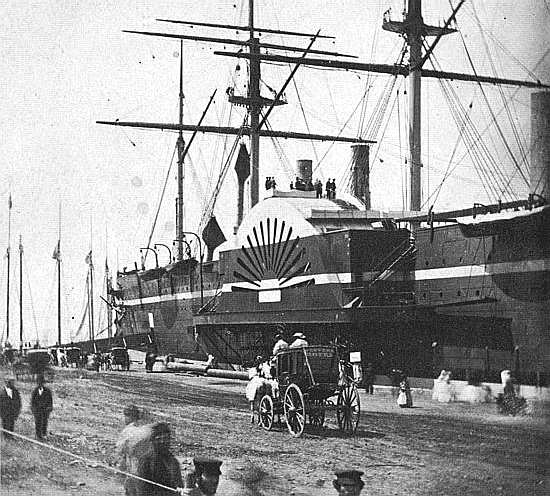
The
Great Eastern in New York harbour
LAUNCH
Brunel had hoped to conduct the launch with a minimum of publicity but many thousands of spectators had heard of it and occupied vantage points all round the yard. He was also dismayed to discover that the Eastern Company's directors had sold 3,000 tickets for spectators to enter the shipyard.
As he was preparing for the launch some of the directors joined him on the rostrum with a list of names for the ship. On being asked which he preferred, Brunel replied "Call her Tom Thumb if you like". At 12:30 pm Henrietta (daughter of a major fundraiser for the ship, Henry Thomas Hope) christened the ship Leviathan much to everyone's surprise since she was commonly known as Great Eastern; her name subsequently changed back to Great Eastern in July 1858.
The launch, however, failed, as the steam winches and manual capstans used to haul the ship towards the water were not up to the job. Brunel made another attempt on the 19th and again on the 28th, this time using hydraulic rams to move the ship, but these too proved inadequate. The ship was finally launched sideways at 1:42pm on 31 January 1858, using more powerful hydraulic rams supplied by the then-new Tangye company of Birmingham, the association with such a famous project giving a useful fillip to the fledgling company.
She was 211 m (692 ft) long, 25 m (83 ft) wide, with a draft of 6.1 m (20 ft) unloaded and 9.1 m (30 ft) fully laden, and displaced 32,000 tons fully loaded. In comparison, SS Persia, launched in 1856, was 119 m (390 ft) long with a 14 m (45 ft) beam.
FITTING OUT
The launch of the ship cost £170,000, a third of Brunel's estimate for the entire vessel, and it had yet to be fitted out. It was difficult to get any more money from the Eastern Company's investors as the company was close to bankruptcy. To prevent this from happening, a new company was formed, the "Great Ship Company", with capital of £340,000. They bought the ship for £160,000, which left enough funds for fitting her out. The Eastern Company's shareholders were given the market value of their £20 shares (£2 10s) towards payment for shares in the new company and the Eastern Steam Navigation Company entered liquidation.
Tenders were invited for fitting the ship out, and two were received – one from Wigram and Lucas for £142,000, and the other from John Scott Russell for £125,000. Brunel had taken a long holiday on medical advice and was absent when the contract was awarded to Scott Russell. The work was begun in January 1859, and was completed by August.
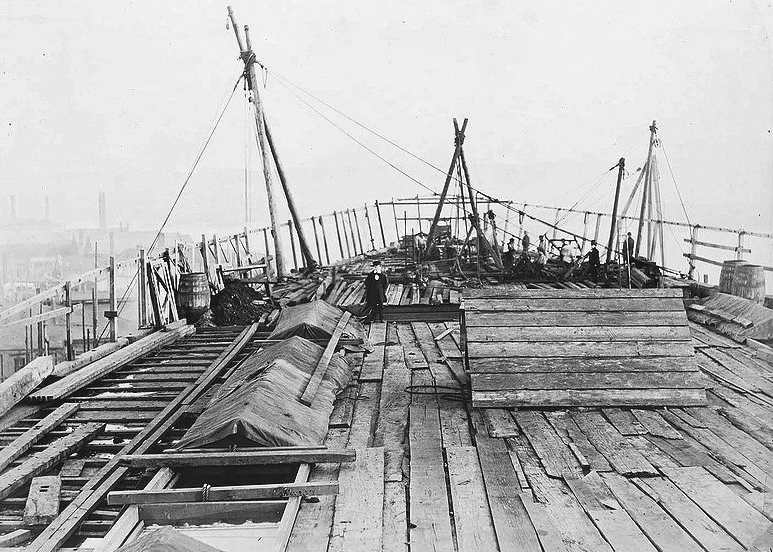
The
Great Eastern - planking on deck
FORTUNES
& MISFORTUNES OF A SHIPPING COMPANY
MAIDEN VOYAGE
30 August 1859 was given as the date of the first voyage, but this was later put back to 6 September. The destination was Weymouth, from which a trial trip into the Atlantic would be made. Following this the ship would sail to Holyhead, Wales, its home port for American voyages. The company had made an agreement with the Canada's Grand Trunk Railway to use Portland, Maine as its US destination, and the railway company had built a special jetty to accommodate the ship. William Harrison was appointed Captain in 1856; he drowned in 1860.
On 9 September the ship had passed down the Thames, and out into the English Channel, and had just passed Hastings when there was a huge explosion, the forward deck blowing apart with enough force to throw the No. 1 funnel into the air, followed by a rush of escaping steam. Scott Russell and two engineers went below and ordered the steam to be blown off and the engine speed reduced. Five stokers died from being scalded by superheated steam, while four or five others were badly injured and one had leapt overboard and had been lost. The accident was discovered to have been caused by a feedwater heater's steam exhaust having been closed, while the explosion's power had been concentrated by the ship's extremely strong bulkheads.
TRANSATLANTIC VOYAGES 1860–63
Although designed for the far Eastern run, Great Eastern was only ever used in the Atlantic. A historian of technology comments: "She was designed for the Far Eastern trade, but there was never sufficient traffic to put her into this. Instead, she was used in the transatlantic business, where she could not compete in speed and performance with similar vessels already in service."
Her first voyage to North America began on 17 June 1860, with 35 paying passengers, eight company "dead heads" (non-paying passengers), and 418 crew. Among the passengers were two journalists, Zerah Colburn and Alexander Lyman Holley, and three directors of the Great Ship Company.
1st VOYAGE TO NORTH AMERICA
Preparations were initially made for the ship to sail on 16 June 1860 and the passengers boarded her on the 14th. After visitors had been sent ashore the Captain announced that he would not be sailing until the 17th, as the crew were drunk. Director Daniel Gooch, who was travelling aboard her, was not pleased. He was further displeased by the route taken by the ship which was the more southerly of the regular steamer routes as he had wanted the ship to complete the journey in nine days. In the event, the voyage took 10 days 19 hours.
GOVERNMENT CHARTER 1861
Upon Great Eastern's return to England, the ship was chartered by the British Government to transport troops to Quebec. 2,144 officers and men, 473 women and children, and 200 horses were embarked at Liverpool along with 40 paying passengers. The ship sailed on 25 June 1861 and went at full speed throughout most of the trip arriving at her destination 8 days and 6 hours after leaving Liverpool. Great Eastern stayed for a month and returned to Britain at the beginning of July with 357 paying passengers.
Although the ship had made around £14,000 on its first Atlantic voyage, the Great Ship Company's finances were in a poor state, with their shares dropping in price. They were also threatened with a lawsuit by the Grand Trunk Railway for not making Portland, Maine the ship's port of call as agreed. In addition, Scott Russell had been awarded the sum of £18,000 for repairs following the 1859 explosion. The Company managed to appeal against this but Scott Russell applied to the courts and the Chief Justice found in his favour. The company appealed again, and due to rumours that the ship was about to leave the country, Russell's solicitors took possession of her. The Great Ship Company lost its appeal and had to pay the sum awarded; to cover this and the expenses of a second US voyage, they raised £35,000 using debentures.
2nd VOYAGE NORTH AMERICA
Only 100 passengers booked for the second voyage, which was originally scheduled to depart Milford Haven on 1 May 1861. However, the boat taking the passengers to the ship ran aground and they and their luggage had to be rescued by small boats.
The voyage took 9 days 13 hours. Great Eastern's arrival in New York was virtually unnoticed, due to the American Civil War and when it was opened to the public at 25 cents a time there was little interest. 194 passengers sailed on the return journey on 25 May and 5,000 tons of wheat was also carried.
3rd VOYAGE USA
Great Eastern sailed from Liverpool on Tuesday 10 September 1861, commanded by Captain James Walker. On her second day out the wind increased to gale force, causing the ship to roll heavily. The port paddle wheel was completely lost, and the starboard paddle wheel smashed to pieces when one of the lifeboats broke loose. At the same time it was discovered that the cast iron rudder post, which was 11 inches (280 mm) in diameter, had sheared off 2 ft (0.61 m) above its collar and the
rudder was swinging free and hitting the screw, which was slowly breaking it up.
Captain Walker ordered his officers to say nothing to the passengers concerning the situation, then had a trysail hoisted which was immediately ripped apart by the wind. He then had a four-ton spar thrown overboard secured with a hawser to try to bring some control to the ship, but it only worked for a short while before being torn away.
By the end of the second day some of the passengers had an idea as to the predicament they were in and formed a committee chaired by Liverpool shipping merchant George Oakwood. The captain agreed to meet Oakwood and allowed him to inspect the ship. What he found was far worse than had been expected: none of the cargo had been stowed properly and it was all rolling loose in the holds. Hamilton E. Towle, an American civil engineer, who was returning to the states after completing his contract working as a supervising engineer on the Danube River dry-docks in Austria, visited the rudder room and after inspecting the damage came up with a plan to regain control of the rudder.
Towle's scheme was taken to the captain, who failed to act on it. In the evening of the third day Magnet, a brig from Nova Scotia, appeared on the scene. Captain Walker asked her Captain if he would stand by. He agreed, but it turned out there was little he could do and after several hours the brig left, later succeeding in a claim for demurrage from the Great Ship Company for the delay.
Towle now presented his plan to the passengers' committee and in turn they pressured the captain into letting him try it. Towle had a 100 ft (30 m) chain composed of 60 lb (27 kg) links wound around the rudder post below the break, then secured the ends of the chain to the port and starboard frames of the ship using block and tackle. Two lighter chains were led down from the wheelhouse and attached to the heavy chain and also to the ship's frames. This allowed some limited movement of the rudder and the ship became steerable again.
On morning of Sunday 15 September the storm finally abated. Towle and the passengers committee insisted that the Captain try the repaired rudder and eventually the engines were started and at 5 pm that day after 75 hours of drifting out of control the ship answered the helm and was turned on to a course towards Ireland, 300 mi (480 km) away.
On arrival at Queenstown the harbour-master refused to let the ship enter because she was not under full control and the injured passengers were taken off by boats. The ship had to stand off for three days until she was towed in by HMS Advice. Arrangements for temporary repairs were begun and the passengers were offered free transport to the US aboard other ships. Once the repairs were completed the ship sailed to Milford Haven where permanent repairs were to be carried out. Smaller 50 ft (15 m) diameter paddlewheels were fitted, and improvements were made to the steering.
Upon arriving in the US, Towle filed a claim for $100,000 under the laws of salvage, claiming that his efforts had saved the ship. The case was taken to court, and he was awarded the sum of $15,000, quite a considerable sum for that period. The Scientific American published an account of the incident and a description of Towle's device. It is uncertain if Towle ever received any of the money awarded to him by the court.
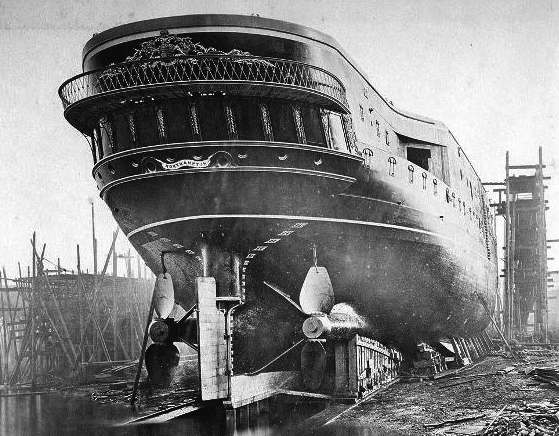
Another
period ship: HMS Northampton, Nelson class warship 1876
VOYAGES 1862
Great Eastern sailed from Milford Haven on 7 May 1862 with 138 passengers, arriving in New York on 17 May. The ship was opened to visitors and around 3,000 a day took the opportunity. The return journey to Liverpool was profitable, with 389 passengers travelling along with 3,000 tons of freight. The west-to-east trip took 9 days 12 hours, a reduction of 12 hours on her previous record.
The second voyage of 1862 saw the ship arriving in New York on 11 July with 376 passengers including the President of Liberia, J. J. Roberts. The return journey later that month carried 500 passengers and 8,000 tons of cargo, the ship arriving at Liverpool on 7 August.
ROCK INCIDENT
After a quick turnround, Great Eastern left on 17 August with 1,530 passengers on board and a substantial amount of freight which increased her draught to 30 ft (9.1 m). The ship encountered a gale but the captain maintained full speed and the ship arrived off Montauk Point, New York at midnight on 27 August.
Not wishing to enter New York Bay over Sandy Hook bar with the ship's deep draught, the captain decided to steam up Long Island Sound and moor at Flushing Bay. The pilot came on board at 1:30 am and the ship moved slowly ahead. At about 2:00 am 1 mile (2 km) east of Montauk, Long Island a rumble was heard and the ship heeled slightly. The pilot said she had probably rubbed against the "North east Ripps" (later renamed "Great Eastern Rock"). The captain sent an officer down to check for damage and he reported no leaks. The ship had a list to port, but she made her way into New York the next day under her own steam. Nobody was hurt, indeed the passengers never even knew what had happened.
It was discovered that the rock had opened a gash in the ship's outer hull over 9 feet (2.7 m) wide and 83 feet (25 m) long, perhaps 60 times the area of the
RMS Titanic's damage. The enormous size of Great Eastern precluded the use of any drydock repair facility in the US, and the brothers Henry and Edward S. Renwick devised a daring plan to build a watertight, 104 feet (32 m) by 15 feet (4.6 m) caisson to cover the gash, held in place by chains around the ship's hull. The brothers claimed that it would take two weeks to complete the repairs and said that they would only take payment if successful. However, the demands of the American Civil War caused delays in getting the iron plates required, and instead of two weeks the repairs took three months at a cost to the company of £70,000. The ship finally sailed from New York for Liverpool on 6 January 1863.
In October 2007, the recovery of a 6,500-pound (2.9 t) anchor in 70 feet (21 m) of water about 4 miles (6.4 km) from the rock has stirred speculation that it may have belonged to the Great Eastern.
VOYAGES 1863
In 1863 Great Eastern made three voyages to New York, with 2,700 passengers being carried out and 970 back to Britain along with a large tonnage of cargo. One of her paddle wheels was damaged on the last outward trip and she completed it using her screw, while on the return journey she ran down and damaged Jane, a small sailing ship. The company lost nearly £20,000 on the voyages due to a price war between the Cunard and Inman shipping lines, and ended up with debts of more than
£142,000, which forced them to lay up Great Eastern.
DISPOSAL SALE
A plan was mooted to offer the ship in a lottery, which came to nothing, and the ship was finally offered for sale on 14 January 1864 at the Liverpool Exchange, the bidding opening at £50,000. No bids were offered and the ship was withdrawn from sale, the auctioneer declaring that it would be offered for sale with no reserve in three weeks time.
Meanwhile, Daniel Gooch approached Thomas Brassey and John Pender to see if they would be willing to assist in the purchase of Great Eastern. The opening bid at the auction was £20,000 and John Yates who was acting for Gooch secured the ship for a bid of £25,000, despite the ship being worth £100,000 in materials alone.
The three men set up a new company, the Great Eastern Steamship Company, and Great Eastern was chartered to the newly formed Telegraph Construction and Maintenance Company for £50,000 of shares, and would be responsible for carrying out the necessary conversion work for the ship's new role.
SHIPPING
RELATED LINKS
Baltic
and International Maritime Council
Australian
Maritime Safety Authority
California
Maritime Academy
Maine
Maritime Museum
Maritime
and Coastguard Agency
Maritime
Companies
Maritime
History and Naval Heritage Homepage
Maritime
Schools Pacific
Maritime Group
PORT
- Maritime Information Gateway
The
International Maritime Organisation
The
Maritime History Virtual Archives
The
Maritime Museum of the Atlantic
The
Mother of All Maritime Links
Welcome
to Maritime Global Net
Clyde
history
MARINE
INSURANCE: SAIL,
POWER, TRAWLERS, LINER,
YACHTS, RIBs, TENDERS,
TANKERS,
CARGO,
CONTAINERS
Paddle & screw steamship (5f/6m). L/B/D:
692 × 82.7 (117ew) × 30 (210.9m × 25.2m (35.7m) × 9.1m). Tons:
18,915 grt. Hull: iron. Comp.: 1st 200, 2nd
400, steerage 2,400. Mach.: oscillating steam engine
driving sidewheels & horizontal direct-acting engine, 4,890
ihp, driving 1 screw; 13 kts. Des.: Isambard Kingdom
Brunel. Built: Scott, Russell & Co. and Isambard
Kingdom Brunel, Millwall, Eng.; 1858.
Youtube
A
heartwarming action adventure: Pirate
whalers
V Conservationists, introducing
John Storm and his
solar powered robot ship as
they fight to save a wounded whale from the sushi bars. For
release as an e-book from 2014 with hopes for a film in
2015/2016 TBA
|