|
APPLE COMPUTER iPOD
|
||||||||||||||||||||||||||||||||||||||||||||||||||||||||||||||||||||||||||||||||||||||||||||||||||||||||||||||||||||||||||||||||||||||||||||||||
|
HOME BIOLOGY CREW GEOGRAPHY HISTORY INDEX MUSIC THE BOAT SOLAR CELLS SPONSORS |
||||||||||||||||||||||||||||||||||||||||||||||||||||||||||||||||||||||||||||||||||||||||||||||||||||||||||||||||||||||||||||||||||||||||||||||||
|
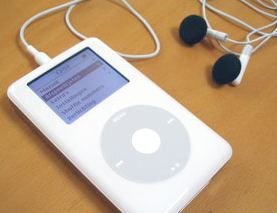
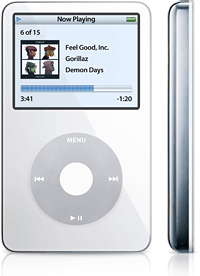
iPod is a brand of portable digital media player designed and marketed by Apple Computer. Devices in the iPod family provide a simple user interface designed around a central scroll wheel (barring the iPod shuffle). Most iPod models store media on a built-in hard drive, while the smaller iPod shuffle and iPod nano use flash memory. Like most digital audio players, an iPod can serve as an external data storage device when connected to a computer. Discontinued versions of the iPod include two generations of the popular iPod mini and four generations of the full-sized iPod, all of which had monochrome screens except for the iPod photo of the fourth generation. As of September 2005, the lineup consists of the fifth-generation iPod which can play videos, the iPod nano which has a color screen, and the iPod shuffle; all three iterations were released in 2005.
The bundled software used for uploading music, photos, and movies to the iPod is called iTunes. iTunes is a music jukebox application that stores a comprehensive library of the music on a user's computer, as well as being able to play and rip it from a CD. The most recent incarnations of iPod and iTunes have video playing and organization features. Other forms of data can be added to iPod as if it were a normal data storage device.
Name
Apple Computer often refers to the player as iPod, without use of the definite article; the. Apple's web site reflects this usage (for example, "iPod incorporates the same touch-sensitive Apple Click Wheel that debuted on iPod mini"), which resembles Apple's use of the words Macintosh or iMac. The company has many other products with a lowercase "i" in front of the name, including iSight, iChat, iTunes, iDVD, and iBook. When Apple first introduced the iMac, the "i" stood for internet (as well as a possible tongue-in-cheek reference to Steve Jobs's title with the company at the time, interim CEO, abbreviated iCEO), meaning that the iMac shipped with everything you would need for a connection, but the prefix stuck, as the brand recognition associated with it has positive effects on the sales of Apple products. Recently, some media have started referring to the generation primarily born in the late 1980s, and which in particular has made the iPod popular, as the iGeneration, suggesting that the "i" family of products may have a far-reaching cultural impact.
History
Tony Fadell first conceived the iPod outside of Apple. When he demonstrated his idea to Apple, the company hired him as an independent contractor to bring his project to the market, putting him in charge of assembling the team that developed the first two generations of the device. Apple's Industrial Design Group, working under the direction of Jonathan Ive designed the subsequent incarnations.
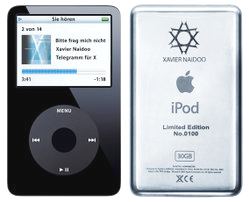
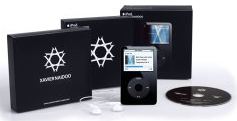
Fifth-generation Xavier Naidoo 30GB Collector's iPod
Apple originally released the iPod on October 23, 2001 as a Mac-compatible product. In 2002, Apple released third-generation iPods that could be formatted for either Mac or Microsoft Windows. At the same time, they also introduced a Windows version of the iTunes software that maintains the iPod music library. As of October 2004, iPod dominated digital music player sales in the United States, with over 90% of the market for hard-drive-based players and over 70% of the market for all types of players. The iPod has sold at a tremendous rate, now past 30 million units since its release. Apple has posited that the iPod has a "halo effect", encouraging users of non-Apple products to switch to other Apple products, such as to Macintosh computers.
Patent disputes
In 2005, Apple Computer faced two lawsuits claiming patent infringement by the iPod and its associated technologies: Advanced Audio Devices claimed the iPod breached their patent on a "music jukebox" and Hong Kong-based IP portfolio company Pat-rights filed suit on behalf of inventor Keung Tse Ho, claiming that Apple's FairPlay technology breached their patent on " Protection of software against unauthorized use".
Apple's application to the United States Patent and Trademark Office for a patent on "rotational user inputs", as used in the iPod's interface, received a third "non-final rejection" (NFR) in August 2005.
Also in August 2005, Creative Technology, one of Apple's main rivals in the MP3 player market, announced that it too held a patent on part of the music selection interface used by the iPod (U.S. Patent No. 6,928,433: "Automatic hierarchical categorization of music by metadata", which Creative dubbed the 'Zen Patent', granted on 9 August 2005).
Capabilities
Software
iPods can play MP3, AAC/M4A, Protected AAC, AIFF, Audible audiobook, MPEG-4 and Apple Lossless audio file formats. The fifth-generation iPod can also play .m4v (H.264) and .mp4 (MPEG-4) video file formats. The Windows version of iTunes can transcode non copy-protected WMA files to an iPod supported format. WMA files with copy protection cannot be played in iTunes or be copied to an iPod. Reviewers have criticized the iPod's inability to play some other formats, in particular the Ogg Vorbis and FLAC formats.
Apple designed the iPod to work with the iTunes media library software, which lets users manage the music libraries on their computers and on their iPods. iTunes can automatically synchronize a user's iPod with specific playlists or with the entire contents of a music library each time an iPod connects to a host computer. Users may also set a rating (out of 5 stars) on any song, and can synchronize that information to an iTunes music library.
Apart from iTunes there are also several third-party applications available that can be used to transfer songs to the iPod. A feature that iTunes lacks, but most third-party applications have is an option to transfer songs from an iPod back to the computer.
In addition to playing music and storing files, the iPod has limited PDA functionality: the unit can synchronize a user's contacts and schedule with programs such as iCal and Microsoft Outlook. Mozilla's Sunbird and Calendar support the use of iCal (.ics) format calendar files. These programs may be used to update the iPod Calendar on any supported operating system, including Windows; originally, the files in Windows had to be manually dragged and dropped into the Calendar directory on the iPod, but iTunes 5.0 added the option to automatically synchronize these files to the iPod.
It can also display notes, and hence host simple games and store restaurant information. However, iPod has limitations as a PDA, since users cannot edit this information on the iPod but only on a computer.
iPods (with the exception of the iPod shuffle) also feature games. First and second generation iPods feature "Brick", a clone of the Breakout arcade game from Atari (originally created by Apple cofounder Steve Wozniak). third, fourth, and fifth generation include Brick, along with three other games:
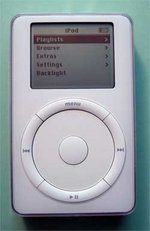
A second generation iPod
Hardware
Except for iPod shuffle, iPod nano, and fifth-generation iPod, all previous models of iPod offered FireWire connectivity. Apple stopped shipping FireWire cables with iPods in favor of only using Hi-Speed USB (USB 2.0), more than likely a cost-cutting and size-saving measure since many Windows-based PCs do not have FireWire ports. iPods can recharge their internal batteries using either FireWire (all generations) or USB power (only fourth generation and later) while connected to a computer or to an iPod AC power adapter. Both USB-based and FireWire-based power adapters exist. First- and second-generation iPods had a standard FireWire connection port. Newer iPods, iPod minis and iPod nanos use a proprietary 30-pin dock connector to connect the iPod to a computer’s FireWire or USB port with a proprietary cable. The iPod shuffle has a built-in USB connector that plugs into a standard USB port for recharging and for data transfer, but a connector for AC charging can be purchased.
The first three generations of iPod used two ARM 7TDMI-derived CPUs running at 90 MHz, while later models have variable speed chips which run at a peak of 80 MHz to save battery life. iPods use 1.8-in (46-mm) ATA hard drives (with a nonstandard connector) made by Toshiba. The iPod mini uses one-inch hard drives made by Hitachi. The iPod has a 32-MiB flash ROM chip which contains a bootloader, a program that tells the device to load the operating system from another medium (in this case, the hard drive). All iPods, except for the 60GB fifth-generation iPod, have 32 MiB of RAM, a portion of which holds the iPod OS loaded from the firmware and the vast majority of which serves to cache songs loaded from the hard drive. For example, an iPod could spin the hard disk up once and copy about 30 MiB of upcoming songs on a playlist into RAM, thus saving power by not having the drive spin up for each song. (The 60GB fifth-generation iPod holds 64 MiB of RAM, to further extend battery life.)
Earphones
All iPods come with earbud headphones with distinctive white cords, a color chosen to match the design of the original iPod. The white cords have become symbolic of the iPod brand, and advertisements for the devices feature them prominently. Despite the fact that new generations of the iPod now appear in black as well as white, the cords still remain white, although hacking and modding weblog Hack A Day has posted a hack on how to make black iPod earphones for a black iPod nano.
Like most headphones that come bundled with other hardware, the stock white earbuds are fairly low quality, and some users choose to replace them. Users rate the substandard bass response as the most apparent negative characteristic found in the standard headphones. They are also known to develop a clicking noise at volume peaks, due to the membrane being displaced. This is often easily solved by applying a small amount of suction to the problem earphone.
The signature earphones have such good recognition characteristics that they can become a liability — after crime in the NYC subway system rose immensely due entirely to iPod theft, the New York Police Department issued a warning advising iPod owners to replace the earphones, so as to not make themselves a target.
Compatibility
The original iPod interacted only with Macintosh computers running Mac OS 9 or Mac OS X until July 17, 2002, when Apple began selling a Windows-compatible iPod, with its internal hard drive formatted in FAT32 instead of the original HFS Plus. Apple released a Windows version of iTunes on October 16, 2003; previously, Windows users needed third-party software such as Musicmatch Jukebox (included with Windows iPods before the release of the Windows version of iTunes), ephPod, or XPlay to manage the music on their iPods.
An iPod with its hard drive formatted as HFS+ operated only with a Macintosh, because Windows did not recognize HFS+, but since the Macintosh could handle FAT32, an iPod formatted as FAT32 could operate with a Macintosh as well as with a PC. All iPods ship with FAT32 by default and are reformatted for use with Macintosh computers.
HFS+ leaves slightly more space available to store data, and it allowed the iPod to serve as a boot disk for a Macintosh computer. The ability to use an iPod as a boot disk for a Macintosh computer was lost when Apple removed FireWire with the introduction of the fifth-generation iPod since none of the G5-based Macintosh models can boot from an external USB drive.
The iPodLinux project has successfully ported an ARM version of the Linux kernel to run on iPods. It currently supports first through third generation iPods, and features simple installers for Mac OS X and Windows. A SourceForge project exists for the project, and copious documentation appears online.
The iPod uses standard USB and FireWire mass-storage connectivity, and therefore any system with mass-storage support can mount it and use it as an external hard drive. The iPod will also charge from any powered USB or Firewire port, regardless of software support. A special database file serves to list the songs available to play, however, so users require a program such as iTunes to upload songs. As of 2005 only gtkpod offers such functionality for Linux and other Unix variants. Apple has not yet released a Linux version of the software used to flash the firmware of the iPod.
Design
Jeff Robbin headed the iPod firmware team at Apple. His team integrated the core firmware from PortalPlayer with the user interface library developed by Pixo. (The founder of Pixo had worked on the Apple Newton, a personal digital assistant formerly produced by Apple.) The Pixo libraries provide the user interface, though the iPod photo has incorporated some visual elements from Mac OS X, such as the animated Aqua style progress bar. More recent iPods, such as the nano and 5th Generation, also incorporate the "brushed-metal" effect, previously used in iTunes before version 5.0, in their stopwatch and screen lock features. Until the release of iPod mini, the user interface of all iPods used "Chicago", the font used on the original Macintosh computer from 1984. The iPod mini uses the "Espy Sans" font (previously seen in eWorld, the Newton, and Copland), while the color fourth-generation iPods (previously known as iPod photo) and fifth-generation iPods use Myriad Pro, Apple's current corporate typeface.
The unit's case snaps together, with no screws or glue involved (though the fourth generation has some glue holding the battery in place). The plastic front of the case has clips which lock under a ridge inside the rim of the metal case back. A servicer can pry the iPod open by carefully inserting a small non-metal screwdriver to pull the metal away from the clips. iPod contains a small internal speaker which generates the scroll-wheel clicks and alarm clock beep sound, but this internal speaker cannot play music.
Operation
iPods (other than the iPod shuffle) have five buttons:
A 'Hold' switch also exists on the top of the unit. Setting this switch to display orange will make the buttons and scroll wheel unresponsive, so that users do not activate them accidentally. Fourth and fifth generation iPods, second generation iPod minis, iPod nanos and iPod shuffles also automatically pause playback when headphones are unplugged from the headphone jack. iPods with FireWire ports can be put into FireWire Disk Mode, in which it behaves like a FireWire hard drive without any of the additional iPod functionality. An iPod unable to start (due to either a firmware or a hardware problem) displays the "sad iPod" image, reminiscent of the sad Mac icon of earlier Macintosh computers.
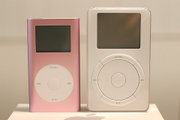
first generation pink iPod mini (left), and a first generation iPod
Models
Apple currently markets three distinct players bearing the iPod name. Some models come with different capacities (a higher capacity allows the storage of more music) or with different designs. The model range as of October 12, 2005 includes:
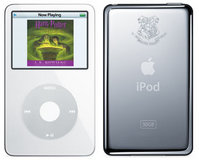
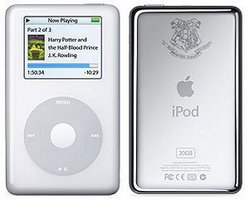
The iPod mini (4 GB and 6 GB and in various colors) are now discontinued, having been replaced by the iPod nano. The iPod U2 Special Edition was also discontinued. The Harry Potter 20 GB Collector's fourth-generation iPod was replaced by the Harry Potter 30 GB Collector's iPod, which is simply a fifth-generation iPod with a Harry Potter engraving and the Harry Potter audiobooks pre-loaded.
Several product revisions have taken place since the original model of iPod appeared, leading to the existence of five distinct generations. As with most hard drive-based devices, the actual drive space available for music, photo, video and data storage does not quite attain the advertised capacity. This comes about because the capacity advertised uses metric prefixes, not binary prefixes. For example, a 4 GB iPod mini actually had 3.77 GiB of usable storage. Some of this is also taken up by the iPod's firmware.
iPod
While all iPods have roughly the same size and the same capabilities, the design has undergone several revisions since its introduction to the market. Five distinct generations of iPods exist, commonly known as: first, second, third, fourth and fifth generations.
Within any generation of iPods, various models with different sizes of hard drives have come onto the market at different price points. During the third generation, three sizes of iPods have coexisted in the marketplace at any given time, priced at US $299, $399, and $499. Currently, Apple sells two sizes of iPod: a 30 GB hard drive for $299, and a 60 GB model for $399. Note that Apple claims that 1 gigabyte of storage will hold 250, 4-minute songs in 128 kbit/s AAC. Encoding songs at higher bitrates will take up more space on the hard drive. One can scale this proportion up; the current 30-gigabyte iPod can hold roughly 7,500 songs, though the Apple website states that 'actual formatted capacity may be lower.'
First generation iPod
First generation
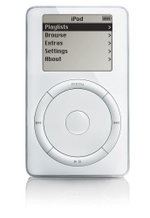
First announced on October 23, 2001, the original iPod cost $399 with a 5 GB hard drive. Critics panned the unit's price, but iPod proved an instant hit in the marketplace, quickly overtaking earlier hard drive MP3 players such as the Nomad Jukebox. Apple announced a 10 GB version ($499) in March 2002.
Apple designed a mechanical scroll wheel and outsourced the implementation and development to Synaptics, a firm that also developed the trackpad used by many laptops, including Apple's PowerBooks. The first generation iPod featured four buttons (Menu, Play/Pause, Back, and Forward) arranged around the circumference of the scroll wheel. Although superseded by nonmechanical "touch" and "click" wheels, the circular controller design has become a prominent iPod motif.
Second generation
Introduced on July 17, 2002, at Macworld in 10 GB and 20 GB capacities, the second generation iPod replaced the mechanical scroll wheel of the original with a touch-sensitive, nonmechanical one (manufactured by Synaptics), termed a "touch wheel". Due to the new Toshiba hard drives, the 20 GB iPod slightly exceeded its first generation counterpart in thickness and weight, while the 10 GB model was slimmer. The second generation iPod came with carrying cases and wired remotes and it was the first generation that was compatible with Windows.
Third generation
On April 28, 2003, Apple CEO Steve Jobs introduced an "ultrathin" iPod series. Slightly smaller than their predecessors, they had more distinctively beveled edges. Over the life of the third generation iPod series, Apple produced 10 GB, 15 GB, 20 GB, 30 GB, and 40 GB sizes.
These iPods use a 30-pin connector called the Dock Connector — longer and flatter than a FireWire plug. This allows them to fit more easily into the new iPod Dock which Apple introduced at the same time. The iPod Dock came bundled with all but the least expensive iPod, and also retails separately.
The third generation iPod featured touch-sensitive buttons located below the display. The new buttons featured red backlighting (controlled by the same preference as the screen backlight), allowing easier use in darkness. The touch-sensitive buttons, which build upon the touch-sensitive scroll wheel introduced in the second generation iPod, make the third generation iPod unique in that it has no external moving parts (other than the hold slider on the top of the unit) and is the only iPod that doesn't have its buttons surrounding the wheel.
With the third generation iPod, Apple stopped shipping separate Mac and Windows versions of the unit. Instead, all iPods now shipped with their hard drives formatted for Macintosh use; the included CD-ROM featured a Windows utility which could reformat them for use with a Windows PC. These iPods also introduced Hi-Speed USB connectivity (with a separately sold USB adapter cable. The third generation iPod could not charge through USB 2.0 however).
When purchased through the online Apple Store, the iPod featured custom engraving: a purchaser could have two lines of text laser engraved on the back (for an additional charge, although currently free).
Although past models proved widely popular, after the release of the third generation model Apple's iPod sales skyrocketed, with a combination of effective advertising and celebrity endorsement making iPods a fashionable item.
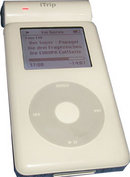
Fourth-generation iPod with an iTrip
Fourth generation
In July 2004, Apple released the fourth generation iPod. In a new publicity route, Steve Jobs announced it by becoming the subject of a Newsweek magazine cover.
In the most obvious difference from its predecessors, the fourth generation iPod carries over the click-wheel design introduced on the iPod mini. Some users criticized the click wheel because it does not have the backlight that the third generation iPod's buttons had, but others noted that having the buttons on the compass points largely removed any need for backlighting. Apple also claimed that updated software in the new iPod allows it to use the battery more efficiently and increase battery life to 12 hours. Other minor changes included the addition of a "Shuffle Songs" option on the top-level menu to make it more convenient for users. After many requests from users asking for these improvements to operate on earlier iPods as well, Apple on February 23, 2005, released a firmware update which brings the new menu items to first through third generation iPods.
Originally, the fourth generation iPod had a monochrome screen and no photo capabilities, like its predecessors. It came in one of two sizes: 20 GB for $299 and 40 GB for $399 (Apple discontinued the 40 GB model in February 2005 and began solely selling a monochrome 20 GB version). The monochrome fourth generation iPod, slightly thinner (about 1 mm less) than the third generation iPod, introduced the ability to charge the battery over a USB connection.
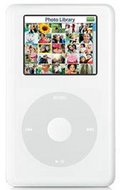
iPod photo with color screen
iPod photo / Color iPod
Released on October 28, 2004, iPod photo (originally named iPod Photo — with a capital P for "Photo" — but renamed less than a month after its launch) featured a 220 x 176-pixel, 16-bit color screen capable of displaying 65,536 colors, and the ability to store and display JPEG, BMP, GIF, TIFF, and PNG images. One millimeter thicker than the standard monochrome fourth-generation iPod, iPod photo could also play music for up to 15 hours per battery charge. It originally came in 40GB and 60GB versions, which cost $499 and $599, respectively.
On February 23, 2005, Apple discontinued the 40GB model; which included a FireWire & USB cable and a dock, introduced a lower-priced 30GB model; which included only a USB cable and no dock, and dropped the price of the 60GB model. However, unlike the first iPod photos, the lower-priced 60GB and the new 30GB models lacked the dock, FireWire cable, carrying case, or AV cables (accessories valued at approximately $120).
On June 28, 2005, Apple Computer merged the iPod and iPod photo lines, removing all monochrome models from the main iPod line, giving the 20GB iPod all of the capabilities of the former iPod photo line for $299, the same price as the previous monochrome version. The price of the 60GB iPod photo, now known as iPod 60GB, dropped from $449 to $399, and Apple discontinued the $349 30GB iPod photo model. Apple Computer — as well as prominent fan sites (such as iLounge) — continued to refer to this lineup as fourth-generation iPods. Along with the new lineup, Apple also updated iTunes to version 4.9, which added podcasting capabilities to iTunes and to iPod.
To manage the photo library on iPod, Mac users use Apple's iPhoto software, while Windows users can use Adobe Photoshop Album or Elements, or use a limited set of features within the free iTunes for Windows software. New Mac computers are bundled with iPhoto, while Windows users must either use the limited features within iTunes for Windows or purchase either of the Adobe products (a limited version of Adobe Album is available for download for free).
As of June 28, 2005, iPod came bundled with a USB cable and an AC adapter. Popular optional accessories include the dock, a FireWire cable (which owners can use in lieu of USB), an iPod AV cable (to view photo albums on a TV set), and an iPod Camera Connector (to transfer and view images directly from a digital camera to an iPod).
The fourth-generation line of iPods/Color iPods have a glitch that causes them to pause on their own, despite the hold switch being activated. A headphone contact switch, in coordination with iPod's auto-pause feature, is supposed to pause the music playback if the headphones are disconnected, but incorrectly detects that the headphones have been removed. This erroneous detection occurs with some third-party headphones (such as Sennheiser models), but users have also reported experiencing the problem with the supplied Apple earbuds. The likely cause for this malfunction is that a small metal disk on the base of the earphone plugs makes electrical contact with the metallic back of iPod, tripping the detection mechanism. To fix this problem, a small piece of cellophane wrap with a hole in it or a thin, non-conductive washer may be placed between the headphone jack and the plug.
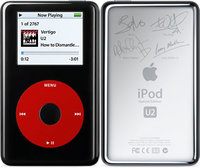
Color U2 signed iPod
iPod U2 Special Edition
On October 28, 2004, Apple released a black-and-red edition of the fourth-generation iPod called iPod U2 Special Edition. Originally retailing for $349, it had a black front with a red click wheel (the colors of U2's latest album, How to Dismantle an Atomic Bomb), and featured the signatures of U2's band members engraved on the back. It also included an iTunes Music Store coupon redeemable for $50 off of the price of The Complete U2, a "digital boxed set" featuring over 400 tracks of U2 music.
On June 28, 2005, at the same time as the announcement of the merger of the iPod and the iPod photo lines, Apple added a color screen and photo capabilities to the iPod U2 Special Edition while dropping the price to $329.
On October 12, 2005, Apple discontinued the iPod U2 Special Edition with the introduction of the fifth-generation iPod.
The U2 iPod was the last Ipod to ship with Firewire connection cables and firmware, prompting some analysts to speculate about the future inclusion of Firewire interfaces on Apple products.
Harry Potter Collector's iPod
On September 7, 2005, Apple released a limited-edition Harry Potter fourth-generation 20 GB iPod that featured a laser engraved Hogwarts crest on the back. This model was superseded on October 12, 2005 with a fifth generation Harry Potter 30 GB Collector's iPod. The iPod was launched along with the Harry Potter audiobooks on the iTunes Music Store. The only way to get a Harry Potter Collector's iPod is to buy it online along with the complete set of Harry Potter audiobooks, at a combined price (as of October 25, 2005) of $548 USD.
Fifth-generation iPod
Fifth generation
On October 12, 2005, Apple announced at the "One more thing..." event, the fifth-generation iPod, which featured the ability to play MPEG-4 and H.264 video with resolutions of up to 480 x 480 (though many users report it is actually capable of 640x480) and 320 x 240, respectively (videos purchased from the iTunes Music Store are limited to 320 x 240.) The new models are available in 30 and 60 GB capacities and are priced the same as the previous generation at $299 and $399 USD, respectively.
It has a 65,536 color (16-bit) screen, with a 320 x 240 QVGA transflective TFT display, and is able to display video on an external TV via the AV cable accessory, which plugs into the headphone minijack and splits into composite video and audio output connectors with RCA jacks. It can also display video on an external TV using the iPod AV or S-video cables with the iPod Universal Dock. The screen size is now 2.5" (6.35 cm) diagonally, 0.5" larger than the previous iPod. It is also 30% thinner than the previous full-size iPod.
The reported battery life for the 30 GB is 14 hours and for the 60 GB is around 20 hours. Watching movies reduces that amount to 2 and 3 hours respectively. The click wheel design is the same as the previous generation, but is marginally smaller than before. The new click wheel is completely flat, unlike older models where the center button is slightly rounded. Apple has stopped using the click wheels used in the fourth generation iPod and iPod mini from their previous supplier, Synaptics Inc of San Jose, CA, and now uses an in-house solution.
The headphone jack has been moved from the center of the top to the right of the top, while the hold switch has been moved to the left side of the top. Gone from the fifth-generation iPod is the remote control accessory port, previously found beside the headphone port, meaning that accessories such as the Griffin iTrip will no longer work. Griffin has, however, released a new version of the iTrip for the new iPod, which mounts to the dock connector on the bottom of the unit. The fifth-generation iPod no longer supports file transfers via FireWire, but still supports charging using FireWire. Like the iPod nano, it comes in two colors, white and black, and it features the World Clock, Stopwatch, and Screen Lock apps.
The fifth-generation iPod also comes with a thin slip case, most likely in response to many complaints concerning the iPod nano's easily scratchable surface. Apple has also discontinued the inclusion of an AC adapter. One must purchase one separately in order to charge it from the AC.
Other notable improvements include the reduction of minor audio defects, such as hard drive noise being heard through the headphone jack, as well as an increase in recording quality to 44.1 kHz stereo, 22.05 kHz mono. A third-party addon will still be required in order to record audio on the iPod, as it was in previous generations.
Harry Potter Collector's iPod
On October 12, 2005 Apple reintroduced the Harry Potter collectible iPod along with the update of the iPod line. The new Harry Potter iPod retains the laser engraved Hogwarts crest on back of the device and is sold with the "complete Harry Potter" (the first 6 books in the Harry Potter series). The capacity of the iPod was increased to 30 GB from the previous 20 GB. The price point remains the same as the fourth-generation model.
Packshot of the Xavier Naidoo 30GB Collector's iPod Edition
Xavier Naidoo Collector's iPod
On November 28, 2005 Apple introduced the Xavier Naidoo collectible iPod as a limited edition of 1,000 pieces. The Xavier Naidoo iPod has a laser engraved singer's star crest on the back of the device and is sold with 14 songs of the album Telegram for X (4 tracks from the previous album are also included). The capacity of the iPod is 30 GB filled up with selected video material and photos.
The Xavier Naidoo Collector's iPod is only available in Europe at one of the 23 Gravis Stores in Germany. Apple does not sell this iPod in any of the Apple Stores. It can also be found on a special promotional website. The price is € 399 EUR incl. tax.
iPod mini
Apple entered the market for "mini"-form-factor digital audio players in January 2004, with the introduction of the iPod mini, competing directly with players like Creative's Zen Micro and Digital Networks Rio Carbon. The iPod mini had largely the same feature set as the full-sized iPod, but lacked support for some third-party accessories. Its smaller display had one less line than previous models, limiting the on-screen track identification to title and artist only.
iPod minis used Microdrive hard drives for storage. The iPod mini was discontinued on September 7, 2005 after Apple announced it was to be replaced by the iPod nano, which was 62% smaller in size and included a color screen.
First generation mini
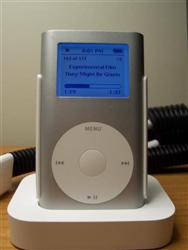
First Generation iPod mini in Dock with Belt Clip
On January 6, 2004, Apple introduced the first iPod mini. It had 4 GB of storage and a price of $249 (at the time, only $50 below the 15 GB third-generation iPod). Critics panned it as too expensive, but it proved to be overwhelmingly popular, and Apple Stores had difficulty keeping the model in stock.
iPod mini introduced the popular "click wheel" that was incorporated into later iPods: the touch-sensitive wheel means that users can move a finger around it to highlight selections on the screen, while the unit's Menu, Back, Forward, and Play/Pause buttons are part of the wheel itself, letting a user press down on part of the wheel to activate one of those functions. The center button still acted as a select button.
Apple initially made iPod mini devices available in five colors: silver, gold, blue, pink, and green. Silver models sold best, followed by blue ones, while the most unpopular was the gold.
Second generation mini
In February 2005, the second-generation iPod mini came on the market with a new 6 GB model at $249 and an updated 4 GB model priced at $199. Most notably, both models featured an increased battery life of up to 18 hours. In addition, they featured richer case colors (though Apple discontinued the gold color) and other minor aesthetic changes (the color of the lettering on the click wheel now matched the color of the iPod mini). Also, the second generation iPod minis did not include the AC adapter or the FireWire cable bundled with previous models. With the introduction of the iPod nano, the iPod mini was discontinued.
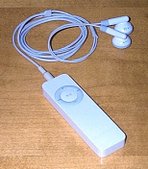
iPod shuffle with earphones
iPod shuffle
Apple announced iPod shuffle at Macworld Expo on January 11, 2005 with the taglines "Life is random" and "Give chance a chance". iPod shuffle introduced flash memory (rather than a hard drive) to iPods for the first time. The shuffle comes in two models: 512 MB (up to 120, 4-minute songs encoded at 128 kbit/s) and 1 GB (up to 240). Unlike other iPod models, iPod shuffle cannot play Apple Lossless or AIFF encoded audio files—possibly due to the iPod shuffle's smaller processing power. The shuffle has a SigmaTel processor. One review regards it as having one of the best-sounding audio systems of all the iPod models.
The iPod shuffle has no screen and therefore has limited options for navigating between music tracks: users can play songs either in the order set in iTunes or in a random (shuffled) order. Users can set iTunes to fill iPod shuffle with a random selection from their music library each time the device connects to the computer. The iPod shuffle weighs less than one ounce (0.78 oz. or 22 g) and approximates in size to a pack of chewing gum (originally, the iPod shuffle website contained a footnote advising people not to eat the iPod shuffle like gum; it was later removed, possibly because several users photographed themselves with their iPod shuffles in their mouths.) Like the rest of the iPod family, iPod shuffle can operate as a USB mass storage device.
iPod nano
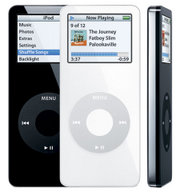
On September 7, 2005, Apple announced the successor to the iPod mini, the iPod nano. Based on flash memory instead of a hard drive, the iPod nano is 0.27 inches (6.9 millimeters) thick, weighs 1.5 ounces (42 grams), and is 62% smaller by volume than its predecessor. It has a 65,536 color display that can show photographs, and connects to a computer via USB 2.0. The headphone jack is located on the bottom. It retains the standard 30-pin dock connector for compatibility with third-party peripherals. The nano is the first dock connector iPod that cannot sync to any PC (Windows or Mac) via FireWire cable, though it can still be charged via a Firewire connection.
The iPod nano has several features that would later be included into the fifth generation iPod. These features were new to the iPod operating system, including the addition of world clocks, a stopwatch, and a screenlock option. The world clock allows users to set the time in cities around the world, and set alarms for each time zone. The clocks can be set to adjust for Daylight Saving Time. The stopwatch feature allows users to press Start to start the timer, and the Stop button to stop. While the timer is on, the Start button changes to a Lap button that allows the user to time individual laps. The nano saves the user's stopwatch stats for multiple timing sessions, which is useful for comparing times.
The screenlock option lets users set a 4 digit passcode for their iPod, and once the screenlock is activated the only buttons that can be pressed are the skip forwards and backwards buttons. The click wheel is used to input the digits to the passcode. The iPod nano is available in white and black, in both 2 GB (US$199) and 4 GB (US$249) configurations. There have been a number of complaints about the Nano's screen being too soft, resulting in it becoming easily scratched or even broken if put under any strain.
Battery life
Apple designed the iPod with an internal lithium ion battery that users cannot easily replace. Like most lithium-ion batteries, the iPod battery lasts roughly 500 full recharge cycles. In other words, the battery will continue to have a useful life through the equivalent of five hundred complete discharges and recharges; through time and use, the life of the battery will generally decrease until eventually it is not able to power the iPod for more than a few minutes. Apple has published guidelines on its web site for maximizing the life of an iPod battery.
The battery in all iPod models cannot be removed or replaced by the user without levering the unit open. This is unusually difficult for a consumer device, but at least half a dozen well-known rivals to the iPod have a similarly enclosed battery. Compounding this problem, Apple would not replace worn-out batteries either. The official policy was that the customer should buy a refurbished replacement iPod, at a cost almost equivalent to a brand new iPod.
This situation led to a small market for third-party battery replacement kits. On November 14, 2003, Apple quietly announced a battery replacement program that initially cost $99 (now $59), and one week later offered users the option to extend the warranty of their iPods for $59.
On November 21, 2003, a short film produced by iPod owners The Neistat Brothers hit the internet. The movie, apparently made before the change in policy, expressed anger because the battery on their early model iPod had failed after eighteen months and Apple refused to replace it. The movie depicted the Brothers vandalizing Apple ads in the New York City area with graffiti proclaiming that "iPod's unreplaceable battery lasts only 18 months." The movie was widely linked and viewed, with much of the commentary failing to mention Apple's recent change in policy. Some iPod users also defended Apple by pointing out that their iPods had lasted longer than 18 months, while other viewers suggested that the brothers had attacked Apple solely for the sake of publicity.
As a response to the battery problem, multiple 3rd parties have appeared that are selling iPod battery replacement kits for one third of the price that Apple charges customers for a battery replacement. These batteries often contain more capacity than the standard Apple batteries.
The big question now is if the 5th Generation iPod battery can be replaced by users as the orthers generations. Some reviews in the arstechnica.com showed that the battery in iPod nano is soldered in the mainboard and in the iPod video its more dificult to be removable and "It's actually affixed to the metal backplate and sits above its own power management circuitry and right next the headphone port and its driver circuitry".
20 GB third generation iPod.
Car Integration
Not to be confused with "Ipod your Car" which allows car integration on a personal car, ipod Car interation allows you to connect your ipod to your car, and listen to premade car playlists for your car, or your entire library; in your car speakers. I some cars, you can control your ipod music through your steering wheel. This feature is only availible in certain cars:
BMW: Z4, X3, X5 - Mercedes-Benz: C-Class, CLK, CLS, E-Class, SLK, M-Class, R-Class - Mini: Cooper, Cooper S - Scion: xA, xB, tC - Volvo: S40, S60, S80, V50, V70, XC70, XC90
This feature will also be available in other cars soon: Acura, Audi, Ferrari, Honda, Nissan, and Volkswagen.
In 2006, this feature will also be availible in other foreign cars (outside US): Japan: Nissan, Mazda, Daihatsu, BMW, MINI, smart, and Alfa Romeo.
iTunes Integration
Apple Computer endorses only one official method for synchronizing with the iPod: iTunes. But several projects addressed synchronization of the iPod with other players, most notably the ml_iPod plugin for Winamp, that allows users to manage their iPod content through Winamp, and even allows functionality not available through iTunes, such as the copying of music off the iPod.
iTunes Music Store
Main article: iTunes Music Store. Introduced on April 28, 2003 the iTunes Music Store (iTMS) is an online music store run by Apple and built into iTunes. Advertised that any song was 99 cents, the music bought from it can be downloaded onto the iPod and the store has become the dominant online music service, helping the sale of iPods.
Apple encrypts the AAC audio files using the controversial FairPlay digital rights management (DRM) system, so that only authorized computers (up to five) and unlimited iPods can play them. However, the files can also be burned to CD, at which time those DRM restrictions are removed.
No portable music player other than the iPod can play the DRM-enabled files sold on the iTMS, and the iPod cannot play files protected with other DRM technologies, such as Microsoft's DRM format or RealNetwork's Helix-DRM system. Microsoft and RealNetworks have accused Apple of using iPod, the iTunes Music Store, and FairPlay to lock iPod users into using iTunes exclusively (and vice versa), creating a vertical monopoly. For a short time in 2004, RealNetworks had advertised that tracks purchased from their RealPlayer Music Store could be played on an iPod through the use of their Harmony technology; however, an iPod update released at the time of the iPod photo launch disabled files created by Harmony. Yet Realnetworks has continued to update the technology allowing iPod owners to download purchased music from RealNetworks music store.
Steve Jobs has stated "We would like to break even (or) make a little bit of money (on the iTunes Music Store) but it's not a money maker." The role of the iTMS is not to sell songs, but rather to promote the sale of iPods by offering owners a convenient service for music. Aside from the controversial iPod-exclusive AAC format of audio files, SonyBMG and Warner Music who had initially signed on with Apple have lately complained that they have been undercharged for the value of their songs due to iTMS's flat fee. Arguing that the cheap songs from iTMS have contributed significantly to the iPods' great success, record labels are also seeking a share of profits from the iPod division itself and they hope to accomplish this by putting pressure of Apple to differentiate between "hot singles" and "golden oldies". Jobs responded by accusing the record industry of being greedy.
Fifth-generation Harry Potter 30GB Collector's iPod
Third-party accessories
iPod has created a large and growing aftermarket accessory industry; in the 2005 Macworld keynote, Steve Jobs referred to it as "the iPod economy." The large availability of these aftermarket products may be one of the reasons that the iPod is so popular among consumers. The accessory industry also does well to satisfy buyers who want an iPod but also want the additional practical features found in competing digital audio players such as memory-card readers, FM tuners, and voice recording. Some of the more exotic accessories include a waterproof case and a flashlight/laser-pointer. Although designed for the original iPod, many third-party add-ons also worked well with the iPod mini, although this may not necessarily hold for the mini's successor, the iPod nano.
Some of the accessories, like the speaker systems made by Bose and the in-car audio interfaces for BMW, make use of the docking connectors found at the bottom of the iPod and have the user dock the unit in the device. Several other carmakers such as Audi plan to make iPod connections available in certain models in 2006, while Toyota, Citroen and Peugeot have the option of iPod connectivity with their Aygo, C1 and 107. These connectors provide control and information as well as a path for the sound signal and power to run the iPod or accessory.
Battery replacement kits from third-party offerings were credited with compelling Apple to offer its own battery replacement policy (previously, Apple suggested that owners of dead batteries should buy a new/refurbished iPod). Several third parties have appeared that are selling iPod battery replacement kits for one third of the price that Apple charges customers for a battery replacement, while these batteries often contain more capacity than the standard Apple batteries.
Software utilities
Third-party software tools supporting iPod include:
Hardware accessories
Car accessories
iPod sales
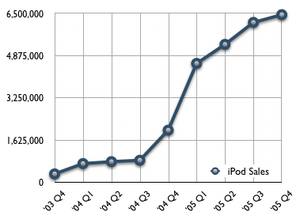
On the 7 September 2005 "special event," Apple CEO Steve Jobs announced that "as of the end of last quarter, that's the end of June 2005, Apple had sold almost 22 million iPods."
Fortune magazine reported on 27 June 2005 that Apple had sold over 15 million iPods, including 5.3 million in the first quarter of that year. The iPod currently dominates the digital audio player market in the US, frequently topping best-seller lists. According to the latest financial statements, iPod's market share accounts for 74% in the US in July 2005. Within one year from January 2004 to January 2005, its US market share tremendously increased by 34% from 31% to 65%. This success was especially based on the introduction of the iPod mini. Therefore, Apple succeeded in chipping away at the mainstream Flash player market in the US. That is why Flash players at the beginning of 2005 account for less than half the US market share they did in 2004. Their market share decreased from 62% in January 2004 to 29% in January 2005. In other countries, the iPod market share is significantly lower, mostly due to high import taxes and less ubiquitous marketing, so flash memory players, or hard disk based players from competitors like Creative are dominant.
In its fourth quarter results of 2005, Apple reported earnings of $430 million — its highest revenue for Q4 in the company's history. Apple shipped 6.16 million iPods during the quarter that ended on June 25, 2005, a 616% increase over the year-ago quarter. Most recently, Apple shipped 6.45 million iPods during the quarter that ended on September 24, 2005, a 220% increase over the year-ago quarter.
On January 8, 2004, Hewlett-Packard announced that they would license the iPod from Apple to create an HP-branded digital audio player based on the iPod. The HP models were the same as the Apple iPod except for the inclusion of an "HP" logo on the back under the Apple logo and "iPod" label They were sold as the "Apple iPod + hp". Retailers of this model included (among others) the retail giant Wal-Mart, which included a disclaimer explaining that it would not work with its own online music service. In July of 2005, HP reversed its decision and announced they would stop reselling the iPod by September 2005, when existing were projected to be depleted. Sales by Hewlett-Packard made up 5% of all iPod sales.
iPod sales according to Apple's yearly financial results:
iPod sales according to Apple's quarterly financial results:
Sales according to Apple
Advertising
Apple has promoted the iPod and iTunes brands in several successful advertising campaigns.
Key personnel
References
External links
New cola available next year. Profits from refreshing Solar Cola sales go toward the build of Solar Navigator.
Don't forget to order your Solar Cola in time for next year's launch.
This short piece tells you what you need to know about what an iPod (or iPod mini) is and does, and what it isn’t and doesn’t do. It explains which different types of iPod are available at the time of writing, and shows you how to distinguish among them and how to differentiate them from the iPod mini. Finally, it suggests how to choose the iPod that will best suit your needs.
Saying “iPod or iPod mini” every sentence is a little awkward, so in this article we use the term iPod to cover all iPods, including the iPod mini. Where the iPod mini behaves differently, or there’s something you need to think about if you plan to use an iPod mini rather than a regular iPod, we’ll tell you.
What Is an iPod? What Is an iPod Mini?
An iPod—the regular, full-size iPod—is a portable music player with a huge capacity, a rechargeable battery good for eight to ten hours of playback, and easy-to-use controls. An iPod mini is a smaller and cuter version with more modest capacity. Your iPod or iPod mini connects to your Mac or PC via a FireWire cable or USB cable that enables you to transfer large quantities of song files and other files quickly to the player.
Built around the type of hard drive used in small laptop computers, a regular iPod doubles as a contact database, calendar, and note board, enabling you to carry around not only all your music but also your vital information. You can also put other textual information on your iPod so you can carry that information with you and view it on the iPod’s screen. With extra hardware, you can extend your iPod’s capabilities even further. For example, with a custom microphone, you can record audio directly onto it. With a custom media reader, you can store your digital photos on your iPod’s hard disk without using a computer. This capability can make your iPod a great travel companion for your digital camera—especially a camera that takes high-resolution photos.
The iPod mini is built around the type of hard drive used in the tiniest laptop computers and some consumer electronics, such as cell phones that have swallowed a PDA and decided that extra storage would improve their digestion. The iPod mini has most of the capabilities of the regular iPod, but at the time of writing, it doesn’t support recording audio or downloading digital photos from third-party devices.
Harry Potter 20GB Collector's iPod
If music, contacts, calendar, notes, and other text aren’t enough for you, you can also use your iPod as an external hard disk for your Mac or PC. Your iPod provides an easy and convenient means of backing up your data, storing files, and transporting files from one computer to another. And because your iPod is ultra-portable, you can take those files with you wherever you go, which can be great for school, work, and even play. The iPod mini scores even higher on portability than the regular iPod, but because its capacity is so much lower, it’s not so great for carrying around huge quantities of files.
Your iPod supports various audio formats, including Advanced Audio Coding (AAC), MP3 (including Audible.com’s Audible files), WAV, and AIFF. Although the iPod doesn’t support other formats—such as Microsoft’s Windows Media Audio (WMA), RealNetworks’ RealAudio, or the open-source audio format Ogg Vorbis—at this writing, you can convert audio files in those formats to AAC, MP3, or another supported format easily enough so that you can put those files on your iPod.
Your iPod contains a relatively small operating system (OS) that lets it function on its own—for example, for playing back music, displaying contact information, and so on. The OS also lets your iPod know when it’s been connected to a computer, at which point the OS hands over control to the computer so you can manage it from there.
Your iPod is designed to communicate seamlessly with iTunes, which runs on both the Mac and Windows. If you prefer, you can use your iPod with other software as well on either operating system. If you use your iPod with iTunes, you can buy music from the iTunes Music Store, download it to your Mac or PC, and play it either on your computer or iPod.
So much for what your iPod does and what it consists of. We now look at some of the things your iPod doesn’t do and what its limitations are. Some may seem obvious, but if you’re in the market for an iPod, you’ll benefit from being clear on all these points right now.
You Can’t Enter (Much) Information onto Your iPod Directly
Out of the box, your iPod is strictly a play-and-display device: you can’t enter information onto it directly. All the information your iPod contains must come from a computer (a Mac or a PC) across a FireWire cable or USB cable.
This changes if you buy a hardware accessory that’s designed to work with the iPod. (The accessory needs to be specifically designed to work with the iPod, otherwise the iPod won’t recognize it.) You can then input certain types of data—for example, you can record audio or import photos from a digital camera—without connecting your iPod to a computer. (The iPod mini can’t handle these types of input at the time of writing.) iPod fans and pundits have long predicted an iPod keyboard that will let you type text onto your iPod, but Apple hasn’t obliged yet. At this writing, dictating voice memos is as good as text entry gets.
The iPod Isn’t the Smallest or Most Skip-Proof Player in Town
Because your iPod is based around a hard drive, it’s far larger than the smallest digital audio players around. Some of the smallest players are around the size of a cigarette lighter, while a regular iPod is more the size of a packet of cigarettes, and an iPod mini is the size of a stack of credit cards.
Your iPod is also less resistant to skips than solid-state players that store data on flash memory rather than on a hard disk. But as you’ll see in the section “What You Might Want to Know About Your iPod’s Internals,” in Chapter 13, Apple has done some clever engineering to reduce skipping caused by the hard drive being knocked around. That said, if you need a super-lightweight, supertough, or wholly skip-proof digital audio player, you should probably look beyond the iPod.
One solution is to use your iPod for most of your music and buy an inexpensive, low-capacity digital audio player for your higher-energy or higher-impact pursuits. That way, if you wipe out while trying to set a new speed record on your street luge, you won’t need to buy a new iPod—just a titanium ultraportable player, a pair of Kevlar shorts, and a pack of Moleskin. Your iPod Supports Only AAC, MP3, WAV, and AIFF Audio Formats
At the time of this writing, your iPod supports only a limited range of audio formats: AAC, MP3 (including Audible.com’s AA format), WAV, and AIFF. Your iPod doesn’t support major formats such as the following:
Because you can convert audio files from one format to another, and because the MP3 format is very widely used, this limitation isn’t too painful. But if your entire music library is in, say, WMA or Ogg format, you’ll have to do some work before you can use it on your iPod. Worse, if your songs are in another compressed format, you’ll lose some audio quality when you convert them to AAC or MP3.
iPod nano
As of March 2004, Apple had released three generations of regular iPods and one generation of the iPod mini:
NOTE: Second-generation Mac iPods were sometimes called MiPods, and Windows iPods were sometimes called WiPods. You could convert an iPod from MiPod to WiPod, and vice versa, if necessary, but because doing so reformatted the iPod’s hard disk, it wasn’t a great idea even at the best of times.
As you can see from that list, there’s a fair amount of overlap, including three different 10GB iPods and two different 20GB iPods. And by the time you read this, Apple may well have released higher-capacity third-generation iPods or a fourth-or subsequent generation, complicating matters even further. You can tell the capacity of any regular iPod easily, because it’s engraved on the back—for example, “10GB” or “40GB.” (The first generation of iPod mini has a 4GB capacity, but it’s not written on the player.) You can also tell easily whether a regular iPod is third-generation or not:
The differences on the bottom is even clearer: third-generation iPods have a socket for a Dock connector, while earlier iPods have nothing. Distinguishing first-generation iPods from second-generation iPods requires a closer look. The first-generation iPods have no cover on their FireWire port, while the second-generation iPods’ This illustration shows how to tell third-generation iPods from earlier generations. The first-and second-generation iPods have a squared look, with the four control buttons arranged around the scroll wheel. The third-generation iPods have a sleeker look and the four control buttons arranged under the screen.
The top of third-generation iPods is substantially different from the top of earlier iPods. FireWire port is covered with a flexible plastic plug. Beyond that, try using the scroll wheel: in the first-generation iPods, it is mechanical, while in the second-generation iPods, it uses a sensor (and so doesn’t move to the touch).
Design and cosmetic differences aside, the main differences among the various iPod models have been in their system software. As usual with any product that involves software, Apple has patched holes and fixed bugs in the iPod’s operating system, the connector to iTunes, and iTunes itself.
Bottom line: third-generation iPods have a socket for a Dock connector; earlier iPods don’t.
But Apple has also gradually added a slew of features to the first- and second-generation iPods via software updates. These are the major features that Apple has added:
If your iPod is not as new as it might be, check if you can update its OS with any features that Apple has released more recently. See the section “Keep Your iPod’s Operating System Up to Date,” in Chapter 13, for details of how to download and install updates.
Why Your iPod's Capacity Appears to be Less than Advertised
Forty gigabytes is a huge amount of music—around ten thousand four-minute songs. Even four gigabytes can hold a thousand songs, enough to keep you quiet (if that’s the word) for nearly three days of solid listening. But unfortunately, you don’t actually get the amount of hard disk space that’s written on the iPod.
There are two reasons for this. The first (and eminently forgivable) reason is that you lose some hard-disk space to the iPod’s OS and the file allocation table that records which file is stored where on the disk. This happens on all hard disks that contain operating systems, and costs you only a few megabytes.
The second (and much less forgivable) reason is that the hard-drive capacities on iPods are measured in “marketing gigabytes” rather than in real gigabytes. A real gigabyte is 1024 megabytes; a megabyte is 1024 kilobytes; and a kilobyte is 1024 bytes. That makes 1,073,741,824 bytes (1024 × 1024 × 1024 bytes) in a real gigabyte. By contrast, a marketing gigabyte has a flat billion bytes (1000 × 1000 × 1000 bytes)—a difference of 7.4 percent.
So your iPod will actually hold 7.4 percent less data than its listed drive size suggests (and minus a bit more for the OS and file allocation table). You can see why marketing folks choose to use marketing megabytes and gigabytes rather than real megabytes and gigabytes—the numbers are more impressive. But customers tend to be disappointed (to say the least) when they discover that the real capacity of a device is substantially less than the device’s packaging and literature promised.
Almost all hard-drive manufacturers give capacities in marketing gigabytes, which has conferred herd immunity on them so far. At this writing, a class-action lawsuit about this double-system of measurements is in the works, and might force manufacturers to state the capacity less ambiguously. A previous class-action lawsuit forced monitor manufacturers to state the viewable screen size of cathode-ray tube monitors as well as the size of the screen itself (part of which is cut off by the monitor bezel). This is why you see monitor ads that state “15" monitor, 13.7" visible”; before the lawsuit, the ads simply claimed “15" monitor.”
The third-generation iPods provide substantial improvements in hardware, especially in capacity. But they, and the iPod mini, also offer substantial improvements to their software, including the following:
To accommodate your music library and such other files as you want to carry with you, you’ll probably want to buy the highest-capacity, latest-generation iPod you can afford. But if you don’t need the iPod Dock, and if it’s still the first half of 2004, and if you can pick up a second-generation 20GB iPod at a knockdown price, you might choose to do so. First-generation iPods are now too long in the tooth to be a sensible buy. (This is because rechargeable batteries gradually lose their capacity after they’re manufactured, even if they’re not being used.) By the second half of 2004, the same will apply to second-generation iPods as well.
If you decide to buy a second-generation iPod, you’ll need to choose between a Mac iPod and a Windows iPod. As mentioned earlier, you can convert an iPod between Mac and Windows, but it’s better to get the right format from the start. (See the section “Move Your iPod from Mac to Windows—and Back,” in Chapter 16, for details on how to convert an iPod from one format to another.)
If you want the smallest and cutest high-capacity player, or if you want your iPod in a color other than white, you’re looking at the iPod mini. The iPod mini is great for smaller music libraries, or for carrying only the newest or most exciting songs in your colossal library with you, but its lower capacity makes it poor value alongside the regular iPod.
Use the table below to see how much music (guide only) you can fit onto the iPod mini and the different models of regular iPod at widely used compression ratios for music. For spoken audio (such as audio books, plays, or talk radio), you can use lower compression ratios (such as 64 Kbps or even 32 Kbps) and still get acceptable sound with much smaller file sizes. The table assumes a “song” to be about four minutes long and rounds the figures to the nearest sensible point. The table doesn’t show less widely used compression ratios such as 224 Kbps or 256 Kbps. (For 256 Kbps, halve the 128 Kbps numbers.)
NOTE: The iPod refers to tracks as “songs,” so this book does the same. Even if the tracks you’re listening to aren’t music, the iPod considers them to be songs. Similarly, the iPod and this book refer to “artists” rather than “singers,” “bands,” or other terms.
To decide which model to buy, you’ll probably want to ask yourself the following questions:
iPod Capacities at Widely Used Compression Ratios
If you’ve set your heart on an iPod mini, buy one. Otherwise, if money is no object, buy the highest-capacity iPod available: between your music and the other items you’ll probably want to use the iPod for, you’ll very likely take up most of its capacity soon enough. But if money is tight, you may need to sacrifice iPod capacity for solvency. Never mind—you may be richer next year, or at least iPod prices will probably have come down.
|
||||||||||||||||||||||||||||||||||||||||||||||||||||||||||||||||||||||||||||||||||||||||||||||||||||||||||||||||||||||||||||||||||||||||||||||||
|
This
website
is Copyright © 1999 & 2005 NJK.
The bird |
||||||||||||||||||||||||||||||||||||||||||||||||||||||||||||||||||||||||||||||||||||||||||||||||||||||||||||||||||||||||||||||||||||||||||||||||
|
BLUEBIRD ELECTRIC CAR MANUFACTURERS ELECTRIC CARS ELECTRIC CYCLES SOLAR CARS |
||||||||||||||||||||||||||||||||||||||||||||||||||||||||||||||||||||||||||||||||||||||||||||||||||||||||||||||||||||||||||||||||||||||||||||||||